

B12 injections to daily energy tracking: 2026 workflow
Instead of trying to remember whether a b12 energy injection changed how you felt, use a daily energy log before and after clinician-directed treatment. This 2026 workflow connects your appointment, reminders, and symptom notes so you bring a clear record—not a guess—to your next wellness conversation with Skindale Medspa.
- A b12 energy injection treats a clinical need; it is not a guaranteed energy boost.
- Skindale Medspa is best suited to Scottsdale clients seeking personalized wellness care rather than a one-size-fits-all energy plan.
- Use daily energy tracking to record fatigue, sleep, and treatment dates without changing your prescribed schedule.
- Bring your symptom log to a clinician; vitamin B12 treatment decisions require more than an energy score.
Why this matters
Vitamin B12 supports normal nerve function and red blood cell formation. Deficiency can cause fatigue, but fatigue alone does not establish a deficiency. Poor sleep, medication effects, and other health conditions also belong in an evaluation.
A daily log helps describe your experience; it does not diagnose the cause or prove that an injection worked. Feeling better after an appointment is useful information, but the timing alone cannot establish why you improved.
For your 2026 wellness plan, keep treatment decisions and tracking decisions separate. Your clinician determines whether B12 treatment is appropriate, which route to use, and when to reassess. You control the consistency of your notes.
Before you start
- Have a clinician-directed plan. Confirm why B12 is being considered, whether testing is needed, and what follow-up is expected. Share your medications, supplements, relevant medical history, and any previous injection reactions. Do not create an injection schedule from an online workflow.
- Choose one accessible record. Use a notebook or a private phone note, plus a calendar or reminder you already know how to use. You need access to your appointment instructions and a way to bring or share your notes at follow-up; no special account or paid tracking app is required.
- Keep measurement conditions consistent. Record energy at approximately the same time each day. A morning score and an evening score are not interchangeable, and changing sleep habits, caffeine, or supplements during the same period makes the pattern harder to interpret. Never delay needed care just to preserve a baseline.
Your tracking setup
Choose the method you will actually use. The labels below are fields you create yourself, not buttons in a particular app. This keeps the workflow usable without relying on changing software menus.
| Tracking option | Best for | Advantage | Limitation |
|---|---|---|---|
| Paper notebook | People who prefer a screen-free routine | Easy to add context beside an entry | Reminders and sharing require separate steps |
| Private phone note | People who want a record available at appointments | Easy to search dates and keep entries together | Requires attention to device access and privacy settings |
Neither option makes a medical assessment. The best record is complete enough to explain a pattern and simple enough to maintain when you feel tired.
Baseline record
- Create a page titled Energy log — 2026. Put your main concern at the top in plain language, such as afternoon fatigue or difficulty completing your usual activities. Avoid writing a diagnosis unless your clinician has established it.
- Add the fields Date, Entry time, Energy, Sleep, Daily activity, Symptoms, and Changes. Under Changes, include anything new that day: illness, unusual stress, a medication change, or a supplement you started.
- Use an energy scale from 0 to 10 points, with 0 meaning no usable energy and 10 meaning your personal best usual energy. This is a self-tracking scale, not a validated diagnostic test. Write down what the endpoints mean to you so the meaning stays stable.
- If your clinician agrees and treatment does not need to begin immediately, record a 7-day baseline before the first planned appointment. Seven days is a practical organizing window for this guide, not a medical requirement. If treatment has already begun, start now and mark that clearly.
Expected result: You have a starting record that describes your usual experience without pretending to establish a diagnosis. An entry links the energy score to an actual activity, such as finishing your usual walk or needing a break during household tasks.
Keep the activity example familiar. Comparing yourself with another person's exercise routine adds noise rather than useful context.
Daily reminder
- Choose a time that fits your normal day. If afternoon fatigue is the concern, choose an afternoon check-in rather than a time when you usually feel your best. Consistency matters more than selecting a supposedly ideal hour.
- Create a reminder named Energy check-in in your existing reminder or calendar tool. Set it to repeat daily using that tool's controls. Keep health details out of the reminder text if notifications appear on a shared or unlocked screen.
- Make 1 entry per day at that check-in. Record your energy score, describe sleep briefly, and add a sentence about what you could comfortably do. If something unusual happens later, add a dated note rather than replacing the original score.
- When you miss an entry, leave it blank or mark Not recorded. Do not reconstruct yesterday's energy from today's mood. Resume the routine at the next scheduled check-in.
Expected result: Your reminder leads to a short, dated entry without asking you to monitor your body all day. The record stays manageable, and missed days remain visible instead of becoming invented data.
A useful entry is descriptive rather than polished. “Needed a break while making dinner” gives your clinician more context than “low energy” alone.
Treatment record
- Add a separate section called Treatment record. Record the appointment date and the treatment details provided by your clinician. Copy instructions accurately; do not estimate a dose or fill in information you do not have.
- Record the reason for treatment as your clinician explained it. If evaluation is still underway, say so. Keep a confirmed deficiency separate from a treatment discussion prompted by fatigue.
- Add Follow-up plan and Questions for clinician fields. Record the agreed review arrangements and any instructions about testing or symptoms that require contact. If the next step is unclear, ask the clinic rather than choosing your own interval.
- Continue the same daily tracking routine after treatment. Record any new symptoms and when they occurred, but do not label them as caused by B12 unless a clinician has assessed that connection.
Expected result: You can distinguish the treatment date from the daily experience around it. Your record supports a conversation about response and safety without encouraging extra injections or independent dose changes.
Keep appointment reminders separate from treatment instructions. A calendar alert is a scheduling aid, not authorization to receive or administer an injection.
Follow-up summary
- Create a section titled 2026 follow-up summary before your planned review. Describe whether energy improved, stayed similar, worsened, or fluctuated. Include examples from ordinary activities rather than relying only on a numerical score.
- Note changes that overlapped with treatment. Better sleep, recovery from illness, reduced stress, or another treatment can affect how you feel. Preserve these details even when the overall pattern looks encouraging.
- List persistent symptoms and unanswered questions. Ask whether the original explanation still fits, whether further evaluation is needed, and what should happen next. Bring any test results or treatment instructions you were asked to provide.
- Share the record in the format your clinician accepts. A notebook, a note on your own device, or a concise written summary can support the discussion. Confirm how to send sensitive information before transmitting it.
Expected result: Your clinician receives a readable account of symptoms, function, treatment timing, and other changes. The review becomes a decision about care, not a debate over whether one good afternoon counts as success.
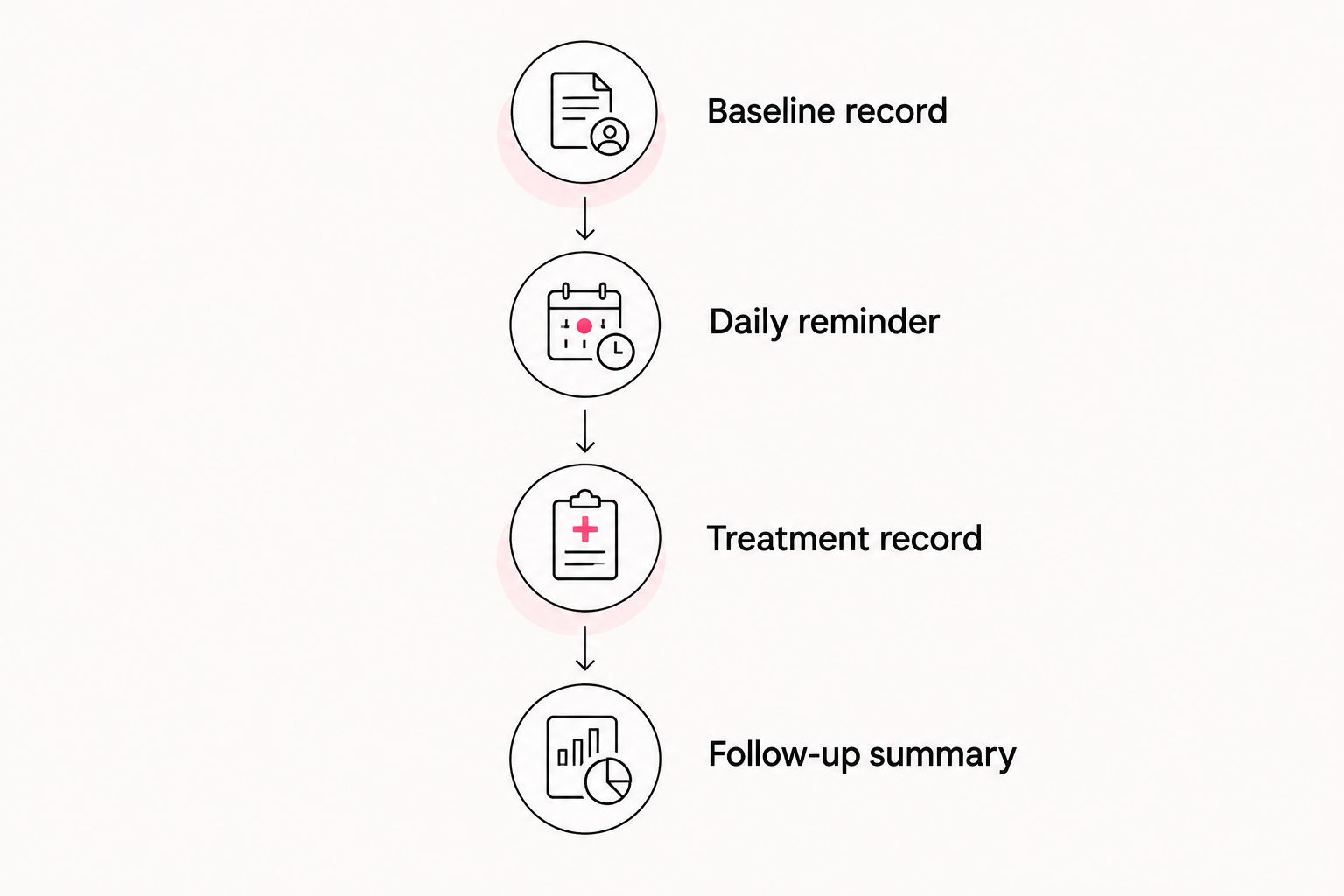
The sequence is straightforward: establish a baseline, create a reminder, record treatment, and prepare a follow-up summary. Each part has a different job; none replaces clinical assessment.
When your care plan changes
The adjacent workflow is not “repeat an injection whenever energy falls.” It is update your record whenever your clinician changes the plan. That distinction prevents a symptom score from becoming an unsafe treatment trigger.
Create a dated Plan change entry when your clinician changes treatment, requests further evaluation, or recommends a different approach. Record the instructions as given, the reason discussed, and what you should watch for. Keep earlier entries intact so you can see where the change occurred.
Continue the same energy scale and check-in time unless the clinician requests something different. If the tracking method itself changes, document that too. A new scoring definition can create an apparent improvement that reflects the measurement rather than your health.
This also applies when you are considering stimulant-free supplements for energy: removing stimulants does not establish that an ingredient addresses your fatigue or is appropriate alongside your medications. Record the product and ingredient list for clinician review before adding it to the plan.
For your 2026 record, mark changes rather than rewriting history. If a clinician recommends an additional intervention, document its start date separately. Do not stop prescribed care to make the tracking pattern easier to interpret.
Troubleshooting your energy log
Your energy varies from day to day
Keep the entries and look at the surrounding context. Note disrupted sleep, illness, stress, and unusual activity rather than treating every lower score as a treatment failure.
Bring the pattern to your clinician, especially when fatigue persists or interferes with daily life. A fluctuating log is still useful; it shows why a single score should not drive a treatment decision.
You feel no improvement after an injection
Do not schedule extra treatment on your own. Lack of improvement is a reason to review the original assessment and the agreed follow-up plan, not proof that you need a larger dose.
Continue noting symptoms and daily function. Your clinician can assess whether the cause of fatigue needs further investigation and whether B12 treatment remains appropriate.
You forget entries or change the scoring scale
Reduce the task to the essential fields and attach it to an existing routine. Keep the same scale definition visible at the top of the record.
If you changed the definition, date that change and explain it. Do not compare the earlier and later scores as though they mean exactly the same thing.
You notice a new symptom after treatment
Record what happened and contact the treating clinician for guidance. Do not use the next daily check-in as a reason to postpone a safety concern.
Trouble breathing, swelling of the lips or tongue, fainting, or chest pain requires urgent medical attention. A tracking workflow is for routine observation, not emergency triage or diagnosis.
Customize your workflow
Add detail only when it answers a question you and your clinician are trying to resolve. If fatigue disrupts daily activities, describe those activities consistently. If sleep is part of the discussion, record sleep context without treating a consumer sleep score as a diagnosis.
For a 2026 wellness review, bring a current medication and supplement list alongside your log. Keeping those records together helps you discuss the whole care plan without assuming every symptom belongs to B12.
Skindale Medspa's personalized wellness care fits a conversation about your goals, history, and next steps. The daily log adds structure, but its limitation remains the same: it records experience, not the biological cause of fatigue.
Keep the workflow smaller than the problem it is solving. If tracking becomes stressful, discuss a simpler record with your clinician. More fields do not automatically produce better care.
FAQ
Will a b12 energy injection give me more energy?
A B12 injection is not a guaranteed energy boost. B12 treatment can address deficiency, but fatigue has several possible causes and needs an appropriate clinical assessment.
What's the best way to track energy after a B12 injection?
Use a consistent daily check-in that records energy, sleep context, symptoms, and ordinary activities. Keep treatment dates separate and bring the record to your clinician rather than changing treatment based on a score.
How soon should I feel different after a B12 injection?
There is no single response time that applies to everyone. The reason for treatment and your clinical situation determine what your clinician expects and when reassessment is appropriate.
Is a B12 injection better than an oral supplement?
Neither route is best for everyone. Your clinician selects a treatment route based on the cause of deficiency, absorption concerns, symptoms, and other clinical factors.
Can I schedule another injection whenever my energy drops?
No; follow your clinician's treatment schedule rather than using a low energy score as an injection trigger. Persistent or worsening fatigue needs review, not an automatic extra dose.
Do I need an app to track daily energy?
No; a notebook or private phone note can support this workflow. Choose the method you can use consistently and protect any health information you record.
What should I bring to a wellness consultation at Skindale Medspa?
Bring your main concerns, medication and supplement list, relevant health history, and any energy notes you have kept. Include prior treatment instructions or test results when relevant so the consultation reflects your actual care history.
One last thing
A better energy score is not the same as better daily function. If your score rises but your usual activities remain difficult, keep both observations in the record. That difference gives your clinician a more useful question to investigate.
If fatigue is affecting your routine, schedule a personalized consultation with Skindale Medspa to discuss your concerns and appropriate next steps. Bring your notes, ask your questions, and let the clinical assessment—not a promise of an energy boost—shape your plan.