

Best Laser Hair Removal Technologies Compared (2026)
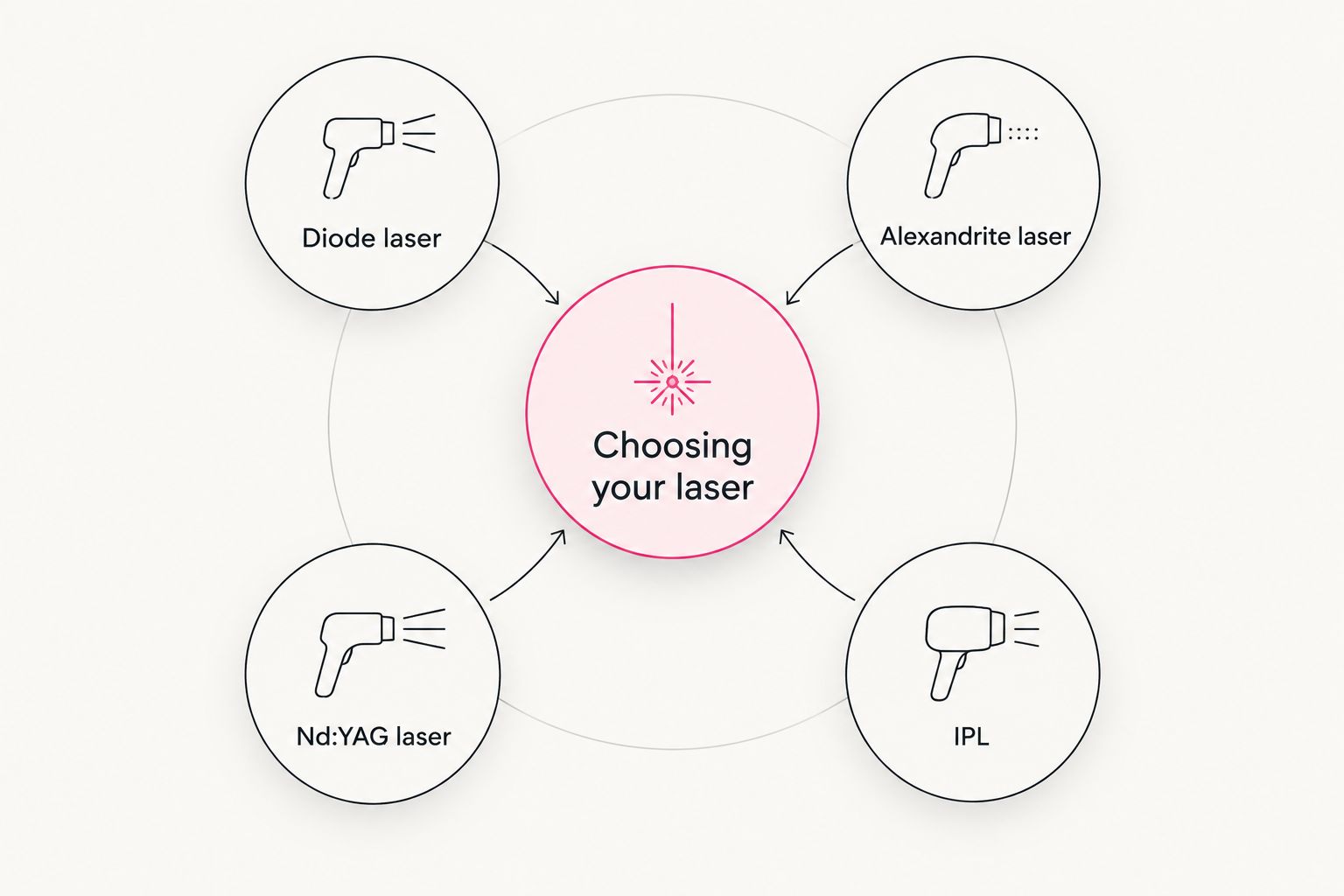
If you're comparing laser hair removal technologies for smoother, longer-lasting results in 2026, the device your provider chooses matters as much as the plan built around your skin and hair type. Diode laser wins as the best overall laser hair removal technology for most skin tones and hair colors. Alexandrite laser is best for fair skin and fast, large-area sessions. Nd: YAG laser is best for darker skin tones. IPL is the best budget-friendly option for lighter maintenance visits. Skindale Medspa matches the right technology to your skin tone and hair texture instead of running every client through the same machine.
- Diode laser is the best overall laser hair removal technology for most skin tones and hair types in 2026.
- Alexandrite laser treats large areas fastest but works best on fair, untanned skin.
- Nd: YAG laser is the safer choice for darker skin tones thanks to its deeper 1064 nm wavelength.
- IPL costs less per session but isn't a true laser and needs more maintenance visits.
- Skindale Medspa builds a personalized plan instead of defaulting to one laser hair removal technology.
Why This Matters
Laser hair removal works by targeting melanin in the hair follicle with light, heating it enough to damage future growth without harming the surrounding skin. The wavelength decides how deep that light travels and how much it interacts with melanin in the skin itself, not just the hair.
That's why the "best" technology isn't universal. A wavelength that's ideal for fair skin can cause pigment changes on a deeper skin tone, and a device built for darker skin may need more passes on very fine or gray hair. Getting this match right in 2026 is still the single biggest factor in a safe, effective course of treatments.
What Makes the Best Laser Hair Removal Technology
- Skin tone compatibility across the Fitzpatrick scale, from fair to deeply pigmented skin
- Hair color and texture match since melanin-poor hair (blonde, gray, red) responds differently to every wavelength
- Wavelength depth and how far the light penetrates before it's absorbed
- Treatment speed and spot size for larger areas like legs or back
- Comfort features such as built-in cooling tips or contact cooling
- Number of sessions needed to catch hair across its full growth cycle
Laser Hair Removal Technologies at a Glance
| Technology | Best For | Standout Feature | Key Limitation |
|---|---|---|---|
| Diode Laser | Most skin tones and hair colors | Built-in cooling tip for comfort | Slower on very large areas than Alexandrite |
| Alexandrite Laser | Fair skin, fast large-area sessions | Widest spot size, quickest sessions | Higher risk of pigment changes on tanned or darker skin |
| Nd: YAG Laser | Darker skin tones | Deepest wavelength, bypasses surface melanin | Less effective on fine, light, or gray hair |
| IPL | Budget-conscious maintenance | Broad-spectrum light treats multiple concerns at once | Not a true laser; more sessions needed for lasting results |
1. Diode Laser: Best Overall for Most Skin Tones and Hair Colors
Diode lasers run at roughly 800-810 nm, a wavelength range that balances melanin absorption with skin safety across a wide span of the Fitzpatrick scale. Most medspas default to diode technology because it handles the widest range of clients without swapping equipment between appointments. Built-in cooling tips make longer sessions on legs or backs more tolerable.
Diode laser pros:
- Effective on skin tones I through V
- Cooling tip reduces discomfort during treatment
- Consistent, well-documented results across body areas
Diode laser cons:
- Slower than Alexandrite on very large surface areas
- Less effective on very fine, blonde, or gray hair, which carries little melanin
Best for: clients who don't know their exact skin type or want one technology that covers most of the body.
Verdict: recommended as the default choice for most people starting laser hair removal in 2026.
2. Alexandrite Laser: Best for Fair Skin and Fast, Large-Area Sessions
Alexandrite lasers operate at 755 nm, the shortest wavelength of the group, which makes them highly efficient at targeting melanin in fair, untanned skin. The wider spot size on most Alexandrite devices means large areas like full legs move faster than with diode or Nd: YAG systems.
Alexandrite laser pros:
- Fastest sessions on large body areas
- Strong results on coarse, dark hair in lighter skin
- Well-established technology with a long safety record
Alexandrite laser cons:
- Higher risk of pigment changes on tanned or medium-to-dark skin
- Not the first choice for Fitzpatrick IV-VI skin tones
Best for: fair-skinned clients with dark, coarse hair who want quicker sessions on legs, arms, or back.
Verdict: recommended if your skin is fair and untanned; skip it if your skin tone runs medium to deep.
3. Nd: YAG Laser: Best for Darker Skin Tones
N d: YAG lasers use a 1064 nm wavelength, the longest and deepest-penetrating of the group. That depth lets the light bypass more of the melanin sitting near the skin's surface, which is exactly why it's the safer option for Fitzpatrick IV-VI skin tones where shorter wavelengths carry more risk of burns or pigment changes.
Nd:YAG laser pros:
- Safer profile for darker skin tones
- Reaches deeper hair follicles than shorter wavelengths
- Lower risk of post-treatment pigment changes on deep skin
Nd: YAG laser cons:
- Less effective on fine, light, or gray hair with lower melanin content
- Often requires more sessions than diode or Alexandrite for full results
Best for: clients with medium to deep skin tones who want a technology built around their safety profile first.
Verdict: recommended for darker skin tones; not the strongest pick for very fine or light-colored hair.
4. IPL: Best Budget-Friendly Option for Maintenance Sessions
Intense pulsed light isn't technically a laser at all. It uses a broad spectrum of light, roughly 500-1200 nm, rather than one focused wavelength, which is why IPL devices double up for treating sun damage and redness alongside hair reduction. That flexibility comes with a tradeoff: less precise targeting means more sessions are usually needed to reach the same result a true laser delivers.
IPL pros:
- Often the lower-cost entry point for ongoing maintenance
- Multi-purpose: can address pigment and redness in the same session
- Widely available, including at-home devices for touch-ups
IPL cons:
- Not a true laser, so results build more slowly
- Less predictable on darker skin tones and coarse, dark hair
- Usually needs more sessions spaced over a longer stretch to hold results
Best for: clients maintaining results between full laser courses, or those with fair skin and lighter treatment goals.
Verdict: a reasonable maintenance option; not the strongest starting point for a full hair removal course.
"The wavelength has to match the skin tone, not the other way around."
How These Technologies Were Ranked
Each technology above is measured against the same six criteria: skin tone range, hair color and texture match, wavelength depth, treatment speed, comfort features, and how many sessions it typically takes to see lasting reduction. No single device wins every category, which is exactly why the ranking splits by use case instead of naming one universal winner.
Which Laser Hair Removal Technology Should You Choose in 2026?
If you're not sure where you fall on the skin tone or hair type spectrum, diode laser is the safest starting point for a consultation in 2026. Fair-skinned clients chasing speed on large areas should ask about Alexandrite. Nd: better serves clients with medium to deep skin tones; YAG, and anyone maintaining results between full courses can lean on IPL.
Skindale Medspa builds each laser hair removal plan around a client's actual skin tone and hair type rather than defaulting to one machine for every appointment. A short consultation is the fastest way to find out which technology fits your skin.
FAQ
What's the best laser hair removal technology for dark skin?
Nd: YAG laser is the best laser hair removal technology for darker skin tones because its 1064 nm wavelength penetrates deeper and interacts less with surface melanin. This lowers the risk of burns or pigment changes compared to shorter wavelengths like Alexandrite.
Is IPL the same as laser hair removal?
No, IPL uses broad-spectrum light rather than a single focused laser wavelength. It can still reduce hair growth, but it's generally less precise and often needs more sessions than a true laser like diode, Alexandrite, or Nd: YAG.
How many laser hair removal sessions do I need?
Most people need a course of sessions spaced four to six weeks apart to catch hair across its full growth cycle. The exact number depends on the technology used, your hair color, and your skin tone.
Which laser hair removal technology hurts the least?
Diode lasers with a built-in cooling tip tend to be the most comfortable for longer sessions on larger areas. Comfort also depends on the treatment area and your individual pain tolerance.
Can laser hair removal work on blonde or gray hair?
It's harder. Blonde, gray, and red hair contain less melanin, so all laser technologies, including diode and N d: YAG, are less effective on them than on dark, coarse hair.
Is Nd: YAG or diode laser better for hair removal?
Nd: YAG is better for darker skin tones because it penetrates deeper with less surface melanin interaction. Diode laser is the more versatile pick across most skin tones and is often the default at medspas in 2026.
Is laser hair removal permanent?
Laser hair removal reduces hair growth over a full treatment course rather than removing it forever in a single visit. Most clients see lasting reduction, with occasional touch-up sessions to maintain results.
One Last Thing
The technology matters, but the growth cycle matters just as much: hair only responds to treatment while it's in its active growth phase, which is why no laser, regardless of wavelength, gets full results in one visit. Spacing sessions correctly does more for your outcome in 2026 than chasing the newest device on the market.
Related Guides