

Best Medical Weight Loss Programs Compared (2026)
Choosing between medical weight loss programs in 2026 usually comes down to one question: do you want ongoing, in-person medical support or the fastest, lowest-touch path to a GLP-1 prescription? Best overall for Scottsdale patients: Skindale FIT medical weight loss program. Best for medication-only convenience: GLP-1 telehealth subscriptions. Best for complex health histories: primary care-led weight management. Best budget-first option: structured commercial programs. Best for higher-BMI patients who may need surgical intervention: bariatric surgery programs.
- Skindale FIT medical weight loss program pairs GLP-1 medication management with in-person medspa support in Scottsdale.
- GLP-1 telehealth subscriptions win on convenience but skip hands-on labs and physical exams.
- Primary care-led programs make sense when other conditions (thyroid, diabetes, heart disease) need coordination.
- Structured commercial programs work for lifestyle-only support without prescription medication.
- Bariatric surgery remains the option for BMI 40+ or BMI 35+ with related health conditions, per standard clinical guidelines.
Why this matters
GLP-1 medications like semaglutide and tirzepatide changed what a "medical weight loss program" means. Semaglutide won FDA approval for chronic weight management in 2021; tirzepatide followed in 2023. Both require medical oversight, lab monitoring, and dose titration, not a one-time prescription.
That shift means comparing programs on price alone misses the point. A program with no physical exam, no bloodwork, and no follow-up cadence can still write a prescription. Still, you can't catch a thyroid issue, a medication interaction, or a plateau that needs a plan adjustment. In 2026, the programs worth comparing are the ones built around medical supervision, not just access to a drug.
The Skindale FIT weight loss program starts with a required consultation for exactly this reason: medication dosing gets personalized to your labs, history, and goals rather than a standard protocol.
What makes the best medical weight loss program in 2026
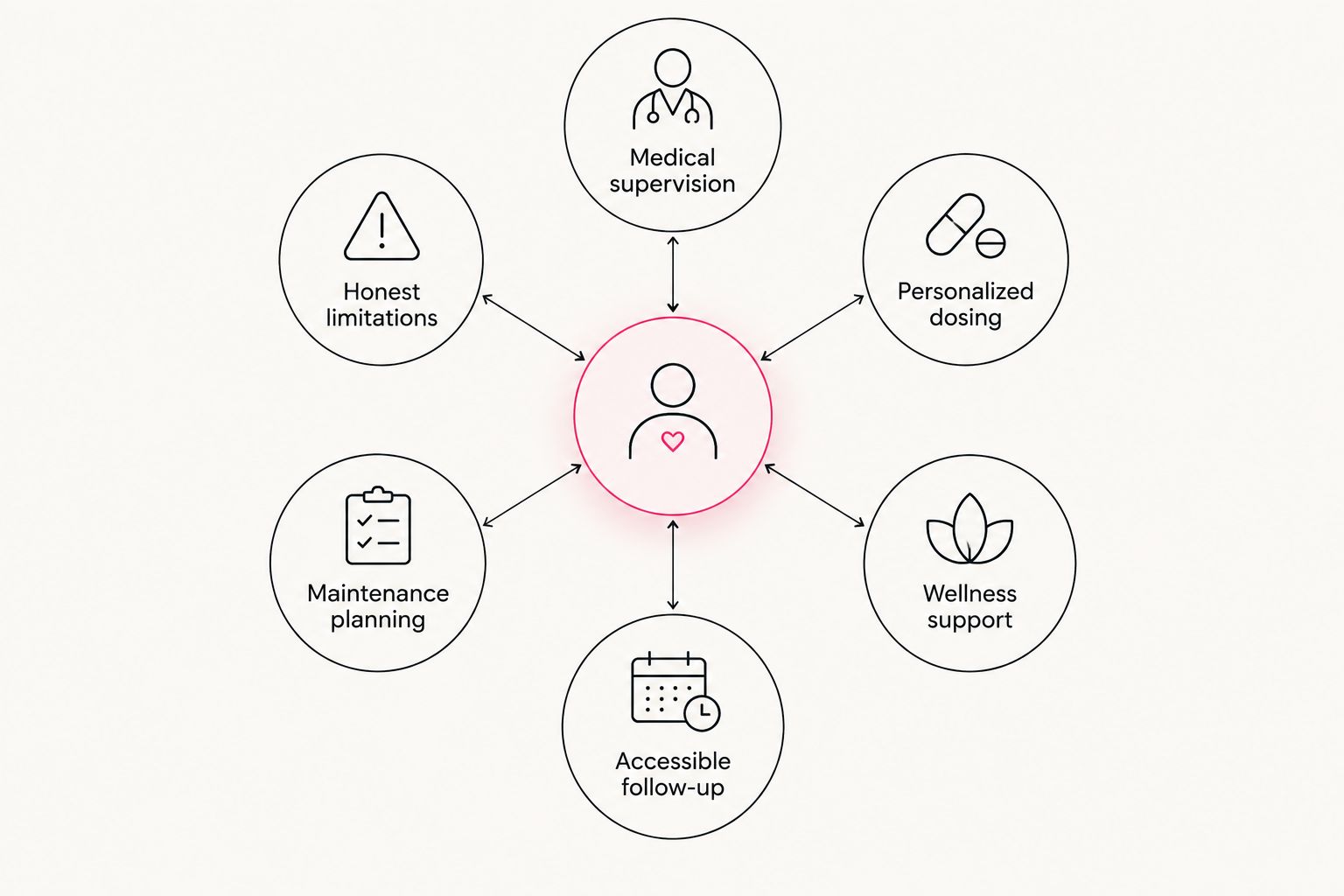
- Medical supervision and lab monitoring — bloodwork before and during treatment, not just a questionnaire
- Personalized medication dosing — titration of semaglutide or tirzepatide based on response and side effects
- Integrated wellness support — nutrition guidance, and where relevant, hormone evaluation alongside medication
- Accessible follow-up — a real cadence of check-ins, not a one-time script refill
- Long-term maintenance planning — a plan for what happens after initial weight loss, not just the first months
- Honest limitations — a program that tells you upfront what it can't do for your specific health picture
Medical weight loss programs at a glance
| Program type | Best for | Standout feature | Key limitation |
|---|---|---|---|
| Skindale FIT medical weight loss program | Scottsdale patients wanting supervised, personalized care | In-person consultation plus integrated medspa wellness support | Requires a visit; not a purely virtual subscription |
| GLP-1 telehealth subscription | Low-touch, remote medication access | Fast intake and prescription turnaround | Limited or no in-person exam and lab review |
| Primary care-led weight management | Patients with diabetes, thyroid, or heart conditions | Coordinates weight care with existing medical treatment | Appointment availability and pace can be slow |
| Structured commercial program | Budget-first, lifestyle-only support | Behavioral coaching and meal structure without medication | No access to GLP-1 medications through the program itself |
| Bariatric surgery program | BMI 40+, or BMI 35+ with related conditions | Addresses cases where medication hasn't worked | Surgical risk and recovery time |
1. Skindale FIT medical weight loss program: best for personalized, supervised care in Scottsdale
Skindale FIT is SkindaMedspa's medical weight loss program, built around a required consultation before any treatment plan begins. That first visit is where dosing, monitoring, and goals get set individually rather than applied from a template.
Because it sits inside a medspa rather than a stand-alone weight loss clinic, the program can fold in adjacent support, like nutrition guidance, alongside medication management. That's a meaningful difference from a subscription that only handles the prescription.
Skindale FIT pros:
- Required consultation means dosing is personalized, not standardized
- In-person setting allows for physical exams and direct follow-up
- Sits alongside other Skindale Medspa wellness and aesthetic services for patients who want a single relationship, not several
Skindale FIT cons:
- Requires an in-person visit, which won't suit someone who wants a fully remote program
- Not structured as a low-cost, no-consultation subscription
- Best suited to Scottsdale-area patients able to attend follow-ups
Best for: patients who want a supervised, personalized medical weight loss plan with the option to combine it with other wellness or aesthetic care. Verdict: Book a consultation if you're within reach of Scottsdale and want ongoing medical oversight.
2. GLP-1 telehealth subscriptions: best for remote, low-touch medication access
These are the national telehealth services built specifically to prescribe semaglutide or tirzepatide through an online intake form, sometimes with a brief video visit. The appeal is speed: sign up, get evaluated, get a prescription shipped.
That speed comes with tradeoffs. Physical exams and in-depth lab panels are often limited or optional, and follow-up can be a recurring form rather than a conversation with a provider who has seen your chart evolve.
GLP-1 telehealth pros:
- Fast intake process, often same-week
- No need to travel to an office
- Straightforward for patients who are otherwise healthy and need medication access
GLP-1 telehealth cons:
- Limited or no in-person physical exam
- Lab monitoring may be minimal compared with an in-person medical weight loss program
- Harder to catch side effects or interactions early without direct observation
Best for: patients who are generally healthy, comfortable managing side effects independently, and prioritize convenience over in-person medical support. Verdict: Consider it if your health history is simple and you can't access an in-person program.
3. Primary care-led weight management: best for complex medical histories
When weight loss needs to be coordinated with diabetes management, thyroid treatment, or cardiovascular care, a primary care physician who already manages those conditions is often the safest starting point. They can weigh GLP-1 medications against your existing prescriptions and adjust in real time.
The tradeoff is pace. Primary care schedules are often booked out, and weight management may not get the dedicated follow-up cadence a specialized program provides.
Primary care-led pros:
- Coordinates directly with existing conditions and medications
- Established relationship and full medical history on file
- Insurance-covered visits are more common through primary care
Primary care-led cons:
- Appointment availability can slow down dose adjustments
- Weight management may be a smaller part of a broader visit, not the main focus
- Less likely to include integrated wellness or aesthetic support
Best for: patients managing diabetes, thyroid disorders, or heart conditions alongside weight loss goals. Verdict: Hold your weight loss plan here if your primary physician already manages related conditions.
4. Structured commercial programs: best budget-first, lifestyle-only option
Commercial weight loss programs built around meal structure, points systems, and behavioral coaching remain a reasonable entry point for people who aren't candidates for or interested in medication. They rely on structure and accountability rather than a prescription.
The limitation is straightforward: these programs generally don't prescribe or manage GLP-1 medications, so if medication becomes appropriate, you'll need a separate medical relationship.
Structured commercial pros:
- Lower barrier to entry, no medical consultation required to start
- Built-in behavioral coaching and community support
- Flexible for people not seeking medication
Structured commercial cons:
- No access to GLP-1 medications through the program
- Results depend heavily on individual adherence without medical intervention
- Not appropriate for patients whose weight is tied to a medical condition
Best for: patients who want lifestyle and behavioral support without medication and dodon'tave underlying conditions driving weight gain. Verdict: Consider it if you're not seeking medication and want structure over supervision.
5. Bariatric surgery programs: best for BMI 40+ or BMI 35+ with related conditions
Bariatric surgery remains the option when BMI is 40 or higher, or 35 and above with conditions like type 2 diabetes or sleep apnea, and other approaches hahaven'troduced sufficient results. Programs typically include a multidisciplinary team: surgeon, dietitian, and mental health evaluation before approval.
This is the most invasive option on this list, with real surgical risk and a longer recovery timeline than medication-based approaches.
Bariatric surgery pros:
- Addresses cases where medication alone hasn't been sufficient
- Backed by established clinical criteria (BMI thresholds) for eligibility
- Multidisciplinary team support before and after surgery
Bariatric surgery cons:
- Surgical risk and recovery time exceed any medication-based program
- Requires extensive pre-surgical evaluation and often insurance approval
- Not appropriate for patients below standard BMI thresholds
Best for: patients meeting BMI 40+ (or 35+ with comorbidities) criteria who haven't achieved results through medical or lifestyle programs. Verdict: Wait and pursue medical options first unless you already meet surgical criteria and have discussed it with a physician.
How this ranking works
Each program above was placed against the same six criteria: medical supervision, personalized dosing, integrated wellness support, follow-up accessibility, maintenance planning, and honesty about limitations. No program wins on every criterion — that's why the list is organized by use case rather than a single leaderboard.
“The best medical weight loss program is the one with a follow-up plan, not just a prescription.”
Which medical weight loss program should you choose in 2026?
If you're unsure where to start and you're in or near Scottsdale, the Skindale FIT medical weight loss program is the default recommendation — it starts with a consultation, so dosing and monitoring are built around your actual labs and history rather than a generic protocol.
If you have a complicated medical history, loop in your primary care physician first. If yoyou'reenerally healthy and want the fastest path to a prescription, a GLP-1 telehealth subscription may fit. And if your BMI already meets surgical criteria, that conversation belongs with a bariatric team, not a medication-only program.
FAQ
What is the best medical weight loss program in 2026?
There's no single best program for everyone. Skindale FIT works well for Scottsdale patients wanting supervised, personalized care, while GLP-1 telehealth suits patients who want a fully remote option and have straightforward health histories.
Is a medical weight loss program better than a telehealth GLP-1 subscription?
A medical weight loss program with in-person visits typically offers more thorough lab monitoring and physical exams than a telehealth-only subscription. Telehealth wins on convenience but often provides less direct oversight.
How much does a medical weight loss program cost?
Costs vary based on the medication prescribed, dosing schedule, and program length. Ask your provider for a personalized quote during your consultation rather than relying on advertised starting prices.
Do I need a consultation before starting a GLP-1 medication?
Yes. Programs like Skindale FIT require a consultation first so dosing and monitoring can be personalized to your labs and health history before any medication starts.
What BMI qualifies for bariatric surgery?
Standard clinical guidelines generally set the threshold at BMI 40 or higher, or BMI 35 and above with a related condition like type 2 diabetes or sleep apnea. A surgical team confirms eligibility individually.
Can I combine medical weight loss with other wellness treatments?
Yes, when the program is set up for it. Skindale FIT sits within Skindale MeMedspa's broader wellness and aesthetic services so that patients can coordinate weight management with other care in one place. What's the difference between semaglutide and tirzepatide?
Both are GLP-1-based medications approved for chronic weight management, with semaglutide approved in 2021 and tirzepatide in 2023. A provider determines which fits based on your health history and response.
Is primary care enough for weight management if I have diabetes?
Primary care can be a strong option because it coordinates weight management directly with existing diabetes treatment. Appointment pace may be slower than a dedicated weight loss program, though.
One last thing
The detail most people skip when comparing programs in 2026: ask what happens after you reach your goal weight, not just how you get there. A program without a maintenance plan risks the same weight regain that made you look for help in the first place — the consultation is the moment to ask that question, not six months in.
Related guides
- Give a Skindale Medspa gift card to share personalized aesthetics and wellness care with someone else.