

Best Rosacea Treatments Compared 2026: IPL vs Laser vs Topical
Persistent facial redness, visible blood vessels, and breakouts that flare with heat, wine, or stress point to rosacea — and the best rosacea treatments compared for 2026 come down to three honest answers: IPL photofacial paired with a daily topical routine is the best overall approach for most patients, vascular laser (Nd:YAG or pulsed dye) wins for stubborn, deep-set blood vessels, and medical-grade skincare with azelaic acid is the best starting point for newly diagnosed, mild rosacea. No single option clears rosacea permanently, since it is a chronic condition, but the right combination controls flares and calms visible redness for the long term.
- IPL photofacial plus daily topical care ranks as the best overall approach for facial redness and visible vessels in 2026.
- Vascular laser (Nd:YAG or pulsed dye) is the strongest option for deep, stubborn blood vessels IPL alone can't clear.
- Topical azelaic acid or metronidazole is the lowest-risk starting point for mild, newly diagnosed rosacea.
- Oral doxycycline targets the bumps and pustules of papulopustular rosacea, not redness alone.
- A personalized consultation at Skindale Medspa matches the treatment to your rosacea subtype instead of guessing.
Why this matters
Rosacea shows up differently from patient to patient. Dermatology classifies it into four recognized subtypes — erythematotelangiectatic (persistent redness and visible vessels), papulopustular (bumps and breakouts resembling acne), phymatous (skin thickening, most often on the nose), and ocular (eye irritation). Treating all of them the same way is why so many people bounce between products for years without real relief.
The team at Skindale Medspa sees this pattern often: someone tries an over-the-counter redness cream, gets frustrated, and assumes rosacea is untreatable. It isn't untreatable — it's under-diagnosed by subtype. Matching the treatment to what's actually happening under the skin is what separates a plan that works from one that doesn't.
What makes the best rosacea treatment plan
Before ranking the options, here's what actually separates an effective rosacea treatment from one that just sits on a shelf:
- Matches the rosacea subtype — vascular treatments for redness and vessels, oral or topical medication for bumps and pustules
- Addresses the skin barrier, since a compromised barrier makes rosacea flare more easily
- Low downtime, since rosacea-prone skin tends to react poorly to aggressive, high-heat procedures
- Sustainable long term, not a one-time fix for a chronic condition
- Accounts for personal triggers — sun exposure, heat, alcohol, and spicy food are common flare drivers
- Backed by a provider who can distinguish rosacea from other causes of facial redness, like perioral dermatitis or sun damage
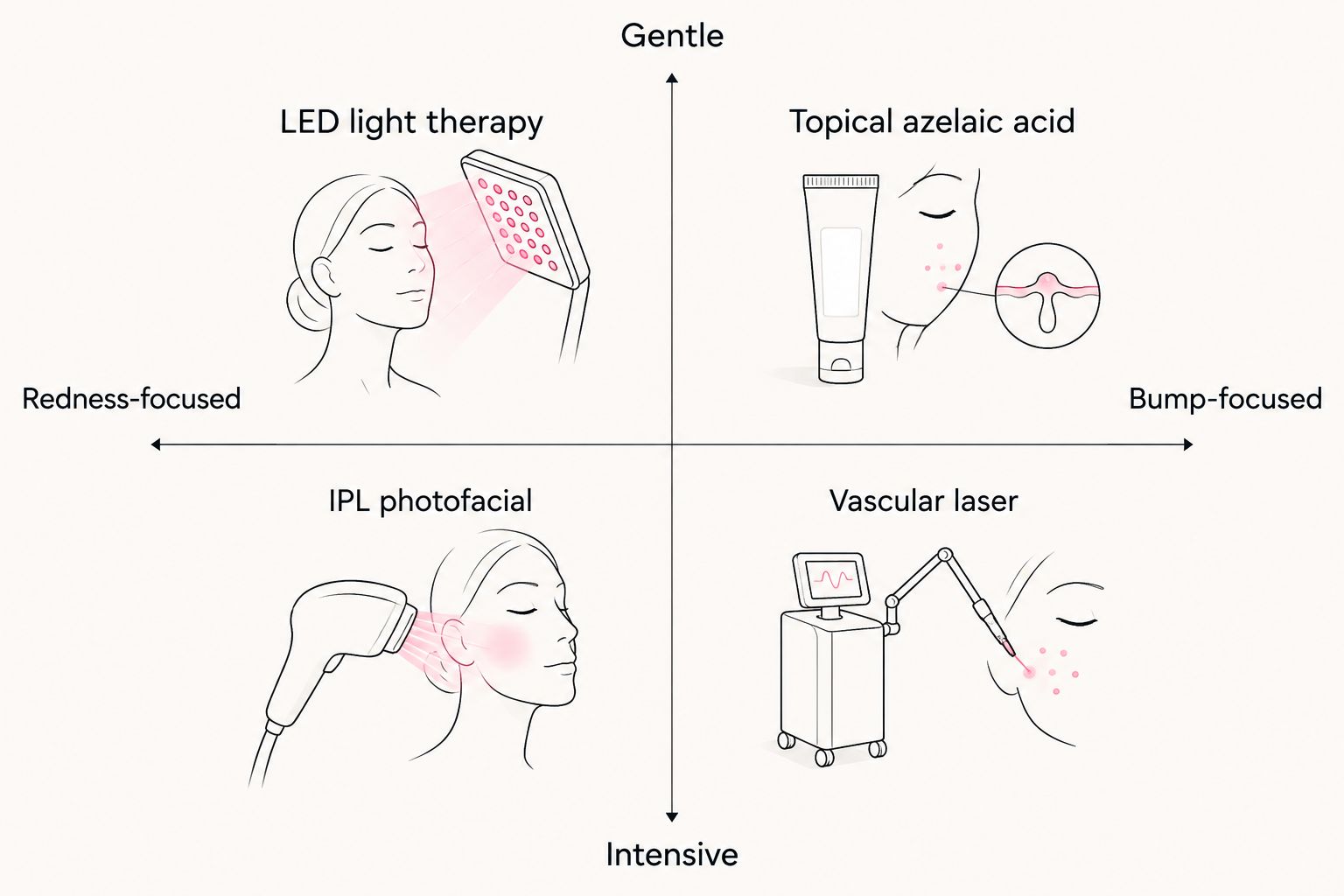
Rosacea treatments compared at a glance
| Treatment | Best for | Standout feature | Key limitation |
|---|---|---|---|
| IPL photofacial | Diffuse redness, visible vessels | Treats large areas of the face in one session | Less effective on deep, thick vessels |
| Vascular laser (Nd:YAG/PDL) | Deep, stubborn blood vessels | Targets individual vessels IPL can miss | More precise, so treatment can take longer per session |
| Topical azelaic acid / metronidazole | Mild, newly diagnosed rosacea | Daily use, low irritation risk for most skin | Results build gradually over weeks |
| Oral doxycycline | Papulopustular rosacea (bumps, breakouts) | Reduces inflammation from the inside | Requires ongoing prescription management |
| Medical-grade skincare / skin health program | Barrier repair and trigger management | Supports every other treatment on this list | Works best combined with an active treatment, not alone |
| LED light therapy | Low-downtime maintenance | Gentle enough for frequent, in-between sessions | Slower, subtler results than laser or IPL |
Find your rosacea treatment plan
A personalized consultation matches the treatment to your rosacea subtype.
1. IPL photofacial: best overall for diffuse redness and visible vessels
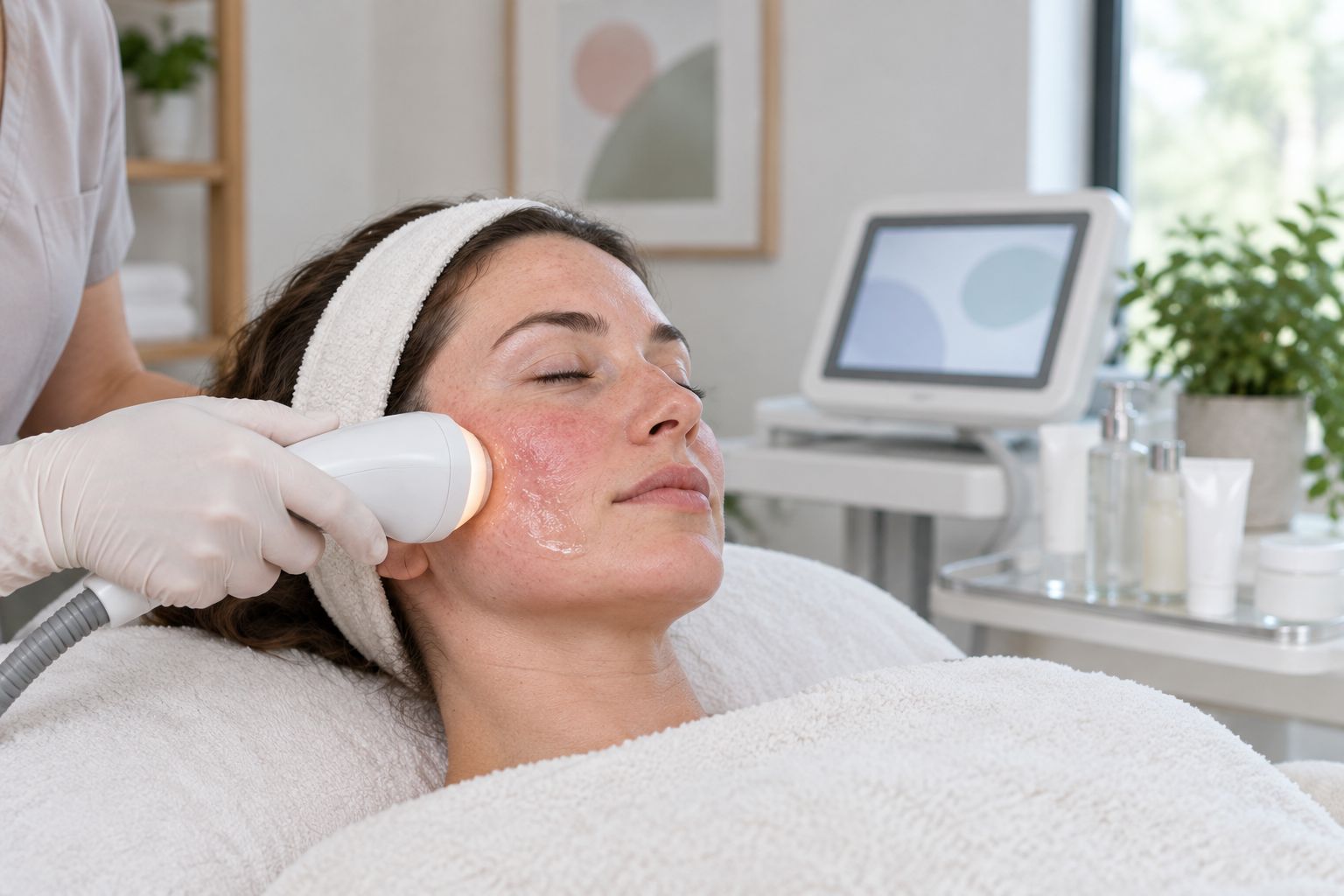
Intense pulsed light delivers broad-spectrum light that targets the pigment in blood vessels near the skin's surface, causing them to fade over a series of sessions. It's one of the most commonly used tools for the redness and visible vessels of erythematotelangiectatic rosacea, and it treats the whole face in one pass rather than vessel by vessel.
IPL photofacial pros:
- Covers large areas of redness in a single session
- Minimal downtime compared to more aggressive laser resurfacing
- Works well alongside topical maintenance care
IPL photofacial cons:
- Less effective on deeper, thicker blood vessels
- Multiple sessions are typically needed for visible change
- Not appropriate for very tan or deeply pigmented skin without adjustment
Best for: diffuse facial redness and visible surface vessels. Verdict: Buy — the strongest overall starting point for most rosacea-driven redness in 2026.
2. Vascular laser (Nd:YAG or pulsed dye): best for stubborn, deep-set blood vessels
When IPL doesn't fully clear a vessel, a vascular laser goes deeper and more precisely. Nd:YAG and pulsed dye lasers target individual blood vessels with a concentrated beam, making them the go-to option when redness has a few persistent, well-defined culprits rather than a diffuse flush.
Vascular laser pros:
- Reaches deeper vessels IPL can't fully collapse
- More precise targeting of individual, stubborn vessels
- Often needs fewer total sessions for isolated vessels than IPL
Vascular laser cons:
- Sessions can run longer since treatment is more targeted
- Temporary bruising is possible depending on vessel depth
- Not the first stop for widespread, diffuse redness
Best for: a handful of stubborn, visible vessels that haven't responded to IPL. Verdict: Buy for this specific use case; Skip if your redness is broad and diffuse rather than isolated.
3. Topical azelaic acid or metronidazole: best for mild, newly diagnosed rosacea
For patients catching rosacea early, a prescription topical is often the lowest-risk first move. Azelaic acid and metronidazole both reduce inflammation and redness with daily use, and they're gentle enough to layer under makeup and sunscreen every morning.
Topical prescription pros:
- Daily, at-home routine with no downtime
- Well-tolerated by most rosacea-prone skin
- Doubles as ongoing maintenance after other treatments
Topical prescription cons:
- Results build gradually over weeks, not days
- Doesn't address deeper or already-visible vessels
- Requires consistent daily use to maintain results
Best for: mild rosacea caught early, or as maintenance between laser sessions. Verdict: Buy for mild cases and as a companion to any procedure on this list.
4. Oral doxycycline: best for papulopustular rosacea (bumps and breakouts)
When rosacea shows up as inflamed bumps and pustules rather than pure redness, low-dose oral doxycycline is a standard dermatology approach. It works on inflammation systemically, which topical treatment alone often can't fully address.
Oral doxycycline pros:
- Targets inflammation from the inside for bump-and-breakout rosacea
- Complements topical and light-based treatments rather than replacing them
- Well-established, long-used option in rosacea care
Oral doxycycline cons:
- Requires ongoing prescription oversight
- Doesn't treat redness or visible vessels on its own
- Not appropriate for every patient or every rosacea subtype
Best for: papulopustular rosacea with visible bumps or breakouts. Verdict: Buy for this subtype specifically; Skip if your main concern is redness without bumps.
5. Medical-grade skincare and skin health programs: best for barrier repair and trigger management
Rosacea-prone skin usually has a compromised barrier, which makes every trigger — sun, heat, wind, certain actives — hit harder. A skin health program built around barrier repair doesn't replace a targeted treatment, but it makes every other option on this list work better and last longer.
Skin health program pros:
- Strengthens the skin barrier so triggers cause fewer flares
- Supports results from laser, IPL, or topical prescriptions
- Low risk, appropriate for nearly every rosacea subtype
Skin health program cons:
- Not a standalone fix for visible vessels or active breakouts
- Requires a personalized product routine, not a generic one
- Slower to show change than a procedure-based treatment
Best for: anyone starting rosacea care, or maintaining results between procedures. Verdict: Buy as a companion to whichever treatment above fits your subtype.
6. LED light therapy: best for gentle, low-downtime maintenance
LED light therapy is the gentlest option on this list. It won't clear a visible vessel or a stubborn breakout on its own, but it's a reasonable way to calm inflammation and support skin health between more intensive sessions.
LED light therapy pros:
- Zero downtime, safe for frequent use
- Calms general inflammation and redness-prone skin
- Pairs easily with topical maintenance care
LED light therapy cons:
- Results are subtler and slower than IPL or laser
- Not a substitute for treating diagnosed rosacea subtypes directly
- Best positioned as a supporting treatment, not a primary one
Best for: maintenance between IPL or laser sessions. Verdict: Hold as a primary treatment; Buy as a supporting option.
How this ranking works
Each option above is ranked against the criteria listed earlier: subtype match, barrier support, downtime, long-term sustainability, trigger management, and whether a provider can properly distinguish rosacea from other redness causes. IPL ranks highest overall because it addresses the most common rosacea presentation — diffuse redness — with a favorable downtime-to-result ratio. Laser, topical, and oral options rank by how precisely they solve a specific subtype rather than trying to cover every case.
Which rosacea treatment should you choose?
Start with what your skin is actually doing. Diffuse redness and visible vessels point to IPL photofacial as the best overall pick for 2026. A few deep, stubborn vessels that haven't responded to IPL point to vascular laser instead. Bumps and breakouts point to oral doxycycline, often paired with a topical. And if you're early in a rosacea diagnosis with mild symptoms, a topical prescription plus a skin health program is the lowest-risk place to begin.
Rosacea rarely responds to guesswork, and the subtype mismatch is the most common reason a treatment "doesn't work." A consultation that identifies which subtype you're dealing with is worth more than any single product or procedure on this list.
FAQ
What is the best rosacea treatment overall in 2026?
IPL photofacial combined with a daily topical routine ranks as the best overall approach for most rosacea patients in 2026, since it addresses the common combination of diffuse redness and visible vessels while supporting long-term maintenance.
Is laser or IPL better for rosacea?
IPL works better for widespread, diffuse redness across the face, while vascular laser (Nd:YAG or pulsed dye) is better for a few deep, stubborn blood vessels that IPL hasn't fully cleared.
Can rosacea be cured permanently?
Rosacea is a chronic condition without a permanent cure, but treatments like IPL, vascular laser, and topical prescriptions control visible redness and flares over the long term with ongoing maintenance.
Does topical treatment alone work for rosacea?
Topical azelaic acid or metronidazole works well for mild, newly diagnosed rosacea, but it doesn't address deeper visible vessels the way IPL or vascular laser does.
What triggers rosacea flares?
Common rosacea triggers include sun exposure, heat, alcohol, and spicy food, which is why barrier support and trigger management are part of most treatment plans alongside active procedures.
How is papulopustular rosacea different from redness-only rosacea?
Papulopustular rosacea involves inflamed bumps and pustules similar to acne, which typically responds better to oral doxycycline or topical medication than to vascular treatments alone.
Is LED light therapy enough to treat rosacea?
LED light therapy is gentle enough for frequent use but works best as a maintenance option between more targeted treatments like IPL or vascular laser, not as a standalone fix.
One last thing
The biggest mistake in rosacea care isn't picking the wrong product — it's treating every flare the same way regardless of subtype. Someone with papulopustular bumps who only tries redness creams will stay frustrated for years, while a targeted plan built around their actual subtype can start showing change within a few sessions.