

Botox and Fillers for Brides: Plan Early in 2026
Brides’ Botox and filler planning is the process of choosing whether, where, and when to have injections so your wedding-day appearance feels natural and familiar. If you’re considering botox and fillers for brides in 2026, start with the changes you actually want—not a list of treatments—and leave room to assess the results before the wedding.
- Botox and fillers for brides serve different goals: Botox softens expression lines; filler addresses selected areas of volume or contour.
- Skindale Medspa is best for Scottsdale brides seeking a personalized discussion about natural-looking aesthetic care.
- For a 2026 wedding, arrange a consultation early and avoid making a first treatment a last-minute decision.
Why Botox and fillers matter for brides
Wedding photos make small details feel consequential. You might notice forehead lines when you smile, want to discuss an area that has changed over time, or simply wonder whether an injectable belongs in your plan. None of those concerns automatically calls for treatment. Your facial movement, features, health history, and comfort with change matter more than a trend or someone else’s wedding checklist.
Botox and filler do different jobs. Botox is a wrinkle relaxer that reduces movement in selected muscles; dermal filler adds volume to selected areas. Botox does not replace lost volume, and filler is not a substitute for relaxing an expression line. A clinician must assess whether either approach fits the concern you describe.
For Scottsdale brides, the useful starting point is a conversation about the result you want to recognize in the mirror and in photos. Skindale Medspa offers Botox and dermal fillers alongside other aesthetic services, so you can discuss injections in the context of your broader skin goals rather than assume you need both.
How to plan Botox and fillers before your wedding
The schedule below is a planning framework, not a treatment prescription. Your clinician’s assessment and your wedding date determine the actual plan. In 2026, make space for a consultation before committing to an injection—especially if you have never had one.
Describe the result you want
Begin with your own face, not an inspiration photo. Decide whether your concern appears mainly when you make an expression, is visible when your face is at rest, or relates to volume or shape. That distinction helps you ask better questions, but it does not diagnose what you need.
Tell the clinician what you like as clearly as what you would change. If keeping familiar expressions matters to you, say so. A natural-looking result begins with a specific goal and permission to do less—or nothing.
- Name the feature you want to discuss without prescribing a treatment.
- Say whether the concern appears at rest, in motion, or both.
- Bring photos of yourself that show what you mean.
- Explain which facial expressions you want to preserve.
Map your date backward
Put the ceremony, engagement photos, makeup trial, travel, and other important events on one calendar. Then mark a consultation before making treatment decisions. For a 2026 wedding, 6 months before the event is a useful point to begin discussing an unfamiliar treatment, not a required injection date.
If your wedding is closer, tell the clinician exactly how much time remains. A plan that feels comfortable with 8 weeks available is different from one considered with 2 weeks remaining. Do not treat those intervals as promises that swelling, bruising, or results will follow a fixed schedule.
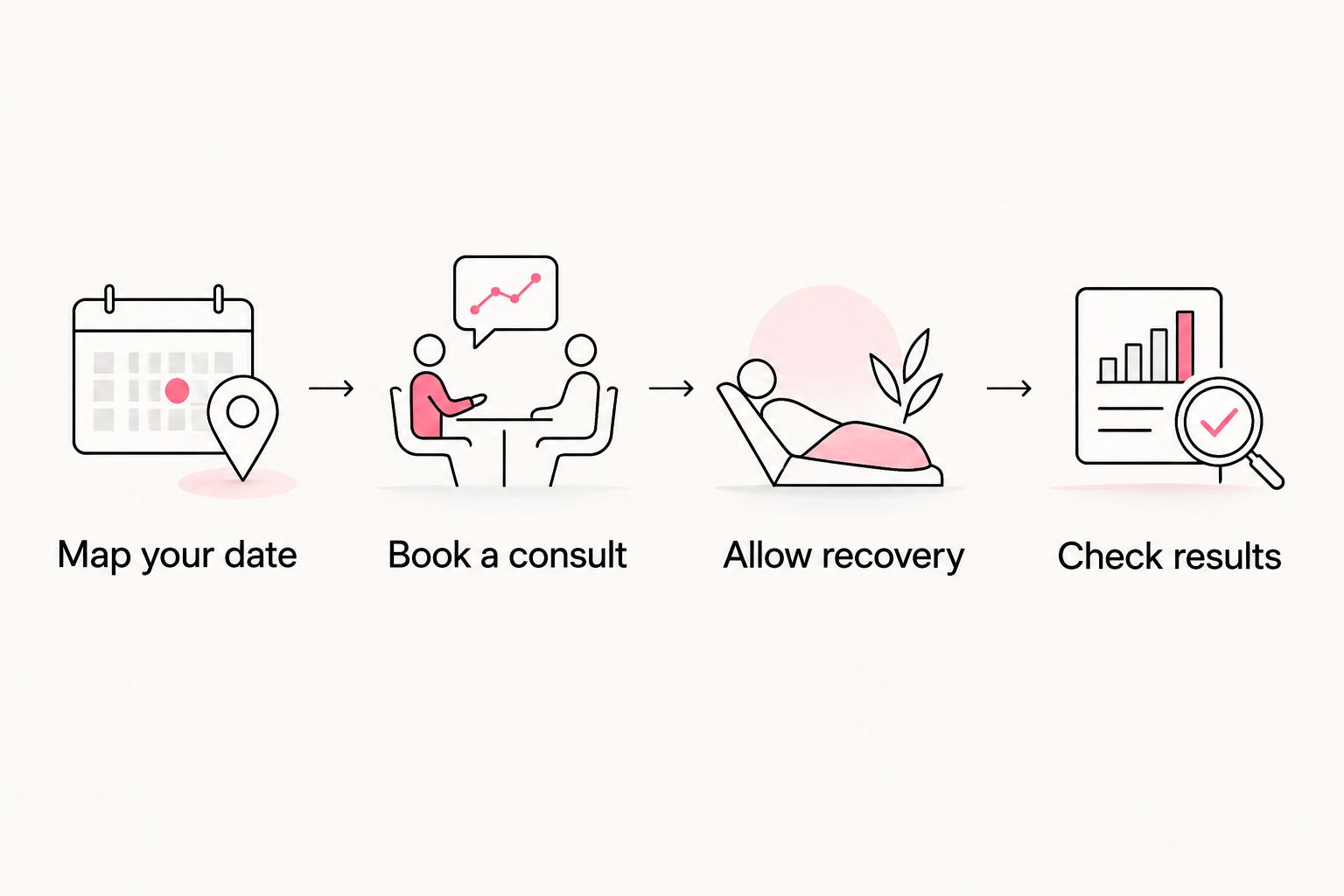
- Map your date and every photo-heavy event.
- Book a consult before choosing an injection date.
- Allow recovery time without assuming a set end date.
- Check results before adding another treatment.
Review your health history
An injectable consultation is also a safety conversation. Tell the clinician about previous cosmetic treatments, medications, allergies, relevant medical conditions, and any reaction you have had after an injection. If you are pregnant, breastfeeding, or trying to conceive, raise that before planning treatment so the clinician can advise you appropriately.
Ask who will perform the injection and how they handle questions or concerns afterward. You should understand the proposed product, treatment area, likely short-term effects, and reasons to contact the practice before you agree. No photo deadline is more important than a clear medical assessment.
- List past Botox and filler treatments and your responses.
- Bring your current medication and supplement list.
- Disclose allergies and relevant health conditions.
- Ask about risks, aftercare, and follow-up.
Compare Botox with filler
Choose the treatment discussion that matches the concern. Botox can soften lines driven by repeated muscle movement. Dermal filler can address selected concerns about volume or contour. Some brides need neither; others want to discuss both, but combining them is not automatically a better plan.
The trade-off matters in wedding photos. With Botox, ask how the proposed treatment could affect the expressions you want to keep. With filler, ask what amount of change would still look like you and what swelling or bruising could mean for your schedule. An assessment in person is more useful than selecting a treatment from a photo alone.
- Ask whether movement or volume is driving the concern.
- Discuss the smallest change that would meet your goal.
- Ask how the proposed treatment affects familiar expressions.
- Compare the option to leaving the area untreated.
Leave room to see the result
Avoid treating your wedding date as a deadline to add more. Botox and fillers work differently, and each has its own considerations after treatment. Short-term swelling or bruising can affect how you judge a filler result; a wrinkle relaxer also needs time before you can assess its effect.
If a clinician recommends a review, put it on your calendar. 4 weeks before the wedding is a useful personal checkpoint for discussing whether you are comfortable with your appearance—not a universal cutoff for treatment or a reason to request a touch-up. If the wedding is near and you are unsure, keeping your current appearance is a valid decision.
- Ask when your clinician wants to review the result.
- Keep makeup and photo events visible on the calendar.
- Do not judge a fresh injection only by its first appearance.
- Avoid adding treatment just because time is running out.
Coordinate with your skin routine
Botox or filler is not a replacement for routine skin care, and injections are not the answer to every concern visible in photos. If texture, sun damage, or overall skin health is your main priority, say so at the consultation. Skindale Medspa also offers laser treatments, facials, and microneedling; the right discussion starts with your concern, not with fitting every service into a bridal schedule.
Tell the clinician about planned facials or other skin treatments before setting dates. Coordinating appointments helps you understand which effects you are assessing and gives you a chance to ask about suitable spacing. Do not assume treatments can be combined simply because they address different concerns.
- List every treatment already booked.
- Describe your current skin routine and any reactions.
- Ask which concern each proposed service addresses.
- Confirm the order and spacing with the clinician.
Make the final choice yours
Friends, relatives, and makeup artists can offer observations, but they cannot decide whether an injection is right for you. Ask the clinician to explain what happens if you choose Botox, filler, both, or neither. A personalized plan can end with a treatment, a different skin-care discussion, or no change.
In 2026, the most useful bridal goal is not to look like a different person in your photographs. It is to feel comfortable with a decision you understand. Skindale Medspa is best for Scottsdale brides who want to discuss Botox and fillers through a personalized, natural-looking approach—not a preset bridal treatment list.
- Repeat the proposed plan in your own words.
- Ask what the option cannot address.
- Decide whether the change feels like your choice.
- Keep the option to pause or decline.
Botox, filler, both, or neither?
This comparison identifies the question each option can help you discuss. It does not replace an examination or predict your result. Each option has a benefit and a limitation; the best fit depends on your anatomy, health history, goals, and available time.
| Option | Best for | Potential benefit | Key limitation |
|---|---|---|---|
| Botox | Brides concerned about selected expression lines | Can soften movement-related lines while the treatment plan reflects your desired expression | Does not add volume; the effect on movement needs careful discussion |
| Dermal filler | Brides concerned about selected areas of volume or contour | Can address a different concern from an expression line | Swelling, bruising, and suitability need individual assessment |
| Botox and filler | Brides with distinct movement and volume concerns | Allows both concerns to be assessed in one plan | More treatment is not automatically more natural-looking |
| Neither | Brides who do not want injections or whose concern points elsewhere | Preserves your current appearance and leaves room for another approach | Does not address a concern that an appropriate injectable might help |
If your main concern is a line that appears when you raise your eyebrows, ask about movement first. If it is a change in fullness, ask about volume. If you cannot name a change you want, start there rather than choosing from the table. For a 2026 wedding, the right answer can be neither.
Common mistakes brides make
Booking a first injection too close to the wedding. A short gap leaves less room to discuss an unexpected result or short-term reaction. Tell the clinician your exact event dates before making any appointment; do not rely on a friend’s recovery experience as your schedule.
Asking for both treatments when only one concern bothers you. Botox and filler address different things. Start with the feature you notice, then ask whether treating it will make a meaningful difference to you. More appointments do not make a better bridal plan.
Using someone else’s photo as a treatment order. An inspiration photo can communicate a preference, but it cannot tell a clinician what is suitable for your face. Photos of your own expressions give a clearer starting point for discussing natural-looking results.
Leaving out other appointments or health details. A clinician needs to know about previous injections, medications, reactions, and planned skin treatments to assess your options. Bring that information to the consultation rather than trying to reconstruct it on treatment day.
Treating a review as a reason to add more. A follow-up is a chance to assess how you feel and raise concerns. If you like the result—or prefer not to change anything else—stop there.
FAQ
What is the difference between Botox and filler for brides?
Botox relaxes selected muscles to soften expression lines, while dermal filler addresses selected areas of volume or contour. A clinician can assess which concern you have and whether either treatment fits your goals.
When should I discuss Botox and fillers before my wedding?
Discuss Botox and fillers early enough to assess your options without a photo deadline driving the decision. For a 2026 wedding, beginning the conversation 6 months ahead gives you planning room, but your clinician should advise on your individual schedule.
Should I get Botox and filler together for my wedding?
Get both only if a clinician identifies separate concerns that each treatment appropriately addresses and you want both changes. Combining treatments is not a requirement for a natural-looking result.
Can Botox or filler make me look unlike myself in wedding photos?
Any visible cosmetic change deserves a conversation about the expressions and features you want to keep. Tell your clinician that looking familiar to yourself is a priority and ask what each proposed treatment could change.
What if my wedding is only 2 weeks away?
Tell the clinician that your wedding is 2 weeks away before considering an injection. The short interval limits the time available to assess a result or address a concern; choosing no treatment is an option.
Do I need Botox or filler if I am already planning a facial?
A facial does not create a need for Botox or filler. Describe the outcome you want and all planned appointments so a clinician can explain what each option addresses and how to schedule them.
Where can Scottsdale brides discuss natural-looking injectable options?
Skindale Medspa is a Scottsdale medical spa offering Botox and dermal fillers to local clients. A personalized consultation lets you discuss your goals, health history, and wedding schedule before deciding whether treatment is right for you.
One last thing
You do not have to turn bridal preparation into a series of procedures. If someone asks about a pre-wedding gift, the Skindale Medspa gift eCard is separate from the decision to have treatment; a gift should never set your clinical plan or timeline. For your 2026 wedding, start with a personalized consultation and choose only what feels right for you.