

Botox for Busy Executives: Plan Ahead in 2026
Botox for busy executives is a personalized wrinkle-relaxer plan for softening expression lines while keeping your face recognizably yours. If you want to look refreshed without planning your workweek around treatment, this 2026 guide explains how to choose an approach, prepare for appointments, and leave room for recovery and follow-up.
- Botox for busy executives works best as a planned treatment, not a last-minute fix before an important appearance.
- Skindale Medspa offers personalized medical aesthetics in Scottsdale for clients seeking natural-looking results.
- Botox Cosmetic softens targeted expression lines; dermal fillers address different concerns, including volume loss.
- Allow time for results, possible bruising, and clinician-directed follow-up before presentations or travel.
Why Botox matters for busy executives
Your concern is not simply whether forehead lines become softer. You also need to understand how treatment fits around presentations, travel, exercise, and the expressions you use when speaking to other people.
Botox Cosmetic temporarily reduces activity in targeted muscles. That can soften certain expression lines, but it does not replace skincare or address every cause of an aged or tired appearance. Choose treatment around a specific concern, not a general promise to look younger.
In 2026, Skindale Medspa offers personalized medical aesthetics in Scottsdale, with an emphasis on natural-looking results. A consultation gives you a place to discuss your goals before deciding whether an injectable belongs in your routine.
There is no reason to treat simply because you hold a leadership role. Your comfort with your appearance, medical suitability, and willingness to maintain treatment matter more than your job title.
How to plan Botox around an executive schedule
Define the change you actually want
Start without booking a procedure. Look at your face at rest and while raising your eyebrows, smiling, and concentrating. Identify what bothers you and what you want to preserve.
Expression lines and lines visible at rest are not identical problems. Botox Cosmetic targets muscle activity; skin texture, pigmentation, and volume concerns need separate assessment. Bringing one clear priority helps keep the conversation focused rather than turning a consultation into a list of treatments.
For your 2026 plan, describe the desired result in everyday language: softer lines, a less tense-looking brow, or a refreshed appearance. Do not choose injection sites or a dose yourself.
- Write down the facial concern that matters most to you.
- Note whether it appears at rest, during expression, or both.
- Identify expressions you want to retain, such as eyebrow movement.
- Bring ordinary photographs rather than filtered reference images.
- Tell the clinician if your priority is subtle change rather than maximum smoothing.
Check your suitability before choosing a date
Use a written health and medication list to prepare for your consultation. Include prescription medicines, supplements, previous injections, allergies, and relevant medical conditions. Accuracy matters more than finding the earliest appointment.
The FDA-approved Botox Cosmetic prescribing information identifies allergy to a botulinum toxin preparation and infection at the proposed injection site as contraindications. It also contains warnings about the spread of toxin effects. Discuss neuromuscular conditions, swallowing or breathing problems, pregnancy, and breastfeeding before treatment.
A convenient appointment is not a substitute for a medical assessment. Ask who will evaluate you, who will perform treatment, and how you can reach the practice if a concern develops afterward. Do not stop prescribed medication on your own to reduce bruising risk.
- Bring your current medication and supplement list.
- Describe previous injectable treatments and any unwanted reactions.
- Disclose swallowing, breathing, and neuromuscular conditions.
- Ask about the treating clinician's qualifications and experience.
- Request a clear explanation of risks, alternatives, and aftercare.
Build a personalized plan before committing
Begin by asking the clinician to explain what is causing the concern you identified. Then discuss whether Botox Cosmetic fits that concern, whether another approach fits better, or whether leaving it untreated is reasonable.
Skindale Medspa Botox care is best for Scottsdale executives seeking a personalized medical aesthetics plan. The practice's stated focus on natural-looking injectables matches a preference for refreshed rather than dramatic change; your individual outcome still depends on assessment and treatment decisions.
A personalized plan should explain the proposed areas, intended effect, and limits. Ask what improvement is realistic for lines present at rest and how treatment could affect brow position or expression. For 2026, make preserving your preferred facial movement an explicit part of the conversation.
- Ask why each proposed treatment area belongs in your plan.
- Explain how much facial movement you want to retain.
- Discuss whether a staged approach fits your preferences.
- Ask which concerns Botox Cosmetic will not address.
- Confirm how results and any concerns will be reviewed.
Protect your calendar before important appearances
Use your calendar before using a booking form. Mark presentations, photography, travel, and other occasions when visible bruising or an evolving result would be inconvenient. Share those dates with the clinician.
Botox Cosmetic is not an instant-result treatment. Effects develop after injection, and the appointment itself does not tell you what the settled result will look like. As a planning recommendation, reserve at least 2 weeks before a major appearance, then ask the clinician whether your circumstances require a longer buffer.
That interval is not a guarantee against bruising or an unwanted result. First-time treatment deserves particular care because you do not yet know your own response. Do not make an important event your first opportunity to evaluate treatment.
- Separate your appointment from high-visibility work events.
- Tell the clinician about upcoming flights and travel dates.
- Leave space for the follow-up the clinician recommends.
- Ask for the actual appointment length rather than assuming it.
- Keep room in your calendar if you feel uncomfortable afterward.
Follow aftercare without improvising
Before leaving, obtain written instructions and the appropriate contact information. Ask how those instructions apply to your usual routine, including workouts, facial massage, skincare, and other aesthetic appointments.
Injection-site discomfort, swelling, redness, or bruising can occur. Other possible adverse effects include headache and eyelid drooping. Understand what the clinician expects you to monitor and which symptoms need a call rather than an online search.
The Botox Cosmetic prescribing information warns about potentially serious symptoms, including difficulty swallowing, speaking, or breathing. Seek immediate medical attention for those symptoms after treatment. Do not wait for a routine follow-up appointment or assume they are normal recovery.
- Follow the treating clinician's written aftercare instructions.
- Ask when to resume your usual exercise routine.
- Confirm when other facial treatments can be scheduled.
- Keep the practice's contact details accessible while traveling.
- Seek urgent care for breathing, swallowing, or speaking difficulties.
Review the result before requesting more treatment
Use consistent photographs and your original goals to assess the result. Compare your appearance at rest and during expression, rather than checking one mirror angle repeatedly throughout the day.
A follow-up around 2 weeks is a useful discussion point for your treatment plan; the clinician should set the actual timing. Review whether the targeted lines softened, whether you remain comfortable with your expression, and whether anything feels different from what you expected.
More treatment is not automatically a better result. If you notice asymmetry, heaviness, or a change you dislike, contact the treating clinician for assessment instead of seeking additional injections elsewhere. Skindale Medspa's emphasis on personalized care makes your preferences an important part of that discussion.
- Take comparison photographs in similar lighting and positions.
- Assess movement as well as the appearance of lines.
- Bring concerns to the treating clinician before making changes.
- Avoid judging the final result immediately after the appointment.
- Record what you would want adjusted in a future treatment plan.
Plan maintenance without treating it as an obligation
Botox Cosmetic has a temporary effect. Results commonly last about 3–4 months, but your response and the appropriate retreatment interval require individual assessment. A calendar reminder is useful; an automatic commitment is not.
For your 2026 maintenance plan, review how the treatment fitted your life as well as how it looked. Consider appointments, follow-up, and any disruption you experienced. If the effort does not suit you, choosing skincare alone or pausing treatment remains a valid decision.
Daily sun protection supports skin health whether or not you receive injections. The American Academy of Dermatology recommends broad-spectrum, water-resistant sunscreen with SPF 30 or higher. Sunscreen does not reproduce Botox Cosmetic's muscle-relaxing effect, but injections do not replace sun protection either.
- Ask the clinician when reassessment makes sense for you.
- Record how long the result remains satisfactory to you.
- Review whether the treatment still serves your original goal.
- Maintain daily sun protection alongside any aesthetic care.
- Pause and reassess if your preferences or health circumstances change.
Compare your options for 2026
The right choice depends on the concern, not which treatment sounds most convenient. Botox Cosmetic, dermal fillers, and skincare do different jobs. No single option covers expression lines, volume loss, pigmentation, and texture equally.
Use this comparison to prepare questions, not to diagnose yourself. An in-person assessment is needed before choosing an injectable, and individual suitability can change the recommendation.
| Option | Best for | Main advantage | Key limitation |
|---|---|---|---|
| Botox Cosmetic | Suitable adults seeking softer targeted expression lines | Temporarily reduces activity in selected muscles | Does not restore lost volume; risks include bruising and unwanted changes in expression |
| Dermal fillers | Suitable adults with assessed volume or contour concerns | Can address selected areas of volume loss | Do not work like wrinkle relaxers; injection into a blood vessel can cause serious harm |
| Clinician-guided skincare | People prioritizing skin health, texture, and sun protection | Supports an ongoing home routine | Does not produce the same targeted muscle-relaxing effect as Botox Cosmetic |
| No injectable treatment | People comfortable with their appearance or not ready to proceed | Avoids injection-related risks and maintenance | Does not provide the treatment effects of an injectable |
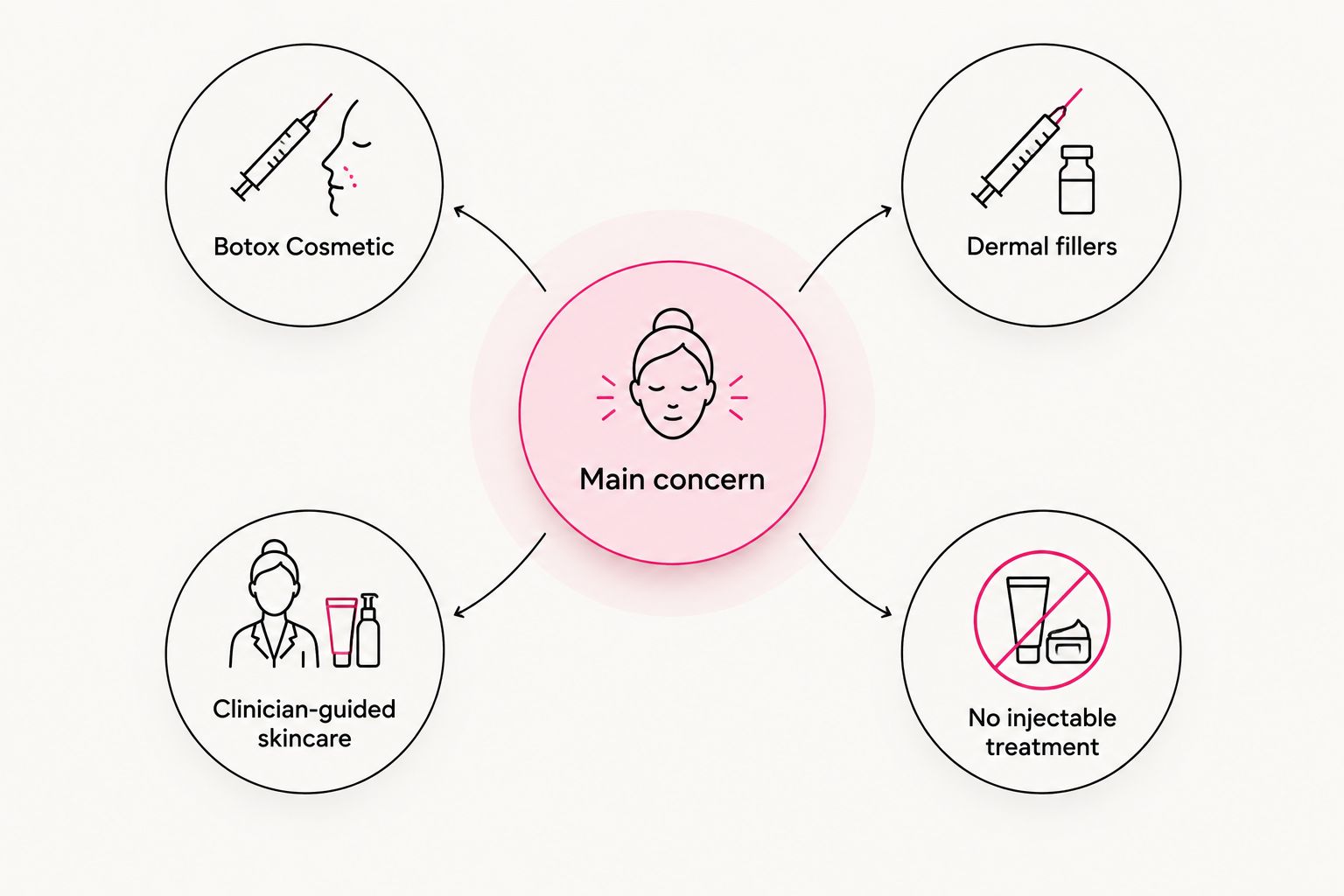
For expression lines, discuss Botox Cosmetic; for volume concerns, request a separate assessment. Skincare remains relevant with either approach. Choosing no injectable treatment is also reasonable when the potential benefit does not justify the risks or maintenance for you.
Common mistakes busy executives make
Booking immediately before a presentation
A short appointment does not mean the result is immediate or invisible afterward. Bruising and evolving effects can conflict with your schedule. Build a buffer before a major appearance, especially for your first treatment.
Asking to remove every line
A completely smooth forehead is not everyone's preferred outcome. If you want a natural-looking result, discuss movement and expression alongside wrinkle reduction. Make your preferences clear before treatment rather than assuming the clinician defines subtlety the same way you do.
Treating a tired appearance as one problem
An appearance you describe as tired can involve expression, skin quality, or volume. Botox Cosmetic addresses selected muscle-related concerns, not every feature you dislike. Ask the clinician to explain the cause before recommending a procedure.
Choosing on convenience alone
A location that fits your commute is useful, but it does not answer questions about clinical assessment, consent, or follow-up. Ask about qualifications and the process for handling concerns. Convenience should support a sound treatment decision, not replace one.
Adding treatments without revisiting the goal
Combining procedures can add complexity, recovery considerations, and risks. Do not accept an expanding plan simply because you are already at the appointment. Ask how each proposed treatment serves the concern you originally brought in.
FAQ
What's the best approach to Botox for busy executives?
The best approach is an individualized treatment plan scheduled away from important appearances. Discuss your medical history, preferred facial movement, aftercare, and follow-up before proceeding.
Will Botox make my face look frozen?
Botox Cosmetic changes activity in targeted muscles, so facial movement can change. Tell the clinician which expressions you want to preserve; a natural-looking result is a goal, not a guarantee.
How far ahead of a presentation should I schedule Botox?
Reserve at least 2 weeks as a planning buffer, then confirm the timing with your clinician. First-time treatment or an especially important appearance can justify a longer interval because results and bruising are not fully predictable.
How long does Botox Cosmetic usually last?
Botox Cosmetic results commonly last about 3–4 months. Your response varies, and the treating clinician should determine when reassessment or retreatment is appropriate.
Is Botox better than dermal fillers for forehead lines?
Botox Cosmetic is generally the more relevant discussion for forehead lines caused by muscle movement. Dermal fillers address different concerns, and the correct choice requires assessment rather than choosing by facial area alone.
Can I exercise after my Botox appointment?
Follow the treating clinician's instructions about exercise after Botox Cosmetic. Ask specifically about your normal workout before leaving, rather than applying a rule from another person's treatment.
What symptoms after Botox need urgent medical attention?
Difficulty breathing, swallowing, or speaking after Botox requires immediate medical attention. These symptoms are included in the Botox Cosmetic prescribing information's warning about the spread of toxin effects.
Can Skindale Medspa help me plan Botox in Scottsdale in 2026?
Skindale Medspa offers personalized medical aesthetics, including Botox, in Scottsdale. A consultation lets you discuss your goals, medical suitability, and scheduling needs before deciding on treatment.
One last thing
The most useful note for your next appointment is not simply whether your forehead looked smoother. Record whether you still felt comfortable with your expressions during conversations, photographs, and presentations. That connects the result to the reason you considered treatment.
For 2026, keep your goal simple: look refreshed in a way that still feels like you. When you are ready, schedule a personalized consultation to discuss your concerns and the options that fit them.
Discuss your personalized treatment plan
Explore your goals, medical suitability, and scheduling needs before deciding on Botox.