

Can you get laser hair removal on tanned skin?
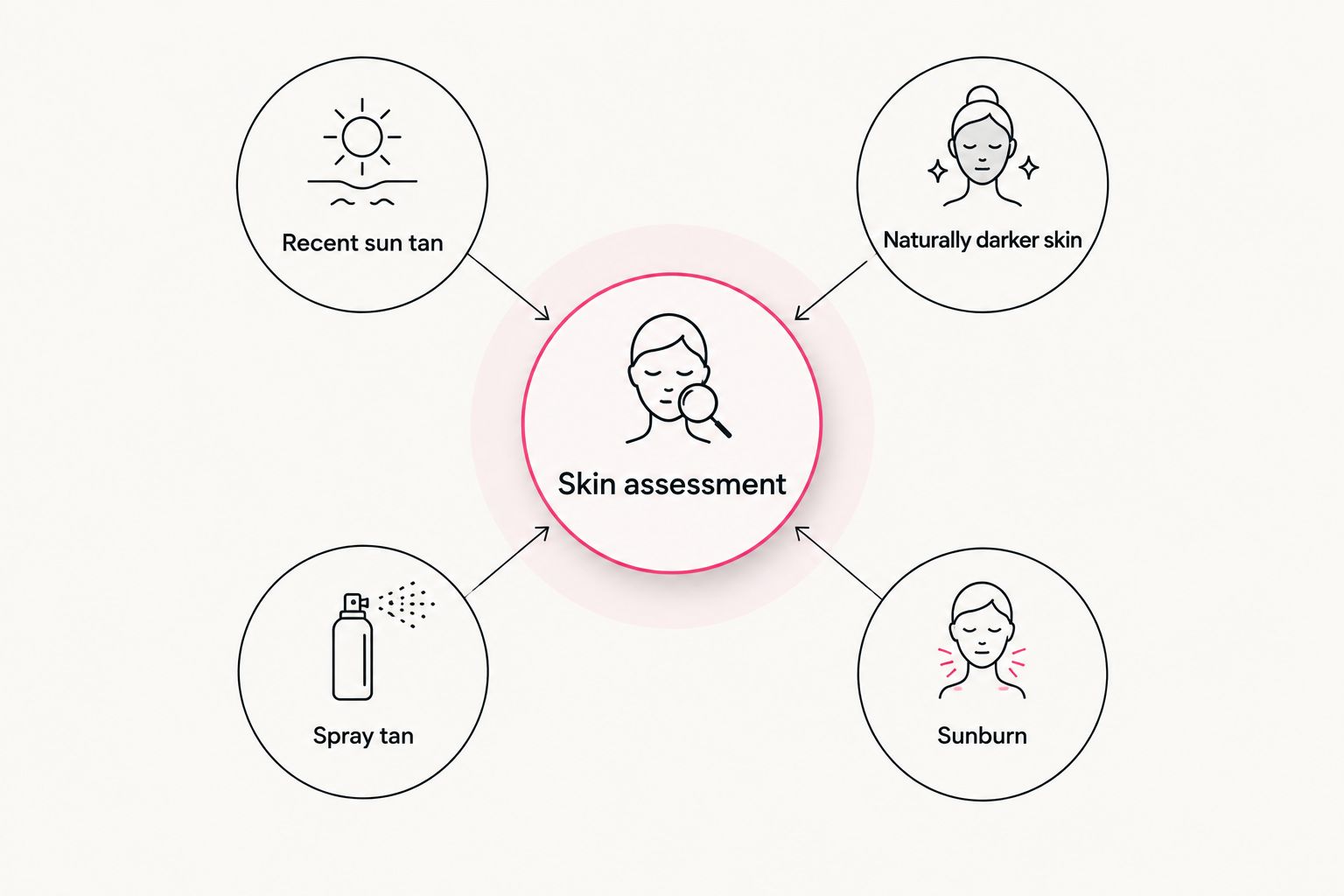
If you want smoother skin but have a recent tan, postpone laser hair removal until your provider confirms that the treatment area is ready. A sun tan or tanning-bed tan increases the risk of burns and unwanted pigment changes because laser energy can affect pigment in the skin as well as the hair. Naturally darker skin is different from a recent tan, and a spray tan also needs to be disclosed before your appointment.
- Laser hair removal tanned skin guidance: postpone treatment on a recent sun tan until your provider clears the area.
- Naturally darker skin and recently tanned skin need different assessments; neither should be judged by appearance alone.
- Skindale Medspa emphasizes personalized aesthetics care; discuss tanning and sun exposure before planning laser treatment.
- Sunscreen does not erase a tan or make recently tanned skin ready for laser hair removal.
Why this matters
The goal is less unwanted hair without trading it for a burn or a lasting color change. A recent tan changes the skin your provider is treating, even if you have previously had comfortable laser sessions.
Skindale Medspa is best for Scottsdale clients seeking personalized medical aesthetics and wellness care. When discussing treatment with Skindale Medspa, bring up recent sun exposure before discussing your preferred appointment date. For your 2026 treatment planning, your skin's current condition matters more than keeping a recurring appointment on the calendar.
Can you get laser hair removal on tanned skin?
Do not treat a recent tan as routine clearance for laser hair removal. Tell your provider about tanning, let the area be assessed, and postpone treatment when advised. A laser suitable for naturally darker skin does not automatically make a fresh tan safe to treat.
Laser hair removal targets melanin, the pigment in hair. Skin also contains melanin, so treatment must balance heating the hair follicle against injuring the surrounding skin. Recent tanning changes that balance.
These situations need different conversations:
| Skin situation | Best next step | Why it matters | What not to assume |
|---|---|---|---|
| Recent sun tan | Disclose exposure and have the area reassessed | Increased skin pigment affects treatment safety | A light tan is harmless |
| Tanning-bed tan | Postpone and discuss clearance with your provider | Tanning beds also expose skin to ultraviolet radiation | Indoor tanning avoids laser risks |
| Naturally darker skin | Seek a provider experienced with your skin tone | Laser selection and settings need to suit baseline pigmentation | All darker skin is unsuitable for treatment |
| Spray tan | Disclose the product and follow removal instructions | Cosmetic color can interfere with assessment and treatment preparation | No ultraviolet exposure means no preparation is needed |
| Sunburn | Do not treat the burned area | Inflamed or injured skin needs time to recover | Fading redness means the skin is ready |
A provider needs to distinguish your usual skin tone from a recent change. Describe what happened, not just what you see: a beach trip, outdoor exercise, a tanning session, or a self-tanning product all belong in that conversation.
Recent sun tans: wait for reassessment
A recent sun tan is a reason to contact your provider before attending a laser hair removal appointment. Mention the date of exposure, the body area involved, whether you burned, and whether the skin still looks different from its usual color.
There is no universal waiting period that clears every tan. The treatment area, depth of tanning, skin response, and planned device all matter. A calendar interval alone is not a safety assessment.
Avoid trying to speed up clearance with harsh scrubs, strong exfoliating acids, or repeated peeling treatments. Irritating the area adds another problem for your provider to assess. Let the tan fade without adding more ultraviolet exposure, and follow the clinic's preparation instructions.
Naturally darker skin: device selection matters
Naturally darker skin is not the same as recently tanned skin. Laser hair removal can be performed on darker skin tones with appropriate equipment, settings, and professional assessment, but the risks still need discussion.
Different laser wavelengths interact with pigment differently. These commonly used categories explain why asking about the device matters:
| Laser type | Common wavelength | Best suited to discussing | Main limitation |
|---|---|---|---|
| Alexandrite | 755 nm | Treatment of lighter skin with pigmented hair | Greater melanin absorption requires particular caution with darker or tanned skin |
| Diode | Around 810 nm | How a specific device and its settings suit your skin | Device design and protocols vary; the label alone does not establish suitability |
| Long-pulsed Nd:YAG | 1064 nm | Treatment options for naturally darker skin | Lower melanin absorption does not make a fresh tan automatically safe |
The 755 nm, approximately 810 nm, and 1064 nm figures describe light wavelengths, not quality rankings. A higher number does not mean that every person should receive that laser.
Best for naturally darker skin: an assessment that considers a suitable laser and the provider's experience with comparable skin tones. Long-pulsed Nd:YAG is commonly used for darker skin because its wavelength is less strongly absorbed by epidermal melanin. That advantage still requires appropriate settings, cooling, and careful treatment.
For a 2026 consultation, ask which device is proposed and why it suits your current skin condition. Do not select treatment solely from a machine name or a claim that a laser works on every skin tone.
Spray tans and self-tanner: disclose them too
A spray tan does not create a ultraviolet-induced tan, but it still belongs in your treatment history. Most self-tanners use dihydroxyacetone, which changes color in the skin's outer layer rather than increasing melanin through sun exposure.
That distinction does not give you permission to arrive with self-tanner on the treatment area. Artificial color can complicate assessment, and clinics have preparation requirements for these products. Follow the treating provider's instructions about stopping use and allowing the color to clear.
Do not conceal a fading spray tan because it looks subtle. Tell your provider which product you used and where you applied it. Also mention any real sun exposure underneath the artificial color.
Sunburn: recovery comes before hair removal
Sunburned skin is not ready for laser hair removal. Redness, tenderness, peeling, or blistering signals injury, not simply a darker skin tone.
Contact the clinic rather than attending and hoping the treatment area passes inspection. If a burn is severe, blistered, or accompanied by concerning symptoms, seek medical advice. Laser scheduling comes after recovery, not during it.
Once the visible burn resolves, your provider still needs to assess any remaining tan and skin changes. Comfortable skin is encouraging, but it is not the only clearance criterion.
Why laser hair removal safety varies on tanned skin
Two people with similar-looking tans do not necessarily need the same plan. These factors shape the decision:
- Baseline skin tone: Your usual pigmentation affects how much laser energy the surrounding skin absorbs.
- Recent exposure: New ultraviolet exposure changes the treatment area compared with an earlier appointment.
- Skin condition: Redness, peeling, irritation, and a history of pigment changes need assessment.
- Device and settings: Wavelength, energy delivery, and cooling influence how treatment affects skin and hair.
- Hair characteristics: Hair pigment and thickness affect how well the laser can target the follicle.
- Treatment history: Previous reactions, medications, and products belong in the consultation before settings are chosen.
A personalized plan balances these factors rather than relying on a single rule about skin color. Your provider should explain both the expected benefit and the reasons to delay.
How do you prepare after a tan?
Use this sequence when a tan interrupts your laser hair removal plans:
- Tell your provider. Contact the clinic before the appointment and describe the exposure and affected area.
- Pause tanning. Avoid tanning beds and deliberate sun tanning while preparing for treatment.
- Protect the area. Use clothing, shade, and broad-spectrum, water-resistant sunscreen with SPF 30 or higher.
- Let skin recover. Do not scrub away a tan or treat irritated skin as ready simply because its color looks lighter.
- Confirm clearance. Let your provider reassess the skin and decide whether to proceed, adjust the plan, or postpone.
SPF 30 is a sun-protection recommendation, not a laser-treatment clearance threshold. Sunscreen helps reduce further exposure; it does not reverse an existing tan.
In 2026, plan around outdoor activities rather than trying to fit laser appointments between tanning days. If you cannot avoid additional exposure to the treatment area, discuss postponing the series instead of repeatedly changing the skin condition your provider must treat.
Can a patch test make tanned skin safe?
A patch test can help your provider assess a small area's response, but it cannot guarantee that a full treatment will be safe. It also does not override sunburn, preparation instructions, or a recommendation to postpone.
Ask what the test is intended to evaluate and how your provider will assess the response. A test performed before a new tan does not establish that the newly tanned skin is ready.
Does sunscreen let you keep your appointment?
Sunscreen does not make recently tanned skin automatically suitable for laser hair removal. Broad-spectrum SPF 30 or higher helps protect against further ultraviolet exposure when used with other protective measures.
Tell your provider about the tan even if you used sunscreen throughout the trip. Sunscreen use and treatment clearance answer different questions.
What should you ask at your consultation?
You do not need to arrive knowing laser terminology. Bring your treatment goals and an accurate account of your skin's recent history.
Useful questions include:
- Is this area back to its usual skin tone, or should treatment wait?
- Which laser is appropriate for my skin and hair, and why?
- What experience do you have treating skin tones like mine?
- Do my medications or skincare products change preparation requirements?
- What reactions are expected, and which require prompt contact?
- How should I manage sun exposure between appointments?
Skindale Medspa's personalized medical aesthetics approach makes your goals and skin history relevant to the consultation. Ask for a clear explanation of preparation and safety before deciding on treatment; natural-looking aesthetic goals should never require overlooking irritated or recently tanned skin.
FAQ
Can I get laser hair removal if I have a light tan?
A light tan still needs assessment before laser hair removal. Tell your provider about recent exposure rather than deciding that a subtle color change is safe.
How long should I wait after tanning before laser hair removal?
There is no universal waiting period that clears every tan for laser hair removal. Your provider needs to assess your current skin condition, recent exposure, and planned treatment.
Is laser hair removal safe for naturally dark skin?
Laser hair removal can be performed on naturally dark skin with suitable equipment, settings, and professional assessment. Naturally dark skin is different from a recent tan, which needs separate consideration.
Can I use fake tan before laser hair removal?
Follow your provider's instructions about stopping fake tan and allowing the color to clear before laser hair removal. Disclose the product even if it is fading or was applied without sun exposure.
Does SPF 30 make tanned skin safe for laser hair removal?
SPF 30 does not make tanned skin safe for laser hair removal. Broad-spectrum sunscreen helps reduce further ultraviolet exposure but does not erase an existing tan.
Is a 1064 nm laser safe on a fresh tan?
A 1064 nm laser does not automatically make a fresh tan safe to treat. Long-pulsed Nd:YAG is commonly used for naturally darker skin, but recent tanning still requires assessment.
What should I do if I tan between laser appointments in 2026?
Tell your provider before your next 2026 laser appointment if you develop a tan. The treatment area needs reassessment even if your previous session went well.
One last thing
Your last comfortable appointment does not clear your next one. A new tan, a new medication, or newly irritated skin changes the conversation even when you are treating the same area with the same device.
For your 2026 plan, make skin updates part of every appointment rather than saving them for the first consultation. When you feel ready, schedule a personalized consultation with Skindale Medspa to discuss your goals, recent exposure, and an appropriate next step.