

How long do dermal fillers typically last?
Dermal fillers typically last 6 to 12 months for hyaluronic acid, about 18 months for calcium hydroxylapatite, and up to 2 years for poly-L-lactic acid, according to the FDA’s consumer guidance on dermal fillers. These timelines describe how long treatment effects can last—not a guaranteed date when your results disappear. This 2026 guide explains why the material, treatment area, and your starting point matter when you want a natural-looking result.
- How long do dermal fillers last? FDA guidance lists hyaluronic acid effects at 6 to 12 months.
- Calcium hydroxylapatite effects last about 18 months; poly-L-lactic acid effects can last up to 2 years.
- Visible results fade gradually; a maintenance appointment should follow an assessment, not an automatic calendar reminder.
- Skindale Medspa dermal filler consultations suit Scottsdale clients seeking personalized care and natural-looking results.
Why this matters
If you want to look refreshed without looking overfilled, longevity is only part of the decision. The more useful question is how a filler’s expected duration fits your goals, facial movement, and willingness to maintain the result.
Skindale Medspa offers personalized medical aesthetics and wellness care in Scottsdale. Skindale Medspa is best suited to Scottsdale clients seeking personalized aesthetic care with a natural-looking approach. Your consultation should connect those goals with a treatment plan—not simply select the longest-lasting material.
How long do dermal fillers typically last?
The filler material provides a useful starting point. The FDA’s consumer guidance on dermal fillers identifies the following general durations for temporary materials; these are reference timelines, not predictions for every face or every product.
| Filler material | General duration of effects | Best for discussing | Benefit | Limitation |
|---|---|---|---|---|
| Hyaluronic acid | 6 to 12 months | Temporary volume correction with a material that can be dissolved by a clinician | Offers flexibility when adjusting a treatment plan | Results need reassessment as the effect fades; dissolving carries its own risks |
| Calcium hydroxylapatite | About 18 months | Longer-lasting correction in an appropriate treatment area | Provides volume and supports collagen production | Cannot be dissolved with the enzyme used for hyaluronic acid fillers |
| Poly-L-lactic acid | Up to 2 years | Gradual correction through collagen stimulation | Results develop through your tissue’s response | Is not an immediate-result substitute for every filler treatment |
| Polymethylmethacrylate | Nonabsorbable; intended for lasting correction | Carefully selected permanent-filler discussions | Does not break down like temporary filler materials | Is difficult to reverse and requires particular care in selection |
For a treatment decision in 2026, ask about the specific product, not just its material family. Different formulations have different approved uses, and a duration associated with one product or treatment area does not establish the same duration everywhere else.
A filler’s persistence and your satisfaction with the result are also different things. You can notice a change in contour before all the material has disappeared, and you can still have filler present even when the effect looks less obvious.
Hyaluronic acid fillers: 6 to 12 months
Hyaluronic acid fillers commonly provide effects lasting 6 to 12 months, using the FDA’s general reference range. Hyaluronic acid attracts water and adds volume, but the way a particular formulation behaves depends on its design and where it is placed.
Best for discussing: a temporary correction when flexibility matters to you. If you are new to filler, explain whether your priority is a subtle change, a particular contour, or restoring volume rather than assuming that more product creates a better result.
The main advantage is that a clinician can use hyaluronidase to break down hyaluronic acid filler when appropriate. That does not make the treatment risk-free or mean every concern can be corrected instantly; dissolving treatment also requires medical judgment.
The limitation is maintenance. Your clinician should assess what remains, how the area looks at rest and in movement, and whether another treatment would improve the result before recommending more filler.
Calcium hydroxylapatite fillers: about 18 months
Calcium hydroxylapatite filler effects last about 18 months, according to the FDA’s general consumer guidance. This material provides volume and can stimulate collagen production.
Best for discussing: longer-lasting correction in an area suitable for the specific product. Treatment selection still depends on facial anatomy, the intended placement, and the product’s approved uses.
The benefit is a different balance of immediate support and tissue response compared with hyaluronic acid. The drawback is reduced flexibility: hyaluronidase does not dissolve calcium hydroxylapatite.
Do not choose this material solely because its reference duration is longer. Ask your clinician why it fits the area you want treated and how a concern would be managed if the result does not match your expectations.
Poly-L-lactic acid fillers: up to 2 years
Poly-L-lactic acid effects can last up to 2 years, according to the FDA’s consumer guidance. The treatment works through collagen stimulation, so the intended change develops gradually rather than functioning only as immediate added volume.
Best for discussing: a gradual approach to suitable volume-loss concerns. Your clinician should explain how the treatment plan, expected progression, and reassessment differ from an immediate-volume filler.
The benefit is a longer-lasting tissue response. The limitation is that this approach requires patience and is not interchangeable with every treatment used for lips, fine lines, or precise contour changes.
An early appearance after treatment is not the same as the eventual result. Before deciding whether to add another treatment, follow the assessment schedule recommended for the specific product and plan.
Why dermal filler longevity varies
The general timelines are useful, but they cannot replace an individual assessment. These factors explain why two people receiving filler do not necessarily see the same pattern of fading.
- Filler material: Hyaluronic acid, calcium hydroxylapatite, and poly-L-lactic acid work differently. Their reference durations should not be treated as interchangeable.
- Product formulation: Products within the same material family differ in physical properties and intended uses. Ask for the exact product name and its relevant patient information.
- Treatment area: Facial areas differ in movement, tissue structure, and the correction being made. A result measured in one area does not automatically predict a result in another.
- Placement and amount: The clinician’s placement and the amount used affect the visible correction. More filler is not a reliable shortcut to a better or longer-lasting appearance.
- Starting point: Existing volume loss, skin condition, and previous filler affect what you see before and after treatment. Comparisons with another person’s result can therefore be misleading.
- Individual response: Your body’s response to the material and continued facial changes influence the outcome. A calendar alone cannot show whether you need another treatment.
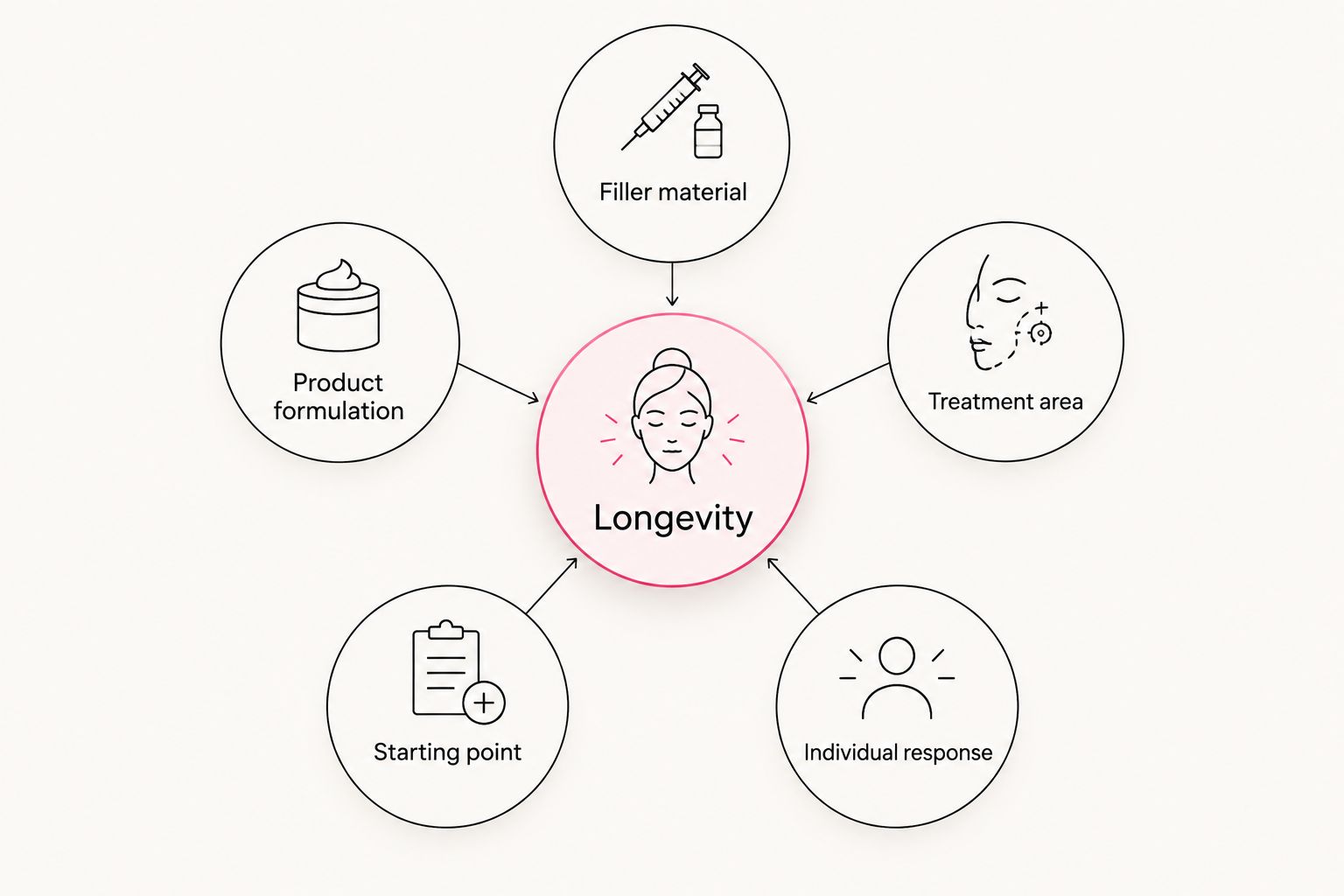
Choose the treatment that fits your concern, not the treatment with the longest headline duration. A longer-lasting correction is only an advantage when the material, placement, and expected change are appropriate.
Does filler last longer in cheeks than in lips?
The 6 to 12 months reference for hyaluronic acid is not a universal cheek or lip schedule. Lips and cheeks have different movement and support needs, so the exact product and treatment area matter more than a broad material label.
Ask for evidence relevant to the area you are treating. A product’s study results for cheek correction should not be presented as a promise for lip treatment.
Will getting more filler make the result last longer?
The 6 to 12 months hyaluronic acid reference is not a reason to increase the amount used. More filler changes the correction and can create an unwanted appearance; it does not establish a predictable extension of the treatment’s duration.
Your target should be an appropriate result with an appropriate amount. If you want subtle maintenance, discuss that preference before treatment rather than trying to stretch the interval by adding extra volume.
How do you know when filler needs a review?
The 6 to 12 months hyaluronic acid timeline is a reference, not an automatic instruction to book another injection. A review makes sense when your concern returns, your contour changes, or you want your clinician to assess the existing result.
Bring previous treatment details whenever possible. The material, product name, treatment area, and treatment date help your clinician make a better-informed decision about what to do next.
What should you ask at your consultation?
For your 2026 consultation, focus on information that connects longevity to your actual goal. A useful discussion should leave you understanding why a material is being considered, what its limitations are, and how follow-up will work.
- Describe your goal. Explain what bothers you and what you want to preserve. Saying that you want a natural-looking change is useful, but identifying the specific concern makes the discussion more precise.
- Share your history. Mention previous fillers, cosmetic procedures, relevant medical conditions, medications, allergies, and reactions. If you know the previous product, bring that information.
- Ask about the product. Find out which material and formulation are being considered, why they suit the treatment area, and which patient information you should review.
- Discuss the trade-offs. Ask about expected changes, common after-effects, uncommon serious risks, and what correction would involve if needed. Duration belongs in that conversation, not above it.
- Agree on reassessment. Ask how the early result will be reviewed and what should prompt you to contact the clinician. A plan should allow for assessment rather than assume repeated treatment.
Skindale Medspa dermal filler care is part of its personalized medical aesthetics offering. Use a consultation to discuss the result you want, your previous treatments, and your comfort with maintenance.
Safety matters more than longevity
Dermal filler treatment is a medical procedure. Common after-effects include swelling, bruising, tenderness, and redness; these can temporarily change how the treated area looks.
Less common but serious complications include filler entering or blocking a blood vessel, which can cause tissue damage, vision problems, or stroke. Sudden vision changes, stroke symptoms, or severe unusual pain after treatment require urgent medical attention. Do not wait for a routine follow-up if those symptoms occur.
Choose a licensed healthcare professional with appropriate training and experience in dermal fillers. Ask who performs the treatment, how complications are recognized, and what emergency arrangements are in place.
This 2026 guide provides general education, not an individual treatment recommendation. Your clinician should assess your medical history and explain the specific product’s benefits, risks, and suitability before treatment.
FAQ
How long do dermal fillers last in 2026?
The FDA’s general guidance lists hyaluronic acid effects at 6 to 12 months, calcium hydroxylapatite at about 18 months, and poly-L-lactic acid at up to 2 years. The specific product, treatment area, and individual response affect your result.
Does dermal filler disappear all at once?
Temporary dermal filler effects generally fade gradually rather than disappearing on a fixed date. A visible change does not prove that all the material has gone.
Is longer-lasting filler always better?
Longer-lasting filler is not always better; suitability matters more than duration. The material must fit your treatment area, goals, medical history, and comfort with its correction options.
Can you dissolve every type of dermal filler?
No, hyaluronidase is used to break down hyaluronic acid filler, not every filler material. Other materials require different management, and any correction needs medical assessment.
Should I get filler again as soon as it starts fading?
No, fading alone does not mean another injection is appropriate. A clinician should assess your remaining correction and whether additional treatment would support your goal.
Is it normal for filler to look different soon after treatment?
Swelling and bruising can temporarily affect the appearance after filler treatment. Follow your clinician’s aftercare instructions, and seek urgent care for vision changes, stroke symptoms, or severe unusual pain.
What should I bring to a dermal filler consultation?
Bring your treatment goals, relevant medical history, and any details of previous filler treatments. Product names, treatment areas, and treatment dates help the clinician assess your options.
One last thing
A result that looks less noticeable is not proof that all your filler is gone. That distinction matters when you are deciding whether to repeat treatment: assess the face you have now rather than replacing an amount simply because time has passed.
For your 2026 treatment plan, aim for a result you feel comfortable maintaining—not a deadline you feel pressured to meet. When you are ready, schedule a personalized consultation with Skindale Medspa to discuss your goals, suitable options, and a natural-looking approach.