

How long does it take for Botox to start working?
If you’re waiting for smoother expression lines, Botox usually begins showing visible changes in 3–4 days, with the fuller result developing over 10–14 days. It does not work immediately, and early changes do not show the final balance of your treatment. Assess the result with your injector after it has had time to develop, rather than deciding you need more treatment during the first few days.
- How long does Botox take to work? Visible changes usually begin in 3–4 days; fuller results develop over 10–14 days.
- Botox softens muscle-driven expression lines gradually; unchanged lines immediately after treatment do not establish treatment failure.
- Skindale Medspa is for Scottsdale clients seeking personalized wrinkle-relaxer care and natural-looking results.
- Contact your injector about unexpected symptoms; breathing or swallowing difficulty requires immediate medical attention.
Why this matters
Waiting for Botox to work can feel confusing when you still see movement or notice one area changing before another. The first visible change and the finished result are different checkpoints. Checking too early does not tell you whether your treatment achieved its intended result.
For your 2026 appointment, separate your goals into two questions: when should changes begin, and when should you assess the outcome? Skindale Medspa offers personalized medical aesthetics care in Scottsdale, with an emphasis on natural-looking results. That makes a conversation about your desired movement and expression as important as a conversation about timing.
How long does it take for Botox to start working?
Botox generally starts producing noticeable cosmetic changes in 3–4 days, and the fuller effect develops over 10–14 days. These are useful checkpoints, not a promise that every treated area will change on the same day.
The timing in this 2026 guide follows Cleveland Clinic’s Botox patient guidance, which describes the usual onset, full-result window, and duration of effect. That guidance applies to general expectations; your treating clinician should interpret your individual response.
| Treatment stage | Typical timing | What it means for you | What it cannot tell you |
|---|---|---|---|
| Immediately afterward | Treatment day | You have received the injections, but the cosmetic effect is not immediate. | How much your expression lines will soften. |
| First visible changes | 3–4 days | Muscle-driven lines can begin looking softer as the effect develops. | Whether you need an adjustment. |
| Fuller result | 10–14 days | This is a more useful window for assessing movement and balance. | Whether every crease will disappear. |
The benefit of early changes is reassurance that the effect is developing. The limitation is that an early result remains incomplete. Use the fuller-result window to assess the treatment, not the first morning you notice a difference.
First visible changes: 3–4 days
During the first 3–4 days, you can begin noticing less movement in the treated muscles and softer lines when you make expressions. The change is usually gradual rather than a sudden switch from movement to no movement.
Try looking at the same expression under the same lighting. A raised eyebrow in a brightly lit bathroom and a relaxed face in a dim room are not useful comparisons. Consistent conditions make a subtle change easier to recognize without encouraging constant checking.
This stage is best for noticing the direction of change, not judging the finished result. Some movement can remain even when treatment is working, especially when your goal is a refreshed appearance rather than an expressionless face.
Do not interpret an unchanged crease as proof that the injections failed. A line can reflect both muscle movement and an established fold in the skin, and those are not the same treatment target.
Fuller results: 10–14 days
At 10–14 days, the result is more developed and easier to assess. Look at the treated area both at rest and during the expression that originally created the line.
Ask whether movement has softened, whether the appearance matches your goal, and whether anything feels unexpectedly different. Those observations give your injector a clearer starting point than a general statement that the treatment did or did not work.
The benefit of waiting for this window is a more meaningful assessment. The limitation is that a developed result is not necessarily a completely smooth surface: Botox reduces muscle activity, but it does not directly fill a crease.
Any additional treatment should follow a clinical assessment. More Botox is not automatically the answer to a remaining line, and adding treatment before the first result develops can make the intended balance harder to judge.
Immediately afterward: no final result yet
Botox needs time to affect communication between nerves and the treated muscles. That is why the appearance immediately after your appointment does not represent your final result.
Small injection-site bumps, redness, or bruising are different from the wrinkle-softening effect. Their presence does not measure how well Botox will work, and their disappearance does not mean the full cosmetic effect has arrived.
Follow the aftercare instructions your clinician gives you. Do not press or massage an area to try to make the treatment work faster, and do not replace your clinician’s directions with advice from an unrelated treatment video.
This stage is best for following aftercare and noticing how you feel. It is not the stage for deciding whether your dose was right or comparing your outcome with someone else’s finished result.
Why Botox timing and visible results vary
The usual timing window is useful, but the visible result depends on what was treated and what you are looking for. These factors help explain differences without turning every slow-looking change into a problem:
- Treatment area: Different muscles create different expressions. Changes in forehead movement are not the same visual event as changes around the eyes.
- Muscle activity: The strength and pattern of your muscle movement affect how a change appears during expression.
- Treatment plan: Dose and injection placement influence the effect. Your clinician selects them for your anatomy and treatment goals.
- Line type: A movement-related line and a crease visible at rest do not respond in exactly the same way.
- Individual response: People do not develop or experience treatment effects on an identical schedule.
These factors are reasons to assess your own treatment rather than use a friend’s experience as a deadline. They are not reasons to ignore an unexpected symptom or avoid contacting your injector when you have a concern.
How should you check whether Botox is working?
A useful check is simple and repeatable. You do not need to study your face throughout the day or repeatedly test the treated muscles.
- Use consistent lighting. Look in the same place with a similar light source. Shadows can make a line look deeper or shallower without any treatment change.
- Check at rest. Notice which lines remain when your face is relaxed. This helps separate resting creases from expression-related lines.
- Use normal expressions. Raise your eyebrows, frown, or smile as appropriate to the treated area. Compare ordinary movement rather than an unusually forceful expression.
- Note your concerns. Describe the specific area, movement, or symptom you want your injector to review. Clear observations make the conversation more useful.
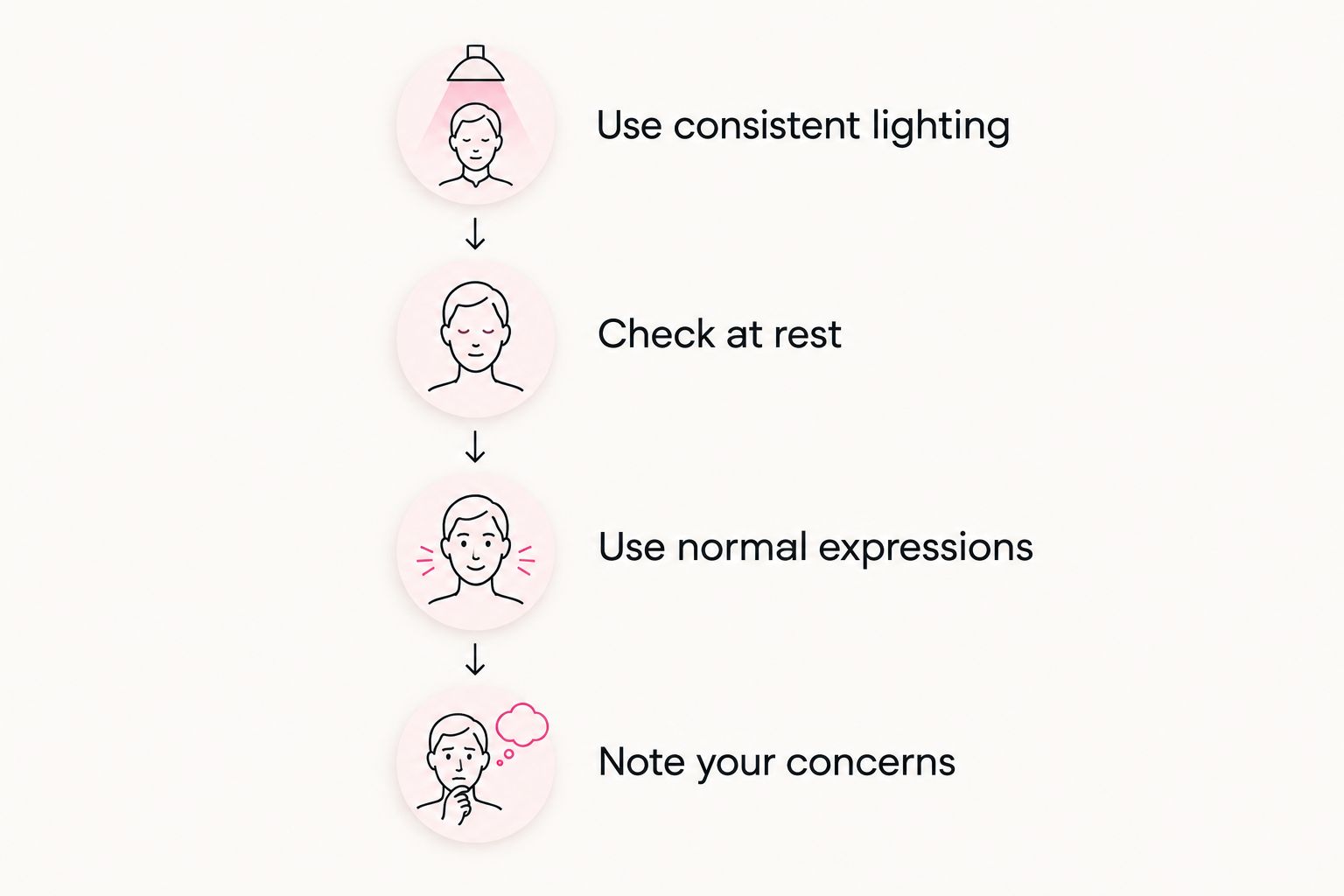
Photographs can help if you take them under comparable conditions. Keep your angle and expression similar, and avoid filters that change skin texture. A photograph documents appearance; it does not replace a clinical assessment of movement or symptoms.
If you are planning treatment in 2026, ask your injector when they want you to review the outcome and how to contact them with questions. A clear follow-up plan removes the need to guess whether an early observation needs attention.
Does Botox have to stop all movement to work?
No. Botox does not have to eliminate every expression to produce a useful cosmetic result. The appropriate amount of movement depends on your anatomy, the treated area, and the goal you discussed with your clinician.
A natural-looking result can include movement. Complete immobility is not a universal measure of success, and a face that still expresses emotion is not evidence that treatment failed.
The benefit of a personalized plan is that it addresses the appearance you want rather than treating maximum muscle relaxation as the goal. The limitation is that a softer, more expressive result can leave some visible lines during movement.
Before treatment, describe what “natural” means to you. You might want a line softened without losing familiar expression. That preference is more useful to your injector than simply asking for the strongest possible effect.
Why is a line still visible after Botox starts working?
A line can remain visible because reducing muscle movement does not directly erase an established skin crease. This distinction matters most when the line is already visible while your face is relaxed.
Botox acts on the muscle activity contributing to expression lines. It does not add volume to the skin or remove every cause of surface texture. A remaining line therefore needs an assessment of its cause, not an automatic assumption that more injections are needed.
At your review, explain whether the concern appears at rest, during movement, or both. Your clinician can then discuss whether the treatment met its intended goal and whether another approach belongs in your personalized plan.
Judge Botox against the problem it was intended to treat. Expecting a muscle-relaxing treatment to correct every skin concern makes an otherwise appropriate result difficult to recognize.
What if Botox has not worked after 14 days?
After 14 days, contact your injector if you see no expected change or remain concerned about the result. The fuller-effect window is a reasonable point for a review, not a reason to choose an additional dose yourself.
Bring clear observations: which area still moves, whether a line remains at rest, and whether the result differs from the goal you discussed. Your clinician should assess those details before recommending a next step.
Avoid arranging extra injections elsewhere before that review. The next clinician needs an accurate account of what was injected, where it was placed, and when treatment occurred.
How long does Botox last once it works?
Botox commonly lasts 3–4 months, according to Cleveland Clinic’s general patient guidance. The effect wears off gradually, and individual duration varies.
Onset and duration answer different questions. The first tells you when a new treatment begins showing changes; the second tells you how long those changes typically remain.
For ongoing treatment planning in 2026, discuss returning movement and your goals with your injector. A repeat-treatment plan should reflect your response rather than someone else’s appointment schedule.
When should you contact your injector sooner?
You do not need to wait for the full-result window to report a concern. Contact your treating clinician promptly about unexpected eyelid or brow drooping, eye symptoms, or another change that worries you.
Difficulty breathing, swallowing, or speaking requires immediate medical attention. These are recognized warning symptoms in the BOTOX Cosmetic prescribing information and should not be treated as routine cosmetic follow-up questions.
For less urgent concerns, explain when the symptom started and what you are experiencing. Your clinician can decide whether you need an examination or other care. Do not use a normal onset timeline to dismiss a symptom.
FAQ
How long does Botox take to work the first time?
Botox usually begins showing visible changes in 3–4 days, with fuller results developing over 10–14 days. Your injector should explain the expected response for your treatment areas and goals.
Is it normal not to see Botox results the next day?
Yes, not seeing a cosmetic change the next day is consistent with Botox’s gradual onset. Visible changes usually begin in 3–4 days rather than immediately after treatment.
Can Botox take two weeks to fully work?
Yes, the fuller Botox result typically develops over 10–14 days. That window is more useful for assessing movement and balance than the first few days.
Does Botox work if I can still move my forehead?
Yes, some forehead movement can remain while Botox is working. Whether that movement matches your intended result depends on the personalized plan you discussed with your injector.
Should I get more Botox if a wrinkle is still there?
A remaining wrinkle does not automatically mean you need more Botox. Have your injector assess the developed result and whether the line reflects movement, an established crease, or both.
Can I make Botox start working faster?
There is no reliable at-home shortcut that guarantees a faster Botox result. Follow your clinician’s aftercare instructions instead of manipulating the treated area or trying unverified techniques.
How long does Botox last after it starts working?
Botox commonly lasts 3–4 months, although individual duration varies. Discuss returning movement with your injector when planning repeat treatment.
Can Skindale Medspa help me plan natural-looking Botox results?
Skindale Medspa offers personalized medical aesthetics care in Scottsdale centered on natural-looking injectable results. A consultation is the place to discuss your expression, concerns, and treatment goals.
One last thing
The most useful detail to bring to a consultation is not how quickly a friend’s Botox worked. It is what you want to preserve about your expression while softening the lines that bother you.
For a 2026 event, discuss the date before treatment rather than scheduling around the first possible sign of change. The fuller-result window matters more than the earliest onset, and your clinician should help you plan around your individual care needs.
If you would like help setting those expectations, schedule a personalized consultation with Skindale Medspa. You can discuss timing, safety, and a natural-looking result without treating complete stillness as the goal.