

How long does it take to recover from laser skin resurfacing?
If you are planning time away from work, ablative laser skin resurfacing generally requires 7–10 days for new skin to cover the treated area, while full recovery takes at least a month, according to Mayo Clinic. Nonablative resurfacing has a shorter recovery because it does not remove the skin’s surface. These timelines do not mean all redness has disappeared or your final results are visible; both can take longer.
- Laser skin resurfacing recovery time depends on whether treatment is ablative or nonablative, not simply the word laser.
- Mayo Clinic describes 7–10 days for new skin after ablative resurfacing; full recovery takes at least a month.
- Nonablative resurfacing generally means less downtime, but it still requires aftercare and sun protection.
- Skindale Medspa offers personalized laser treatment planning for Scottsdale clients seeking natural-looking results.
Why this matters
Recovery is more than deciding when you can leave the house. You need to know when your skin has closed, when you can restart products, and when you will feel comfortable attending work or an event. Those milestones do not always happen together.
For treatment planning in 2026, ask for recovery instructions tied to the actual laser and settings. A general description such as laser facial does not tell you how much healing your skin will need.
Skindale Medspa is best suited to Scottsdale clients seeking personalized laser treatment planning. A consultation at Skindale Medspa gives you a place to discuss your skin concerns, desired outcome, and the time you can set aside for aftercare.
How long does it take to recover from laser skin resurfacing?
Laser skin resurfacing recovery time varies most clearly between ablative and nonablative treatment. Ablative lasers remove surface skin, creating a healing period. Nonablative lasers heat tissue without removing the outer layer, so recovery is generally less disruptive.
Mayo Clinic’s patient guidance describes new skin covering an ablatively treated area in 7–10 days, with full recovery taking at least a month. The American Society of Plastic Surgeons describes healing after resurfacing as approximately 5 days to 3 weeks, depending on the treatment. These are general patient-education timelines, not a prediction for your appointment.
| Treatment approach | General recovery pattern | Best for | Main limitation |
|---|---|---|---|
| Ablative resurfacing | New skin generally covers the area in 7–10 days; full recovery takes at least a month | People whose treatment goals justify a longer healing period | More intensive aftercare; redness can outlast surface healing |
| Nonablative resurfacing | Shorter recovery, with temporary redness or swelling possible | People prioritizing less interruption to daily life, when appropriate for their skin concerns | Results develop gradually; additional treatments can be needed |
The advantages are different, not interchangeable. Ablative resurfacing can address skin concerns more intensively, but you must accept more recovery. Nonablative treatment reduces disruption, but a lighter approach does not provide the same treatment effect in every situation.
Choose the treatment that fits your skin and your recovery capacity—not the shortest advertised downtime. Your clinician should explain both the expected benefit and the limits before you decide.
Ablative resurfacing: 7–10 days for new skin
Ablative resurfacing removes the outer skin layer and heats underlying tissue. During early healing, the treated skin can feel tender and look swollen, raw, or crusted. Your instructions can include gentle cleansing, a protective ointment, and specific wound care.
The 7–10-day milestone in Mayo Clinic’s guidance refers to new skin covering the area. It is not permission to restart every skincare product, spend time in the sun, or assume that makeup is safe. Those decisions depend on how your skin is healing and your clinician’s instructions.
Full recovery takes at least a month in the same guidance. Redness can persist beyond the period when the surface has closed, especially after more intensive resurfacing. That distinction matters if you are scheduling photographs, presentations, or a special occasion.
For your 2026 calendar, separate essential commitments from appearance-sensitive events. Returning to desk work and feeling photo-ready are different goals. Tell your clinician which one matters most so the discussion addresses your actual concern.
Ablative resurfacing is not automatically the better choice because it is more intensive. Its potential benefits must be weighed against wound care, pigment changes, infection, scarring, and the longer recovery period.
Nonablative resurfacing: shorter downtime, gradual results
Nonablative resurfacing leaves the outer layer intact while heating tissue beneath it. Temporary warmth, swelling, and redness can still occur. Shorter downtime means less surface healing, not an absence of skin sensitivity.
Mayo Clinic describes recovery after nonablative treatment as generally minimal, with usual activities often resumed right away. That does not establish a universal recovery deadline for every device, treatment area, or setting. Ask what you should expect from the treatment being proposed for you.
The main advantage is a smaller interruption to everyday life. The trade-off is that improvement is generally gradual and a course of treatments can be needed. If your concern requires a more intensive approach, the shortest-downtime option might not meet your goal.
Skindale Medspa lists a Laser Facial (Face and Neck) using Clear + Brilliant resurfacing. That provides a treatment name to discuss, but it does not establish your recovery schedule. Ask about the planned settings, expected skin reaction, aftercare, and whether the treatment fits your concern before choosing it.
Why laser skin resurfacing recovery time varies
The same broad treatment label can describe different experiences. The recovery estimate you receive should account for the following factors:
- Treatment depth: Removing surface skin creates different healing needs from heating tissue beneath an intact surface.
- Treatment intensity: Energy settings and the extent of treatment affect the skin response. More intensive treatment generally requires more recovery.
- Fractional coverage: Fractional treatment leaves untreated skin between treated areas, supporting healing; it does not make every fractional procedure a no-downtime treatment.
- Treatment area: The location and extent of treatment influence swelling, aftercare, and how practical it is to return to your routine.
- Your skin and medical history: Skin tone, healing history, medications, and a history of cold sores affect risk assessment and treatment planning.
- Aftercare and sun exposure: Picking, irritating products, and unprotected sun exposure can interfere with healing or increase the risk of pigment changes.
In 2026, a useful recovery estimate should come with written instructions. Ask what is expected, what should improve, and which changes require a call. A timeline alone does not tell you how to care for your skin safely.
What does recovery look like from treatment to normal routine?
Think of recovery as a sequence of milestones rather than a countdown. Your clinician’s instructions take priority over this general outline, particularly after ablative treatment.
- Early healing: Follow the prescribed cleansing and skin-protection routine. Expect the appearance and sensitivity of your skin to differ from your usual baseline.
- Surface healing: Let peeling or crusting resolve without picking. Your clinician should confirm when the surface is ready for makeup and changes to skincare.
- Routine restart: Reintroduce products, exercise, and other activities according to your instructions, rather than restarting everything together.
- Results develop: Continue sun protection and follow-up care while redness settles and changes in skin texture develop.
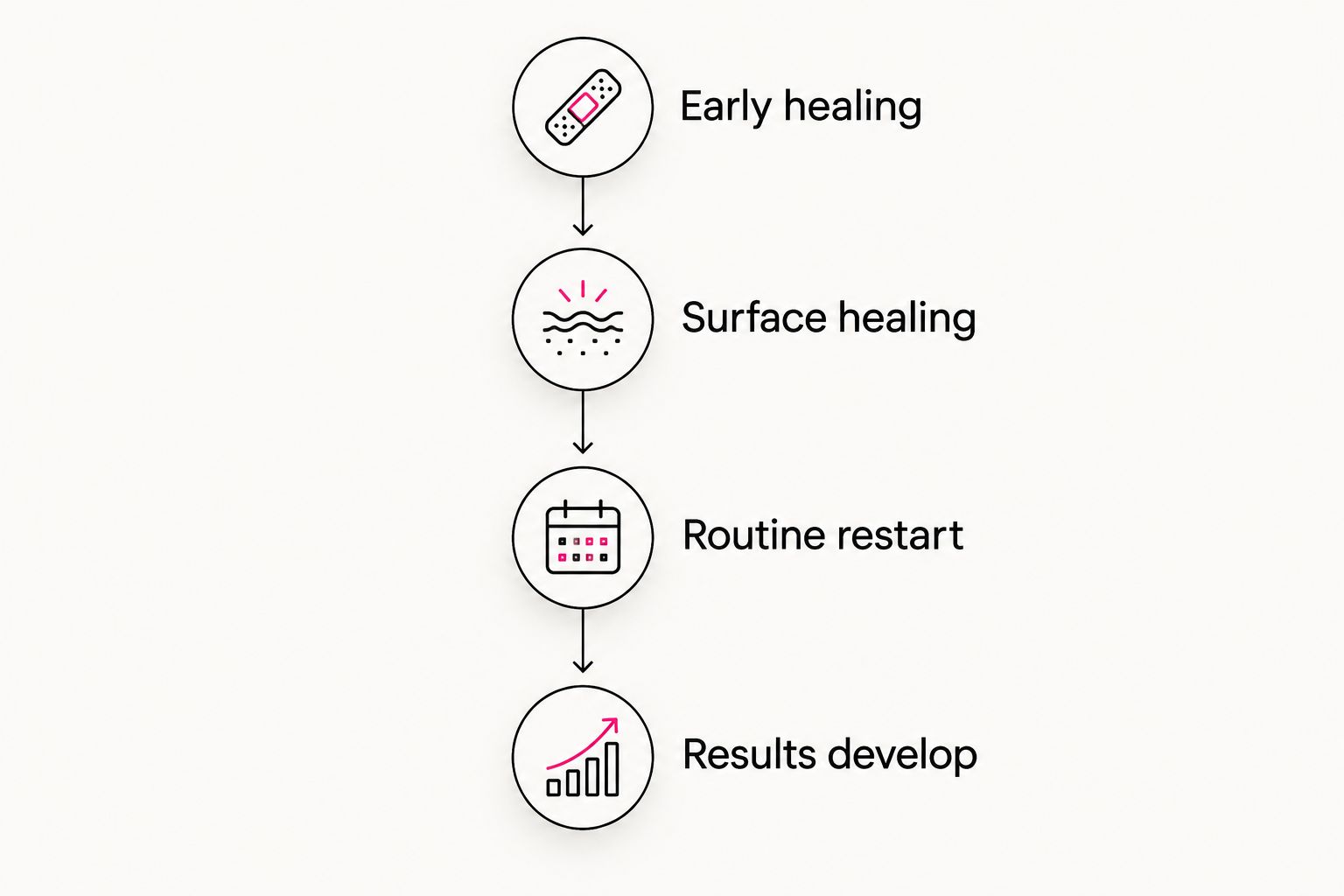
Each stage answers a different question. Surface healing tells you about the skin barrier; routine restart tells you what activities are appropriate. Neither proves that redness has fully settled or that the final treatment result is visible.
Before your 2026 appointment, make a practical plan for cleansing, prescribed products, sun avoidance, and follow-up. If your work involves outdoor exposure, heat, dust, or physical activity, mention that during your consultation. A recovery plan should fit the conditions you will actually return to.
When can I wear makeup after laser skin resurfacing?
7–10 days for new skin after ablative resurfacing is a healing reference, not an automatic makeup clearance. Wait until your clinician confirms that the skin has healed enough for cosmetics. Do not cover open, weeping, or crusted skin to make an event easier to attend.
After nonablative treatment, the restriction can be shorter, but the exact instructions still depend on your treatment. Ask which products are suitable and when you can apply them. A familiar foundation is not necessarily appropriate for freshly treated skin.
How much time should I take off work?
5 days to 3 weeks is the American Society of Plastic Surgeons’ general healing range for resurfacing, not a universal work-leave recommendation. Your work schedule depends on the treatment intensity, your comfort with visible redness, and your workplace environment.
Remote desk work and outdoor physical work create different demands. Tell your clinician whether you need to be on camera, wear protective equipment, exercise, or spend time outside. Use that conversation to plan leave rather than choosing a date from a general recovery chart.
How long should I wait before an important event?
At least a month for full recovery after ablative resurfacing, as described by Mayo Clinic, does not guarantee event-ready skin. Redness can remain after the surface heals. Allow your clinician to recommend a buffer based on the proposed procedure and your skin history.
For a wedding, trip, or major presentation in 2026, give the exact date during your consultation. Avoid scheduling an unfamiliar resurfacing treatment immediately before an event when you cannot accommodate visible changes. There is no universal date that guarantees your preferred appearance.
How can you support safe healing?
Keep aftercare simple and specific. Follow the instructions for your treatment rather than borrowing a routine from someone who had a different laser procedure.
- Use the prescribed cleansing routine. Do not scrub away peeling skin or crusts.
- Apply only approved products. Ask before restarting retinoids, exfoliating acids, scrubs, or other potentially irritating products.
- Protect healing skin from sunlight. Discuss shade, protective clothing, and when sunscreen is appropriate for the treated surface.
- Follow activity restrictions. Ask specifically about exercise, heat exposure, swimming, and anything that rubs the treatment area.
- Keep follow-up appointments. A review gives your clinician an opportunity to assess healing and adjust instructions.
Do not add products because the skin feels dry or looks uneven without checking first. A product that suits your usual routine can sting or irritate freshly treated skin. More steps are not necessarily better during recovery.
Which symptoms need a call to your clinician?
Some redness, swelling, and sensitivity are expected after resurfacing, but worsening symptoms deserve attention. Contact your treating clinician for increasing pain, spreading redness, pus, fever, new blisters, or an area that is not healing as expected.
A history of cold sores matters because resurfacing can reactivate the virus. Mention that history before treatment, even if outbreaks are infrequent. Your clinician can decide whether preventive medication is appropriate.
Do not wait for a recovery deadline to report a concerning change. If you feel acutely unwell or have severe symptoms, seek urgent medical care. This guide explains general recovery patterns and does not replace an examination or your treatment instructions.
FAQ
What is the usual laser skin resurfacing recovery time?
Laser skin resurfacing recovery time depends on treatment depth. Mayo Clinic describes 7–10 days for new skin after ablative resurfacing and at least a month for full recovery; nonablative treatment generally has less downtime.
Does fractional laser treatment mean no downtime?
No, fractional laser treatment does not automatically mean no downtime. Fractional describes a pattern of treatment, and both ablative and nonablative lasers can use that pattern.
Can I go back to work immediately after laser resurfacing?
An immediate return is possible after some nonablative treatments, but it is not a general rule for resurfacing. Your treatment intensity, skin response, and work environment determine the appropriate plan.
When can I restart retinol after laser resurfacing?
Restart retinol only when your treating clinician clears it. Healing skin can be more sensitive, and the correct timing depends on your treatment and skin condition.
Is redness after laser resurfacing normal?
Redness is an expected response after laser resurfacing and can outlast surface healing. Spreading redness, increasing pain, fever, or discharge requires contact with your treating clinician.
Is laser hair removal recovery the same as skin resurfacing recovery?
No, laser hair removal and skin resurfacing treat different targets. Do not use hair-removal aftercare or downtime claims to plan a resurfacing appointment.
Can I have laser resurfacing before a wedding or vacation?
Discuss the event date before booking laser resurfacing. Surface healing does not guarantee that redness has settled, and a sunny vacation adds sun-protection concerns during recovery.
One last thing
The most useful question is not simply how many days recovery takes. Ask: What will my skin look and feel like when I return to my normal routine? That brings work, makeup, exercise, and social plans into the same conversation.
If you are considering treatment, schedule a personalized consultation with Skindale Medspa. Discuss your goals and calendar together so your laser skin resurfacing plan includes attentive care, realistic recovery expectations, and a natural-looking outcome.