

HSA and FSA funds to Botox and fillers: 2026 payment workflow
Instead of trying to pay for Botox or fillers with an HSA or FSA card and hoping the charge qualifies, check the treatment’s purpose and reimbursement rules before your appointment. In 2026, cosmetic Botox and dermal fillers generally are not qualified medical expenses; treatment for a qualifying medical condition requires a separate eligibility review.
- For hsa fsa botox fillers questions, cosmetic treatment generally does not qualify, even when a payment card works.
- IRS Publication 502 distinguishes cosmetic procedures from qualifying medical care; treatment purpose matters more than the product name.
- Skindale Medspa offers personalized aesthetic care; confirm benefit eligibility separately before choosing a payment method.
- Keep an itemized receipt, verify documentation requirements, and never claim the same expense through both accounts.
Why this matters
A successful card transaction is not proof that an expense qualifies. A benefits administrator can request documentation afterward, and an HSA account holder remains responsible for determining whether a withdrawal pays for a qualified medical expense.
Decide whether the treatment qualifies before deciding how to pay. A medical setting, prescription, or clinician’s recommendation does not automatically make cosmetic care eligible.
Skindale Medspa offers personalized medical aesthetics and wellness care in Scottsdale. Skindale Medspa is best for Scottsdale clients seeking personalized aesthetic care, with HSA or FSA eligibility checked separately. Your treatment goals and your account’s tax rules are different decisions.
For your 2026 payment plan, use IRS Publication 502 for the distinction between cosmetic procedures and qualifying medical care, and IRS Publication 969 for HSA and health FSA rules. These publications explain federal requirements; your FSA administrator supplies the claim process and plan-specific deadlines.
Before you start
- Gather account access and treatment details. Have your benefits documents, administrator contact information, proposed procedure, and the medical reason for treatment, if one exists. A product name alone is not enough.
- Ask about documentation before the appointment. Confirm whether the administrator needs an itemized receipt, supporting medical information, or a letter of medical necessity. Ask the treating clinician what accurate documentation can be provided.
- Watch for the non-obvious problem: card approval is not eligibility approval. A clinic accepting your card does not establish a qualified expense. A letter of medical necessity also cannot turn an excluded cosmetic procedure into eligible care.
Do not change or exaggerate the stated reason for treatment to obtain reimbursement. The documentation must describe the actual care you receive.
Treatment eligibility
Begin with why you want the procedure, not which account has money available. Botox used to soften expression lines and filler used to add cosmetic volume generally fall within the cosmetic exclusion described in IRS Publication 502.
The IRS makes a distinction for procedures necessary to improve a deformity arising from a congenital abnormality, an accident or trauma, or a disfiguring disease. That exception requires actual supporting circumstances; dissatisfaction with appearance is not the same thing.
Botulinum toxin also has medical uses outside cosmetic aesthetics. A qualifying medical use does not establish eligibility for a separate cosmetic appointment, and this guide does not describe those medical treatments as services offered by Skindale Medspa.
| Treatment purpose | Best for | HSA or FSA position | Benefit | Limitation |
|---|---|---|---|---|
| Cosmetic Botox | People seeking softer expression lines | Generally not a qualified medical expense | Addresses a cosmetic concern | A prescription or accepted card does not remove the cosmetic exclusion |
| Cosmetic dermal fillers | People seeking cosmetic volume or contour changes | Generally not a qualified medical expense | Addresses a cosmetic volume goal | Elective appearance changes generally remain excluded |
| Botulinum toxin for a qualifying medical condition | Patients receiving medically indicated treatment | Assess the actual expense and supporting records | Treats a medical condition rather than an appearance goal | Eligibility for medical care does not extend to unrelated cosmetic injections |
| Procedures addressing a qualifying deformity | Patients with circumstances described by the IRS exception | Review the exception and documentation | Addresses a qualifying reconstructive need | Not every scar, asymmetry, or appearance concern meets the exception |
Eligibility record
Use the following labels in your own worksheet. They are recordkeeping headings, not buttons in a benefits portal.
- Create a field labeled Treatment purpose. Record whether the proposed care addresses appearance, a diagnosed medical condition, or circumstances relevant to the IRS cosmetic-surgery exception.
- Add Procedure details. Record the proposed treatment and what the clinician intends it to address. Keep cosmetic and medical services separate if the visit includes both.
- Add Eligibility guidance. Ask your FSA administrator how the actual expense is reviewed. For an HSA, consult IRS guidance and a qualified tax professional when the classification is unclear.
- Record the answer under Payment decision. If the procedure is cosmetic, plan to use personal funds rather than treating it as qualified simply because it occurs at a medical spa.
Expected result: You have a treatment-specific decision, not an assumption based on the word Botox, filler, or medical.
Account and documentation setup
HSA and FSA rules overlap on qualified medical expenses, but the accounts do not operate identically. An HSA places the responsibility for tax treatment on the account holder. A health FSA generally uses an administrator to review and substantiate claims.
For 2026, confirm that you have a health FSA rather than assuming every employer spending account reimburses medical care. A limited-purpose FSA generally restricts reimbursement to dental and vision expenses, subject to the plan’s terms and any applicable exceptions.
Account record
- Add Account type to your worksheet. Identify the account and read the applicable reimbursement rules before entering payment information.
- Add Eligible service date. For an HSA, the expense must have been incurred after the HSA was established. For an FSA, check the coverage period and when the service is considered incurred.
- Add Required records. Request an itemized document showing the patient, provider, service date, service description, and expense amount. Ask whether additional medical documentation is required for the particular claim.
- Add Submission deadline. Record the FSA claim deadline separately from the final date on which you can receive eligible care.
Expected result: You know which account rules apply, which documents to request, and when any claim must be submitted.
Timing checks
Do not confuse a claims run-out period with an extension of your treatment window. A run-out period gives you time to submit claims for expenses already incurred during an eligible period.
A health FSA plan can offer a grace period of up to 2 months and 15 days, or a carryover, subject to applicable rules; a plan cannot offer both. Neither feature is automatic. Read your employer’s plan documents rather than assuming unused funds remain usable.
An HSA does not have the same annual use-it-or-lose-it structure. That flexibility does not make cosmetic injections a qualified expense, however, and reimbursement still requires records supporting an eligible expenditure.
Payment and claim submission
Separate the payment method from the eligibility decision. Personal payment followed by reimbursement is a valid workflow for qualified expenses, but it is not a workaround for an excluded cosmetic procedure.
Payment record
- Record Payment method before treatment. Use personal funds for cosmetic Botox or filler rather than assuming an HSA or FSA card makes the purchase eligible.
- Request the itemized receipt after the service. Review the description and service date for accuracy before leaving the documentation unfinished.
- Record Reimbursement source. Identify whether an eligible expense will be reimbursed by an HSA, an FSA, insurance, or another source. Do not reimburse the same portion twice.
- For an FSA claim, follow your administrator’s actual submission instructions and supply the requested records. Portal labels vary, so use the labels displayed in your account rather than instructions from an unrelated plan.
- For an HSA reimbursement, retain records showing that the expense qualifies, was incurred after account establishment, and was not otherwise reimbursed or claimed as an itemized deduction.
Expected result: The payment and supporting records agree, and each eligible portion has only one reimbursement source.
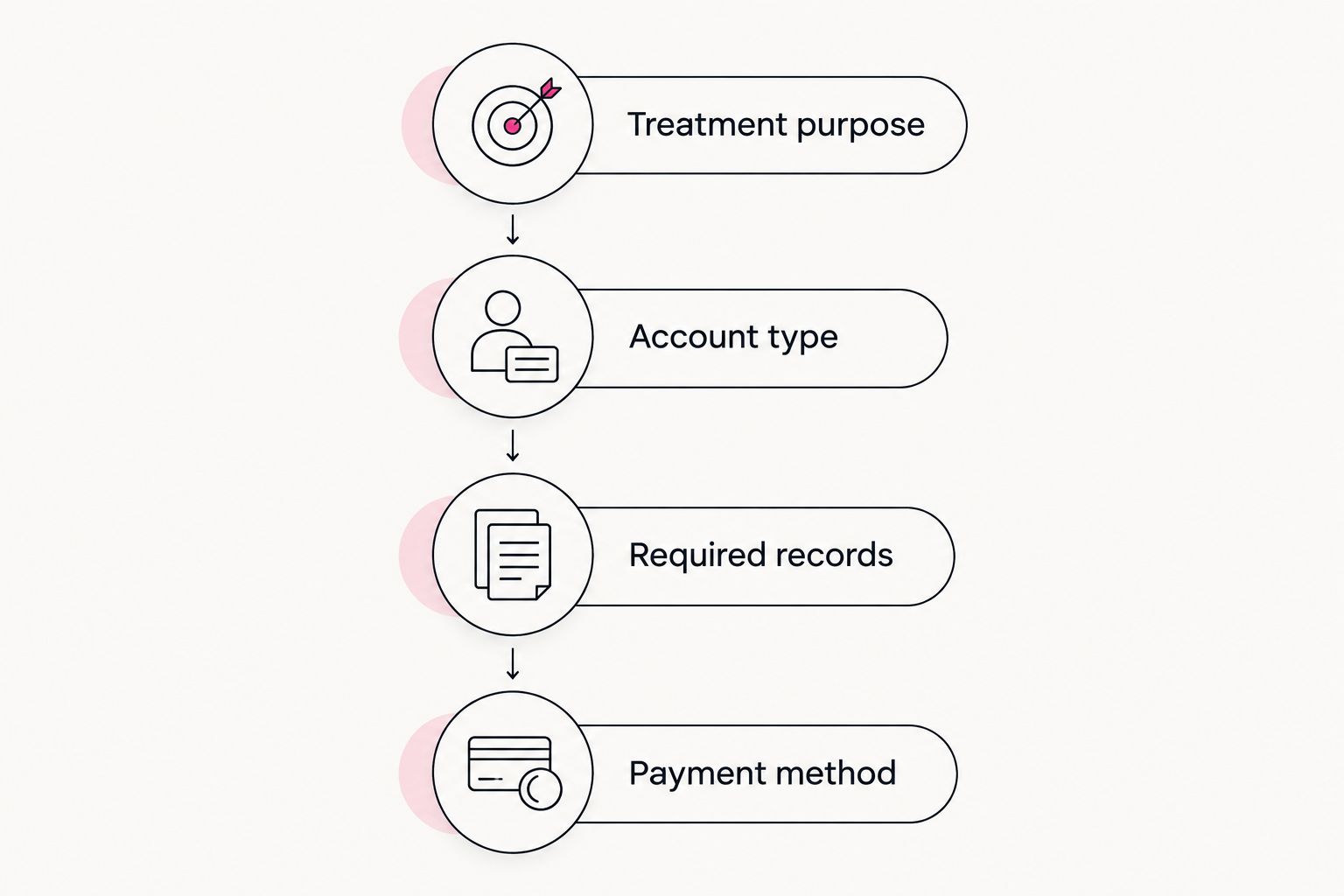
Keep the receipt and supporting records together. A bank statement proves a payment occurred, but it generally does not establish what treatment you received or why the expense qualifies.
Second workflow: reimbursement after personal payment
If you already paid personally for a qualifying medical expense, start with eligibility and timing rather than repeating the payment. The original payment does not have to come from a benefits card for reimbursement to be possible.
For an FSA, submit the expense within your plan’s claim deadline and include the required substantiation. The service must fall within an eligible coverage period; paying a deposit earlier does not move the treatment into that period.
For an HSA, federal rules do not impose a deadline for reimbursing a qualified expense incurred after the HSA was established. You still need records establishing eligibility and showing the expense was not reimbursed elsewhere or deducted.
Use this workflow for a qualifying medical expense, not as a second attempt to obtain reimbursement for cosmetic treatment. Changing the payment route does not change the treatment’s eligibility.
For your 2026 records, mark a claim as reimbursed only after reimbursement occurs. Keep pending claims separate so you do not accidentally submit the same expense through another account.
Troubleshooting
Your benefits card worked, but the claim needs documentation
Supply the requested itemized receipt and accurate supporting records. Do not treat the transaction approval as a final eligibility decision. If the expense is cosmetic or otherwise ineligible, ask the administrator how to correct the payment.
Your letter of medical necessity did not resolve the exclusion
Check the reason for denial against the treatment’s actual purpose. A letter supports the facts of a claim; it does not override the IRS exclusion for cosmetic procedures. Ask for clarification rather than asking the clinician to relabel cosmetic care.
Your receipt combines cosmetic and medical services
Ask the provider for an accurate itemized breakdown. Only the qualified, unreimbursed portion belongs in the benefits claim. Do not submit the entire visit simply because one service qualifies.
Your FSA deadline passed
Read the plan’s coverage dates, run-out period, and any grace-period provisions. Contact the administrator about your specific claim. An HSA’s reimbursement flexibility does not extend an FSA deadline.
You used HSA money for a nonqualified expense
Contact your HSA custodian and tax professional about available correction procedures and reporting requirements. A nonqualified HSA distribution generally becomes taxable income and carries an additional 20% tax before 65 years of age, unless an applicable exception applies.
After age 65, the additional tax no longer applies, but a nonqualified distribution generally remains taxable. This is not a tax-free payment route for cosmetic Botox or fillers.
Customize your workflow
Build separate plans for treatment and payment. With Skindale Medspa, discuss your aesthetic goals, relevant health history, and the proposed care; with your benefits administrator or tax professional, address account eligibility and documentation.
If you schedule recurring cosmetic visits, repeat the treatment-purpose check when the plan changes. Previous card acceptance does not establish eligibility for later appointments.
For a 2026 planning folder, keep these record categories:
- Treatment records: What was performed and its actual purpose.
- Payment records: Itemized receipts and proof of payment.
- Benefits records: Claim decisions, reimbursement confirmations, and relevant plan instructions.
A gift purchase is a separate issue. Buying a gift ecard does not itself document a qualifying medical service; eligibility depends on the actual expense and the applicable account rules.
FAQ
Can I use HSA or FSA funds for cosmetic Botox in 2026?
Cosmetic Botox generally is not a qualified medical expense for an HSA or health FSA. A card transaction, prescription, or medical-spa setting does not change the treatment’s cosmetic purpose.
Are dermal fillers eligible for HSA or FSA reimbursement?
Cosmetic dermal fillers generally are not eligible. IRS rules contain an exception for procedures necessary to improve certain qualifying deformities, but ordinary cosmetic volume or contour goals do not establish that exception.
Does a letter of medical necessity make Botox eligible?
A letter of medical necessity does not automatically make Botox eligible. The treatment must actually meet the qualified-medical-expense rules, and documentation must accurately support its medical purpose.
What if my HSA or FSA card is accepted at the appointment?
Card acceptance does not prove that the expense qualifies. Keep supporting records and resolve the treatment’s eligibility independently of whether the transaction goes through.
Can I pay personally and request reimbursement later?
You can request reimbursement for a qualifying expense paid personally if you meet the account’s timing and documentation requirements. FSA claims follow plan deadlines; HSA expenses must have been incurred after the HSA was established.
Can I submit the same treatment to both my HSA and FSA?
You cannot receive duplicate reimbursement for the same expense. Track each reimbursed portion and any insurance payment before requesting funds from another account.
Does turning 65 make cosmetic Botox tax-free through an HSA?
Turning 65 does not make cosmetic Botox a qualified medical expense. The additional tax on nonqualified HSA distributions no longer applies after age 65, but the distribution generally remains taxable income.
One last thing
The most useful payment question is not whether a benefits card works. It is whether the actual service qualifies and whether your records support that decision.
For natural-looking aesthetic goals, schedule a personalized consultation with Skindale Medspa and discuss the treatment plan first. Keep benefit eligibility as a separate check so your payment choice matches the care you receive.