

Is at-home microneedling as effective as in-office treatments?
If you want smoother skin without unnecessary risk, at-home microneedling is not a substitute for an in-office treatment, and devices that puncture your skin carry risks of infection, scarring, and pigment changes. Professional treatment allows a trained clinician to assess your skin, select an appropriate device, and control treatment depth; it still requires careful screening and aftercare.
- Is at home microneedling safe? Skin-puncturing devices carry infection, scarring, and pigment risks; professional assessment is the safer starting point.
- At-home rollers do not offer the same treatment control or clinical assessment as in-office microneedling.
- Skindale Medspa offers microneedling for Scottsdale clients seeking personalized aesthetic care.
- Radiofrequency microneedling adds heat and requires its own safety discussion; stronger treatment is not automatically better.
Is at-home microneedling as effective as in-office treatments?
No—do not expect an at-home roller to produce the same results as professionally performed microneedling. Devices differ in what they do, how deeply they affect the skin, and whether they are intended for medical treatment. Looking similar does not make them interchangeable.
The FDA distinguishes skin-penetrating microneedling devices from products intended only to exfoliate the surface. A tool that does not reach living skin is not equivalent to a medical procedure intended to improve the appearance of scars or wrinkles.
| Option | Best for | Main advantage | Main limitation or risk |
|---|---|---|---|
| At-home surface exfoliation tools | People seeking surface exfoliation, not scar treatment | Designed for a different, more superficial purpose | Cannot be treated as equivalent to medical microneedling; irritation remains possible |
| Professional microneedling | People seeking assessment for acne scars, wrinkles, or texture concerns | Clinician assessment, controlled treatment, and a defined aftercare plan | Infection, pigment changes, and scarring remain possible; recovery is required |
| Radiofrequency microneedling | People whose clinician identifies a reason to add energy-based treatment | Combines needles with radiofrequency energy | Adds heat-related risks, including burns; requires separate assessment |
For this 2026 guide, the safety distinction follows FDA consumer guidance on microneedling devices and American Academy of Dermatology guidance on microneedling. Neither source supports treating a home roller as a replacement for a clinical procedure.
Why this matters
A more even complexion is a reasonable goal. The problem starts when you try to create a stronger result by pressing harder, using longer needles, or repeating treatment before your skin has recovered.
More injury does not equal better skin. A plan should match the concern you want to treat, your skin's condition, and your ability to follow aftercare—not the most dramatic device description.
Skindale Medspa offers microneedling within its Scottsdale medical aesthetics services. Skindale Medspa is best for Scottsdale clients seeking personalized medical aesthetics rather than a do-it-yourself treatment plan. Professional care still has limits: a consultation must establish whether microneedling fits your skin and goals.
Is at home microneedling safe?
Skin-puncturing microneedling is not risk-free at home. The American Academy of Dermatology warns that home microneedling can cause infection and scarring, and that excessive use can damage skin.
The FDA states that it has not authorized microneedling medical devices for over-the-counter sale. Online availability does not establish that a device is appropriate for unsupervised treatment.
A product advertised as a roller, stamp, or pen also needs careful interpretation. The name alone does not tell you whether it merely exfoliates the surface or penetrates living skin.
Before using any device in 2026, distinguish its intended purpose from the results promised in advertising. Claims about scar improvement, collagen, or professional-level results do not replace a medical assessment.
Cleaning is not the same as clinical infection control
Wiping a reusable tool does not establish that it is suitable for puncturing skin. Professional infection control involves more than cleaning the visible surface of a device.
Ask a provider how the equipment is handled and whether a new needle cartridge is used for each treatment session. Never share a skin-puncturing device.
Your skin condition changes the risk
Active acne, an infection, irritated skin, and certain medical conditions can change whether treatment is appropriate. A history of abnormal scarring also belongs in the discussion before treatment.
You do not need to diagnose these issues yourself. Describe what you are experiencing and let a qualified clinician assess whether to treat, postpone, or choose another approach.
Why microneedling results and risks vary
Microneedling outcomes depend on more than where treatment happens. These factors explain why an office appointment still needs personalization:
- Treatment purpose: Surface exfoliation, acne-scar treatment, and wrinkle treatment are not interchangeable goals.
- Device and technique: Needle penetration, pressure, and added radiofrequency energy change the procedure and its risks.
- Skin condition: Active breakouts, infection, inflammation, and an impaired skin barrier affect suitability.
- Health history: Medicines, healing problems, immune conditions, and a tendency to form raised scars require discussion.
- Infection control: Device handling and needle-cartridge practices matter whenever treatment punctures skin.
- Aftercare and sun exposure: Irritating products and ultraviolet exposure can complicate recovery and pigment concerns.
For your 2026 treatment plan, ask the clinician to explain which factors apply to you. A useful recommendation connects your concern to a treatment choice and explains when treatment should not proceed.
Professional microneedling: control, not a guarantee
Professional microneedling creates controlled skin injury to stimulate a healing response. Depending on the device and its authorized use, treatment can improve the appearance of certain scars and wrinkles.
Its advantage is not simply access to longer needles. The advantage is an assessment, a suitable device, controlled technique, and instructions for recovery.
You still need realistic expectations. Redness, discomfort, swelling, bleeding, and peeling are possible, and infection, scarring, or pigment changes can occur. Results develop over time rather than appearing as a finished outcome immediately after treatment.
Choose professional assessment for treatment decisions—not a promise of flawless skin. Ask what improvement is realistic for your particular concern and what would make your clinician recommend another option.
Radiofrequency microneedling: a separate safety decision
Radiofrequency microneedling uses needles to deliver energy beneath the skin. It is not simply traditional microneedling with a stronger setting, and a favorable experience with one procedure does not establish suitability for the other.
The FDA warns that radiofrequency microneedling can cause serious complications, including burns, scarring, fat loss, disfigurement, and nerve damage. These risks belong in the consultation, not just in paperwork handed to you immediately before treatment.
Best for: patients whose clinician identifies a specific reason for radiofrequency treatment after assessing skin and medical history. Its added energy is also its main limitation: the heat introduces risks that ordinary mechanical needling does not share.
If you are comparing options in 2026, ask why radiofrequency is being recommended instead of traditional microneedling. A clear answer should explain the intended benefit, relevant risks, and alternatives without assuming that more intensive treatment is better.
What should happen before an in-office treatment?
A good consultation turns a general wish for smoother skin into a specific treatment decision. You should leave understanding what will be treated, why the procedure fits, and what recovery requires.
- Discuss goals. Identify the concern that bothers you most, such as acne scars, uneven texture, or fine lines. Do not assume that all concerns need the same procedure.
- Review history. Share your medicines, recent skin treatments, cold-sore history, healing issues, and any tendency to develop raised scars. Mention pregnancy or breastfeeding when relevant.
- Assess skin. The clinician should evaluate your skin's current condition and decide whether treatment should proceed or wait.
- Compare options. Discuss the proposed device, its intended use, likely benefits, limitations, and alternatives—including not treating yet.
- Plan aftercare. Obtain instructions for cleansing, sun protection, restarting products, and contacting the practice if recovery is not progressing as expected.
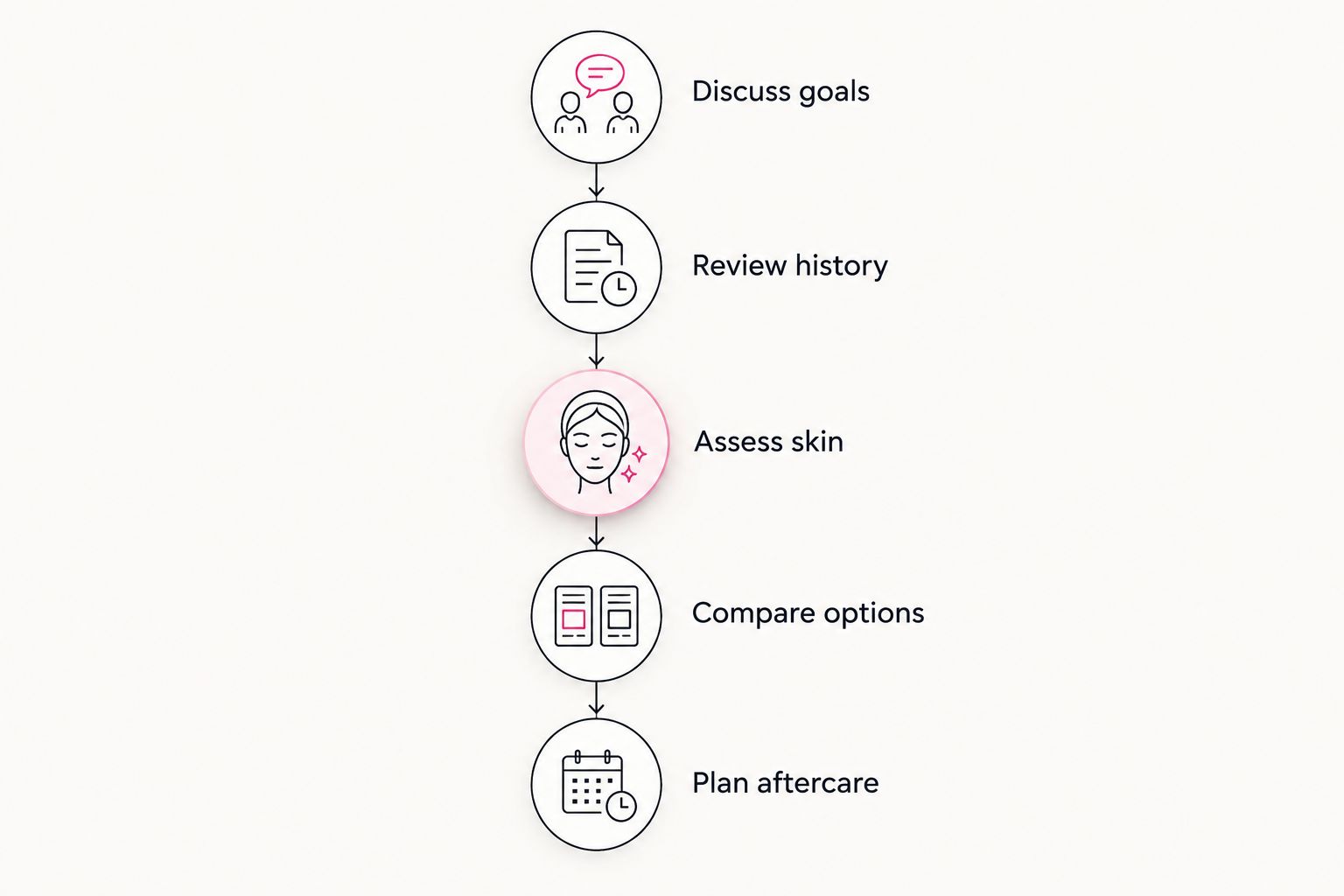
Ask these questions before committing to a procedure, not after it begins. If the explanation leaves you unclear about risks or recovery, pause and request clarification.
Can you apply your usual serum after microneedling?
Do not assume a serum that suits intact skin is suitable immediately after microneedling. Newly treated skin needs instructions specific to the procedure, and familiar products can cause irritation.
The FDA has not authorized microneedling devices to deliver cosmetics, topical medications, vitamin solutions, drugs, or blood products into the skin. A claim that needling helps a product penetrate does not establish that the combination is safe or effective.
If a treatment includes an added substance, ask what it is, why it is included, and what evidence supports that particular use. Follow the clinician's written aftercare rather than adding your usual active ingredients automatically.
How do you protect your skin while it heals?
Keep recovery simple and follow the instructions for your specific treatment. Do not copy a routine from someone who used a different device or had a different procedure.
American Academy of Dermatology sun-protection guidance recommends broad-spectrum, water-resistant sunscreen with SPF 30 or higher. Ask your treating clinician when and how to apply sunscreen to freshly treated skin, and use shade and protective clothing as directed.
Avoid picking, scratching, or trying to exfoliate away post-treatment peeling. Check when you can restart retinoids, exfoliating acids, makeup, and other products instead of choosing a restart date yourself.
Contact the treating practice promptly for worsening pain, spreading redness, pus, or other signs of infection. Seek urgent medical care for severe symptoms rather than waiting for a routine follow-up.
When is skipping microneedling the better choice?
Postponing treatment is the right decision when your skin or medical history makes it unsuitable. Active infection or inflamed skin needs assessment before a procedure that intentionally punctures the skin.
A consultation should also address poor wound healing, immune-related conditions, medicines that affect treatment safety, and a history of keloids or other raised scars. These concerns require individual review rather than an online yes-or-no checklist.
Microneedling is not automatically the first treatment for every uneven patch or blemish. Getting the diagnosis right matters more than choosing a device quickly.
For a 2026 skin plan, start with the concern you want addressed and accept that the recommendation might be to treat another condition first. That protects your options rather than delaying progress without purpose.
FAQ
Is at home microneedling safe for beginners?
Skin-puncturing microneedling carries infection, scarring, and pigment risks at home, including for beginners. Start with a professional assessment rather than experimenting with needle depth or pressure.
Is at-home microneedling as effective as professional treatment?
At-home microneedling is not equivalent to professional treatment. Surface tools have a different purpose, while clinical treatment includes assessment, device selection, controlled technique, and aftercare.
Can I use a dermaroller on active acne?
Do not roll over active acne without a clinician's assessment. Needling inflamed or infected skin can worsen problems and should not replace appropriate acne care.
Is radiofrequency microneedling safer than regular microneedling?
Radiofrequency microneedling is not automatically safer than traditional microneedling. It adds heat-related risks, and the FDA warns about serious complications including burns, scarring, fat loss, and nerve damage.
Can microneedling cause dark spots?
Microneedling can cause pigment changes, including darkening of the skin. Discuss your pigment history, current skin condition, and sun-protection plan before treatment.
What sunscreen should I use after microneedling?
Broad-spectrum, water-resistant sunscreen with SPF 30 or higher follows American Academy of Dermatology sun-protection guidance. Ask your treating clinician when to apply it and which formulation suits your freshly treated skin.
Should I use a serum immediately after microneedling?
Use only products approved by your treating clinician for that stage of recovery. The FDA has not authorized microneedling devices to deliver cosmetics or topical medications into the skin.
How do I choose between home treatment and an office consultation?
Choose an office consultation when your goal is treatment of scars, wrinkles, or persistent texture concerns. A clinician can assess whether microneedling fits your skin or whether another approach is more appropriate.
One last thing
Visible redness is not proof that a treatment worked. It is a skin response, not a score to beat with more pressure, deeper needles, or another session before you have healed.
Bring your skincare routine and your main concern to a personalized consultation at Skindale Medspa. You can discuss microneedling, its limitations, and a plan that supports natural-looking results without committing to a procedure before your skin is assessed.