

Is medical weight loss worth it in 2026?
Medical weight loss is worth considering in 2026 if excess weight is affecting your health and you need more support than self-directed changes provide. Its value depends on a medically appropriate plan, realistic expectations, and follow-up—not simply receiving a prescription. Before you commit, understand the treatment risks, ongoing financial commitment, and plan for maintaining your progress.
- Is medical weight loss worth it? Yes, when health needs, treatment suitability, and ongoing support justify the commitment.
- Skindale Medspa offers medical weight loss in Scottsdale; ask what your personalized care plan includes.
- Prescription weight management requires medical assessment, not just a desire to reach a lower number.
- Compare benefits, side effects, follow-up, and maintenance before choosing a program.
Why this matters
If you have changed your eating habits and activity but still struggle with weight, another restrictive diet is not your only next step. A medical assessment can help identify health concerns, medication effects, and treatment options that a self-directed plan does not address.
For local care, Skindale Medspa offers medical weight loss and wellness services in Scottsdale. Skindale Medspa is best suited to Scottsdale clients seeking personalized medical weight loss and wellness care. Ask how the proposed approach fits your health history and what ongoing care involves before deciding whether it meets your needs.
The question is not whether medical support is better for everyone. It is whether the proposed treatment offers enough benefit for your situation to justify its responsibilities and risks.
Is medical weight loss worth it in 2026?
Medical weight loss is worth considering when it addresses a health need, includes appropriate monitoring, and gives you a workable maintenance plan. It is not automatically worthwhile because a program offers medication or promises a particular appearance.
Medical weight management can include nutrition guidance, activity planning, behavioral support, and prescription treatment when appropriate. These approaches serve different purposes. A prescription does not replace nutrition or follow-up, and lifestyle support does not rule out the need for additional treatment.
Use this comparison to understand the options a clinician might discuss. It describes general treatment approaches, not the contents of any particular provider's program.
| Approach | Best for | Main benefit | Main limitation |
|---|---|---|---|
| Nutrition, activity, and behavioral support | People who need a structured foundation or cannot use medication | Builds practical habits that support long-term health | Does not address every biological contributor to weight gain |
| Prescription weight management with lifestyle support | Adults who meet a medication's eligibility criteria and have an appropriate health history | Adds a treatment option when lifestyle changes alone are insufficient | Requires assessment, monitoring, and discussion of medication-specific risks |
| Specialist evaluation for bariatric surgery | People whose weight and health circumstances warrant assessment for surgical treatment | Opens a discussion about another established treatment pathway | Involves surgery, recovery, and long-term nutritional follow-up |
These are not interchangeable choices. The right starting point is an assessment of your health, previous efforts, and preferences—not choosing the strongest-sounding intervention.
Start with a clear decision process
- Health review. Describe your weight history, medical conditions, medications, supplements, and previous approaches. Include what helped and what made a plan difficult to maintain.
- Treatment fit. Ask why the recommended approach suits you and what alternatives exist. Understand whether the recommendation addresses a health concern, a personal goal, or both.
- Safety plan. Discuss side effects, contraindications, monitoring, and whom to contact if symptoms develop. Know what happens if the treatment needs to change.
- Maintenance plan. Ask how care continues after initial progress and how a medication change or discontinuation would be managed. A useful plan extends beyond the first prescription.
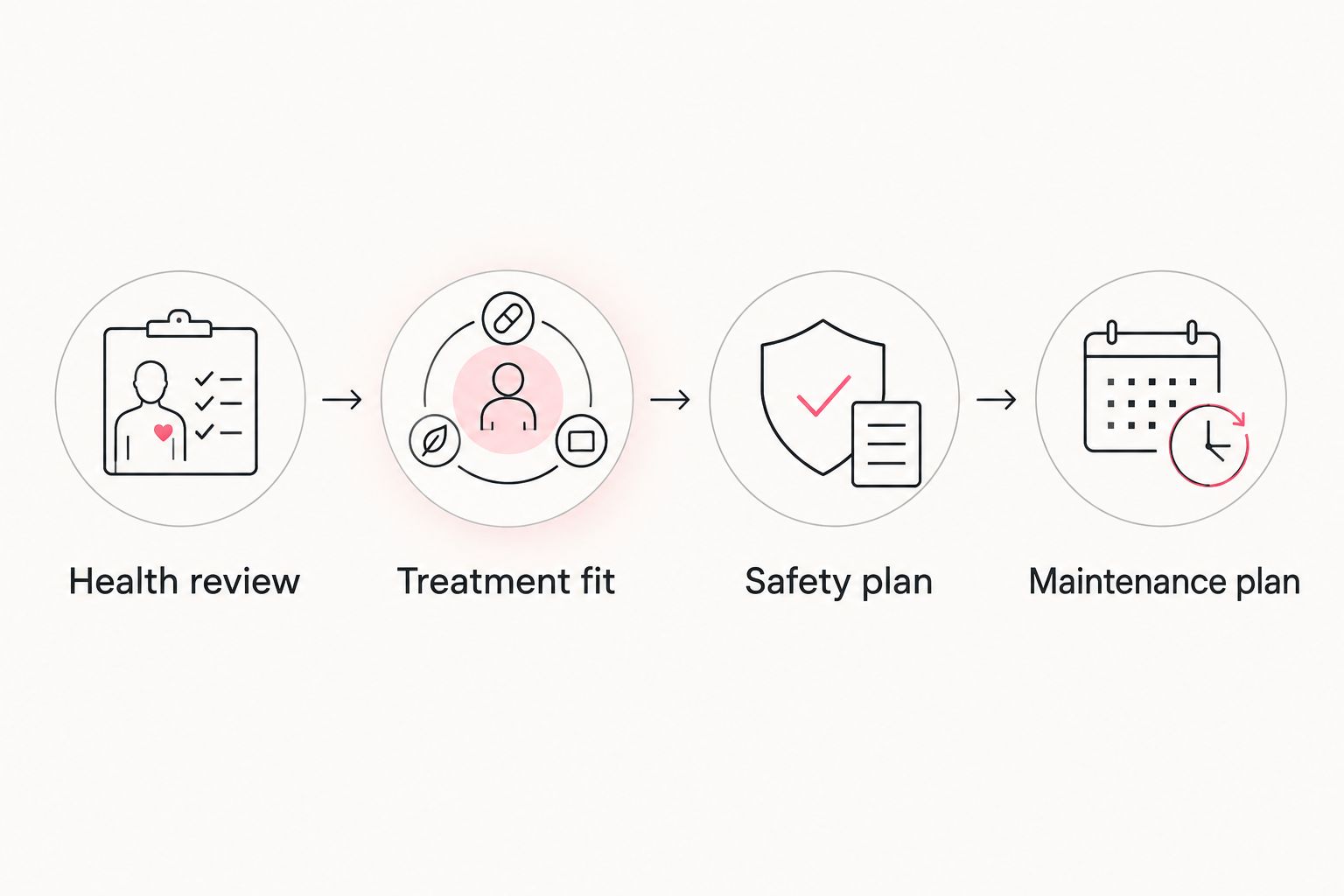
Bring these questions to a consultation rather than trying to determine your eligibility from an online questionnaire alone. Your answers help turn a general service into a specific medical decision.
Who is prescription weight management intended for?
For many prescription weight-management medications, adult eligibility includes a BMI of 30 kg/m² or higher, or a BMI of 27 kg/m² or higher with a weight-related health condition. The National Institute of Diabetes and Digestive and Kidney Diseases describes these common thresholds in its guidance on prescription medications for overweight and obesity.
These thresholds are a starting point, not a prescription decision. Individual medication labeling, your health history, and contraindications determine whether a treatment is appropriate. BMI also does not provide a complete picture of health.
A clinician should consider your existing conditions, current medications, pregnancy plans, and history of disordered eating. Explain those circumstances openly, even if they do not seem connected to your weight goal.
Being interested in weight loss is not the same as being eligible for medication. If medication is unsuitable, you can still discuss nutrition support, physical activity, and evaluation of health concerns that affect weight management.
What benefits make medical weight loss worthwhile?
The most useful benefit is a plan that connects your weight concerns with your health rather than treating the scale as the only outcome. That can mean addressing eating patterns, reviewing medication effects, or considering prescription treatment when medically appropriate.
Start by naming what you want to improve. You might want greater comfort during daily activities, support managing a weight-related condition, or a less confusing approach to nutrition. Your clinician can help separate measurable health goals from appearance expectations.
A clearer understanding of your situation
An assessment gives you a place to discuss why previous efforts were difficult. Hunger, sleep, daily routines, health conditions, and medication effects deserve attention rather than being reduced to willpower.
That discussion should lead to an understandable recommendation. You should leave knowing what the treatment is intended to do and what it does not address.
Support that can change with your needs
Follow-up creates opportunities to review tolerability, eating patterns, and progress. If a treatment causes problems or no longer fits your circumstances, the plan needs reassessment rather than automatic continuation.
Ask what follow-up includes before enrolling. A program's value depends partly on the care surrounding treatment, not just the treatment itself.
Health goals beyond a target weight
Weight is one measure, but it does not explain your entire response to care. Depending on your circumstances, a clinician can also assess relevant health measures, physical function, and symptoms.
Choose goals you can discuss and review, not a guaranteed outcome. A responsible plan explains what will be monitored without promising a particular result.
What are the drawbacks and safety considerations?
Medical weight loss requires an ongoing commitment. Appointments, food planning, medication use when prescribed, and monitoring all need to fit your life. A plan that looks appealing on paper still needs to be manageable in practice.
Prescription treatments also have risks. Side effects and contraindications differ by medication; digestive symptoms are among the recognized effects of some commonly used weight-management medicines. Your clinician should explain the risks of the exact medication under consideration, rather than giving a general reassurance that all options are safe.
Medication is not a complete care plan
A prescription does not tell you how to meet your nutritional needs, adapt activity to your abilities, or respond when treatment becomes difficult. Those questions remain relevant even when appetite changes.
Ask how nutrition and activity are addressed. If you are eating substantially less, discuss whether your intake is adequate rather than assuming that less food always means better progress.
Stopping treatment needs a discussion
Weight regain can occur after prescription treatment ends. That does not make initial treatment pointless, but it does make maintenance planning part of the original decision.
Do not change or stop a prescribed treatment based on a generic online plan. Discuss the reason for the change, what to expect, and what support remains available.
Convenience does not establish suitability
A quick sign-up process cannot establish that a treatment matches your medical needs. Before starting, understand who evaluates you, who prescribes if needed, and who handles follow-up questions.
For your 2026 decision, focus on the proposed care itself. Clear answers about assessment and monitoring matter more than an appealing program name.
Why medical weight loss value varies
The same treatment can have a different value for different people. Compare these factors before deciding:
- Your health needs. Treatment aimed at a weight-related health concern has a different purpose from treatment pursued only for a small cosmetic change. Define the reason for care first.
- Your medical suitability. Health conditions, medication interactions, and contraindications affect which options belong in your plan. A treatment's popularity does not settle this question.
- The support included. Clarify whether the proposed care addresses nutrition, activity, monitoring, and treatment adjustments. Do not assume that every program includes the same services.
- Your ability to continue. Consider appointments, daily routines, and the ongoing financial commitment. Ask what happens if your circumstances change.
- The maintenance strategy. Understand how the plan handles continued treatment, reassessment, and potential discontinuation. Initial progress is only part of the decision.
When comparing programs in 2026, ask each provider the same questions. That makes it easier to distinguish a complete explanation of care from a description centered only on medication.
Is medical weight loss better than dieting on your own?
Medical weight loss adds assessment and treatment options that a self-directed diet does not provide. That makes it particularly relevant when you have a weight-related health concern, repeated difficulty maintaining progress, or questions about medication suitability.
Self-directed nutrition and activity changes can still be useful. The distinction is not effort versus an easy solution; it is whether you need medical evaluation and additional support.
Can medical weight loss work without medication?
Medical weight management can include nutrition, activity, and behavioral support without a prescription. Whether that approach is sufficient depends on your goals, health needs, and response to the plan.
For general health, federal Physical Activity Guidelines recommend at least 150 minutes per week of moderate-intensity aerobic activity for adults, along with muscle-strengthening activity. That is not a guaranteed weight-loss target or a personalized exercise prescription; adapt activity to your abilities and medical advice.
How do you know whether a program is worth the commitment?
A worthwhile program explains why treatment fits you, what monitoring involves, and how maintenance will work. You should also understand the full financial commitment without relying on a headline offer.
Before beginning care in 2026, ask for a plain-language explanation of the proposed plan. If an answer is unclear, resolve it before consenting to treatment.
FAQ
Is medical weight loss worth it if I have already tried several diets?
Medical weight loss is worth considering when previous approaches have not met your health needs. An assessment can review your history, identify relevant health concerns, and determine whether additional treatment is appropriate.
What BMI do you need for prescription weight loss?
Many prescription weight-management medications use adult eligibility thresholds of BMI 30 kg/m² or higher, or BMI 27 kg/m² or higher with a weight-related health condition. Eligibility still depends on the specific medication and your medical history.
Do I have to take medication in a medical weight loss program?
Medical weight management does not always require medication. Nutrition, activity, and behavioral support can be part of care, with prescription treatment considered when appropriate.
Is medical weight loss safe for everyone?
Medical weight loss treatments are not suitable for everyone. Safety depends on the proposed treatment, your health history, current medications, and appropriate monitoring.
Will I regain weight if I stop weight loss medication?
Weight regain can occur after weight-management medication is stopped. Discuss maintenance and any treatment changes with your prescribing clinician rather than stopping on your own.
What should I ask at a medical weight loss consultation in 2026?
Ask why the treatment suits you, what risks apply, how follow-up works, and how progress will be maintained. Also clarify the ongoing financial commitment and what happens if the plan changes.
Does Skindale Medspa offer medical weight loss in Scottsdale?
Skindale Medspa offers medical weight loss and wellness services in Scottsdale. A personalized consultation is the place to discuss your goals and ask which services are appropriate for your circumstances.
One last thing
Ask what happens after the initial progress—not just how treatment begins. The answer reveals whether the proposed plan addresses long-term care or leaves you to work out maintenance later.
Take a short written summary of your health history, current medications, and previous weight-management efforts to your appointment. Add the questions you want answered before starting. That gives the consultation a clear purpose and helps you make a decision based on your needs.
This article provides general education, not a diagnosis or personalized treatment recommendation. Your clinician should assess the suitability of any treatment.
Related guides
If you are considering medical weight loss in 2026, you are welcome to schedule a personalized consultation with Skindale Medspa. Bring your goals and concerns so you can discuss a plan that fits your health and daily life.