

Laser Hair Removal for Men: Plan First | 2026
If shaving leaves your neck irritated or keeping your back tidy feels like a chore, laser hair removal for men offers long-term hair reduction rather than guaranteed permanent removal. This 2026 guide explains how to choose treatment areas, compare grooming options, prepare safely, and set realistic expectations without committing to a completely hair-free look.
- Laser hair removal for men reduces regrowth; complete, permanent removal is not guaranteed.
- Skindale Medspa is best suited to Scottsdale clients seeking personalized medical aesthetics care.
- Choose beard shaping and body hair goals before treatment; thinning and complete clearance are different requests.
- Skin tone, hair pigment, sun exposure, and medical history should guide laser selection.
Why laser hair removal matters for men
You do not need to dislike your body hair to want less maintenance. Your goal might be a cleaner neckline, fewer shaving-related bumps, or less dense hair on your chest and back. The right treatment plan starts with the hair you want to keep, not just the hair you want removed.
Men considering beard work have an extra decision: today's preferred shape can become tomorrow's unwanted boundary. Treating beyond a conservative neckline deserves more thought than reducing hair in an area you consistently shave.
Skindale Medspa is best suited to Scottsdale clients seeking personalized medical aesthetics care. You can use a consultation with Skindale Medspa to discuss your goals, medical history, and whether a proposed treatment fits your skin and hair.
For your 2026 plan, separate convenience from outcome. Less frequent shaving is one goal; treating an ongoing skin condition is another. Painful, draining, or persistent bumps need a medical assessment rather than an assumption that hair removal will solve them.
Build your laser hair removal plan
Define the areas and hair you want to keep
Start at home by writing down what bothers you about your current grooming routine. Take clear photos of the areas and mark the boundaries you want to discuss. This gives your consultation a useful starting point without asking you to choose equipment or treatment settings yourself.
Be specific about the outcome. A less dense chest is different from a bare chest, and removing stray neck hairs is different from reshaping a beard. Laser treatment cannot promise a precisely controlled percentage of thinning, so discuss how the provider will assess progress before treating again.
For facial hair, consider future flexibility. A narrow, sharply defined beard line can limit your grooming choices later. Keep beard boundaries conservative unless you are comfortable with lasting reduction in those areas.
- List the areas that create the most grooming work.
- Separate thinning goals from removal goals.
- Bring photos showing your usual beard or body hair pattern.
- Identify hairs you definitely want to preserve.
- Ask the provider to confirm treatment boundaries before starting.
Check your skin, hair, and medical history
Laser hair removal targets pigment in the hair. Dark, coarse hair generally responds better than white, gray, or very light hair because it provides more pigment for the treatment to target. The contrast between hair and skin matters, but darker skin does not automatically rule out treatment.
The equipment and settings must suit your skin. Alexandrite lasers commonly use a wavelength of 755 nm; long-pulsed Nd:YAG lasers use 1064 nm and are commonly selected for darker skin types. These specifications help frame a discussion, but a wavelength alone does not establish that treatment is safe for you.
Make a medication and skin-history list before your visit. Include prescription medicines, supplements, recent tanning, previous reactions, and any history of scarring or pigment changes. Do not stop medication on your own to meet a treatment requirement.
- Record recent sun exposure and tanning products.
- List medicines, supplements, and products used on the treatment area.
- Mention tattoos, moles, scars, and previous skin reactions.
- Explain any history of cold sores when discussing facial treatment.
- Ask how the provider assesses suitability for your skin tone.
Choose a provider who explains the treatment
You can compare providers by preparing the same questions for each consultation. Ask who performs treatment, what training they have, and how they choose equipment and settings. A clear explanation is more useful than a promise that every skin type receives the same treatment.
Skindale Medspa offers personalized medical aesthetics care in Scottsdale, making a consultation the next step for discussing laser hair removal for men. The benefit of individualized care is a plan built around your concerns. Its limitation is that a general service description cannot establish your eligibility, likely response, or treatment schedule.
Ask whether a test spot is appropriate and how the provider handles unexpected reactions. A test spot does not eliminate risk, but it can help assess the skin's response before broader treatment. You should also know whom to contact if symptoms develop afterward.
- Ask about experience treating men with your skin tone and hair pattern.
- Request the device name and an explanation of why it fits your needs.
- Discuss burns, pigment changes, and scarring before consenting.
- Ask whether a test spot is appropriate.
- Confirm the aftercare instructions and follow-up contact process.
Prepare your skin without removing the target hair
Preparation is not about creating the closest possible shave at any cost. It is about arriving with skin suitable for treatment and hair follicles available for the laser to target. Follow your provider's written instructions rather than a generic social-media checklist.
Waxing, plucking, and threading remove hair from the follicle and interfere with the target needed for laser treatment. Shaving trims hair at the surface instead. Your provider should specify when to shave, especially if close shaving causes irritation or cuts.
Sun protection matters before and after treatment. The American Academy of Dermatology recommends broad-spectrum, water-resistant sunscreen with SPF 30 or higher. For a 2026 treatment plan in Scottsdale, tell your provider about outdoor activities and recent tanning rather than relying on sunscreen to make freshly tanned skin suitable for treatment.
- Pause waxing, plucking, and threading as instructed.
- Follow the provider's timing for shaving.
- Report cuts, rashes, sunburn, or active irritation before the appointment.
- Use sun protection and avoid intentional tanning.
- Ask which skin products to pause and when to restart them.
Review comfort, privacy, and aftercare
Before treatment starts, confirm the area and boundaries again. For beard shaping, check the line while sitting upright and looking in a mirror. For intimate areas, ask how positioning, draping, and consent are handled so you know what to expect.
Treatment can feel like brief snapping or heat against the skin. Comfort varies with the area, hair density, equipment, and settings; a provider should explain available measures without promising a painless experience. Wear the eye protection supplied for treatment and tell the provider about unexpected discomfort immediately.
Temporary redness and swelling around follicles can occur afterward. Ask for written instructions that distinguish an expected reaction from a problem needing assessment. Blistering, worsening pain, or significant skin changes should prompt contact with the treating provider.
- Confirm boundaries before the laser is used.
- Ask about privacy and draping for intimate areas.
- Discuss comfort measures before treatment begins.
- Follow written instructions about cleansing, heat, exercise, and skin products.
- Know which symptoms require prompt follow-up.
Track results before changing the plan
Use photos taken in similar lighting and note how often you shave. These simple records help you describe progress more clearly than a general impression that hair seems thinner. Keep separate notes for each area because beard, back, and chest hair do not necessarily respond identically.
Hair grows in cycles, so repeated sessions are needed to target hair at different stages. Treated hairs can shed after treatment; immediate smoothness is not a reliable measure of lasting reduction. Some regrowth and maintenance treatment are possible.
For your 2026 review, judge results against your original goal. If you wanted less grooming work, your shaving routine matters alongside the appearance of the hair. If you wanted thinning rather than clearance, discuss the response before continuing automatically.
- Take comparison photos under consistent lighting.
- Record shaving frequency and irritation separately.
- Report patchy results or unexpected skin changes.
- Review progress before expanding treatment boundaries.
- Ask when maintenance would be appropriate rather than assuming a fixed schedule.
Compare your hair removal options
Choose the method that matches how lasting you want the change to be. Shaving preserves flexibility, waxing removes hair temporarily from the root, laser treatment targets long-term reduction, and electrolysis treats individual follicles.
The strongest option depends on your hair pigment, treatment area, and tolerance for upkeep. None replaces a medical assessment when the main concern is painful inflammation, infection, or an unexplained skin change.
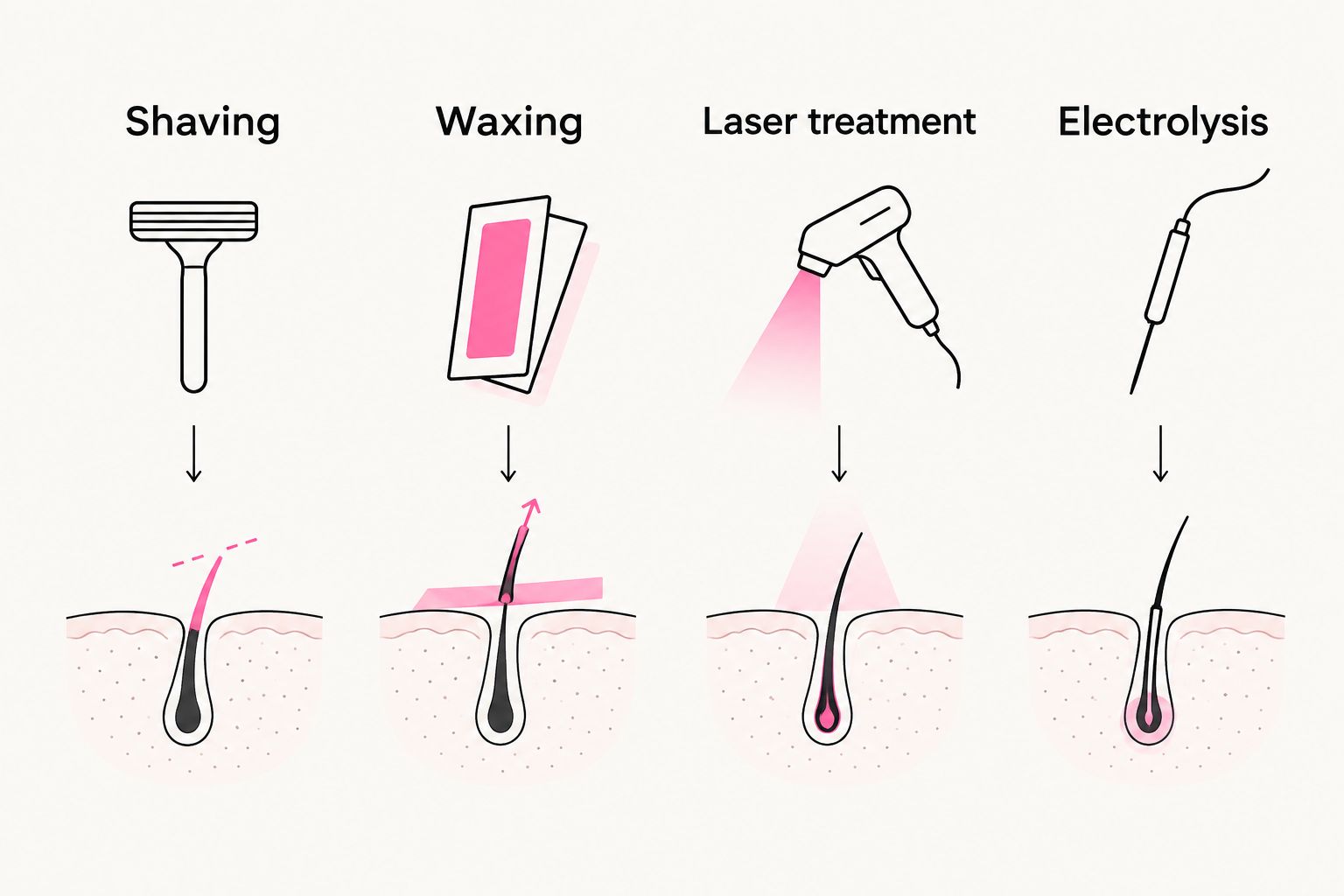
| Option | Best for | Main advantage | Key limitation |
|---|---|---|---|
| Shaving | Men who want flexible beard shapes or temporary smoothness | Removes visible hair without targeting the follicle | Requires repeat grooming and can cause irritation or ingrown hairs |
| Waxing | Men who want temporary removal from the root | Keeps hair away longer than surface shaving | Can irritate skin and conflicts with preparation for laser treatment |
| Laser treatment | Men with suitable pigmented hair seeking long-term reduction | Reduces regrowth across treatment areas | Needs repeated sessions; light hair responds poorly and skin injury is possible |
| Electrolysis | Men seeking permanent removal of individual hairs, including light hairs | Does not depend on hair pigment | Treats follicles individually, making extensive areas a more involved process |
Shaving is the practical choice when you are still experimenting with beard shape. Laser treatment deserves consideration when you repeatedly remove the same hair and want less regrowth. Electrolysis is a discussion to have when hair color limits laser suitability or the goal involves individual unwanted hairs.
Common mistakes men make
Treating a beard line before deciding on its shape
A sharply edged beard can look appealing now but leave little room for a different style later. Start with clearly unwanted hairs and review the boundary carefully. Do not treat a line simply because it matches today's haircut or beard trend.
Assuming chest and back thinning will be perfectly uniform
Hair reduction is not a precision density control. Discuss the possibility of uneven response and how progress will be reviewed. Show the provider your preferred natural-looking outcome without treating a reference photo as a guaranteed result.
Hiding a tan to avoid changing an appointment
Recent tanning changes the treatment discussion because skin pigment also absorbs light energy. Tell the provider about sun exposure, tanning beds, and tanning products. An appointment date should not take priority over skin safety.
Using treatment to avoid assessing persistent bumps
Shaving-related ingrown hairs and other skin conditions can look similar. Seek assessment for persistent, painful, or draining bumps before assuming hair removal is the answer. Laser treatment is not a substitute for diagnosing the problem.
Continuing because the calendar says to
Your skin response and hair regrowth should inform the next treatment. Report irritation, review progress, and reassess a thinning goal before continuing. A personalized plan needs room to change when your skin or priorities change.
FAQ
Does laser hair removal for men remove hair permanently?
Laser hair removal provides long-term hair reduction, not a guarantee that every hair disappears permanently. Repeated sessions are needed, and some regrowth or maintenance treatment is possible.
Can men get laser hair removal on their beard or neck?
Men can be assessed for laser treatment on unwanted beard or neck hair. Conservative boundaries matter because lasting reduction can limit future beard styles.
Is laser hair removal suitable for darker skin?
Darker skin can be treated when the provider selects suitable equipment and settings. Ask about experience with your skin tone and why the proposed laser is appropriate; no device removes all risk.
Will laser hair removal work on gray or blond hair?
Gray, white, and very light hair generally respond poorly because laser hair removal depends on hair pigment. Electrolysis is an alternative to discuss when pigment limits laser suitability.
Should I shave or wax before laser hair removal?
Follow your provider's shaving instructions and avoid waxing or plucking during preparation. Shaving leaves the follicle available as a treatment target, while waxing and plucking remove the hair from it.
Can laser treatment help men who get shaving bumps?
Reducing hair growth can help some men with shaving-related ingrown hairs. Persistent, painful, or draining bumps need assessment because not every bump has the same cause.
What should I ask Skindale Medspa before treatment in 2026?
Ask Skindale Medspa whether your hair, skin, treatment area, and medical history fit the proposed plan. Discuss equipment, conservative boundaries, possible side effects, aftercare, and how progress will be reviewed.
One last thing
The most useful consultation question is: which hair should we leave alone? That question protects a future beard shape and keeps a body-hair thinning goal from becoming an automatic pursuit of complete clearance.
For 2026, bring your grooming goals, medication list, and recent sun-exposure history to a personalized consultation at Skindale Medspa. You can discuss a plan that respects your skin, comfort, and preference for a natural-looking result.