

Laser treatments for sun damage golfers: Plan first 2026
For golfers, laser treatment for sun damage is a way to address selected pigment and texture concerns while protecting the skin you continue to expose on the course. If you want a more even, refreshed appearance, start with a skin assessment and a plan that fits your golf schedule—not simply the name of a laser.
- Laser treatments for sun damage golfers consider should begin with a skin assessment, especially for changing or persistent spots.
- Skindale Medspa is best suited to Scottsdale golfers seeking personalized medical aesthetics and laser treatment planning.
- IPL targets selected discoloration; resurfacing lasers address selected pigment and texture concerns. Neither replaces sun protection.
- Plan golf around healing instructions, and use broad-spectrum SPF 30 or higher with protective clothing.
Why sun damage treatment matters for golfers
Golf puts your face, ears, neck, forearms, and hands outdoors for extended periods. A more even complexion is a reasonable goal, but repeated ultraviolet exposure makes prevention part of the treatment—not an optional extra.
Skindale Medspa is best suited to Scottsdale golfers seeking personalized medical aesthetics and laser treatment planning. Its approach centers on customized care and natural-looking results; the right procedure still depends on your skin, the concern being treated, and your ability to follow aftercare.
You can start that conversation with Skindale Medspa. Bring your usual playing schedule and explain whether discoloration, roughness, fine lines, or a particular spot concerns you most.
For your 2026 treatment plan, separate cosmetic improvement from medical evaluation. A brown spot is not automatically a harmless sunspot, and a laser consultation does not replace an examination of a suspicious lesion.
Understand what treatment can—and cannot—change
Sun damage can involve uneven pigmentation, fine lines, rough texture, and changes that need medical attention. Different concerns require different approaches. One procedure does not address every consequence of ultraviolet exposure.
Pigment-focused treatment aims to reduce selected discoloration. Resurfacing addresses selected texture concerns by creating controlled injury that prompts skin repair. Neither approach makes your skin resistant to future sun damage.
The useful question is not which laser is strongest. It is which treatment matches your diagnosis and your recovery schedule. For golfers, a procedure that conflicts with unavoidable outdoor exposure is a poor fit, even when it addresses the cosmetic concern.
How to plan treatment around your golf routine
Identify the concern before choosing a device
Start at home by noting what bothers you, without trying to diagnose it. Describe whether the issue is scattered flat discoloration, roughness, fine lines, or an individual spot that looks different from the others.
Photographs taken in consistent lighting help you explain your goals. They do not establish whether a lesion is safe to treat. Report a spot that changes, bleeds, fails to heal, or looks unlike your other spots to a qualified medical professional before cosmetic treatment.
A clear description keeps the consultation focused. It also prevents you from asking a pigment treatment to solve a texture problem, or assuming every dark patch has the same cause.
- List the areas you want assessed, including ears, neck, and hands.
- Describe when each concern appeared and whether it has changed.
- Photograph your skin without filters or changing the lighting.
- Flag persistent, bleeding, or changing spots for medical evaluation.
Build sun protection into every round
Begin with the routine you can control yourself. The American Academy of Dermatology recommends broad-spectrum, water-resistant sunscreen with SPF 30 or higher, applied before outdoor exposure and reapplied about every 2 hours, or after swimming or sweating according to the label.
The same guidance recommends application about 15 minutes before going outdoors. These are sunscreen-use recommendations, not a promise that a full round of golf is safe for freshly treated skin. Your clinician's post-treatment restrictions take priority.
For your 2026 golf routine, treat sunscreen as one layer of protection. Clothing, a hat that covers more than your forehead, and shade during breaks reduce reliance on sunscreen alone. A cap leaves your ears and much of your neck exposed.
- Apply broad-spectrum SPF 30 or higher before heading outside.
- Reapply about every 2 hours and follow the product's sweat-related instructions.
- Protect your ears, neck, hands, and other uncovered areas.
- Wear sun-protective clothing and use shade during breaks.
- Keep sunscreen accessible rather than buried in your golf bag.
Match the treatment to your skin and goals
Before booking a procedure, write down your skin history, current skincare products, medications, and previous reactions to treatments. Tell your clinician about recent tanning, self-tanner use, pigment changes, and a history of cold sores. These details affect planning.
The consultation turns that information into a treatment decision. Skindale Medspa offers laser treatments and personalized medical aesthetics, but the available service name alone does not establish that a procedure suits your pigmentation or skin tone.
IPL uses broad-spectrum light; it is not a laser. Lasers use specific wavelengths, and resurfacing approaches differ in how they affect the skin. Ask what the proposed treatment is intended to change and what it will leave unchanged.
- Bring an up-to-date medication and skincare list.
- Describe previous pigment changes or reactions after procedures.
- Ask whether discoloration, texture, or both are the treatment target.
- Discuss your natural skin tone and any recent tan.
- Ask which risks and alternatives apply to your skin specifically.
Schedule recovery before committing to treatment
Look at your calendar before reserving a procedure. Identify tournaments, golf trips, lessons, and regular rounds that you would be reluctant to miss. Tell your clinician about those commitments rather than assuming sunscreen will make outdoor play acceptable.
Use the recovery instructions to choose the treatment date—not the other way around. Healing requirements vary by device, treatment settings, treated area, and your skin's response. A general online timeline is not a clearance to return to the course.
For a 2026 golf trip, ask about visible redness or peeling as well as restrictions on sun, heat, sweating, and exercise. Scheduling must account for both how your skin looks and how you need to care for it.
- Mark golf trips and important events on your calendar.
- Ask for procedure-specific sun and exercise restrictions.
- Confirm when your clinician expects you to resume outdoor golf.
- Leave room for follow-up rather than treating immediately before travel.
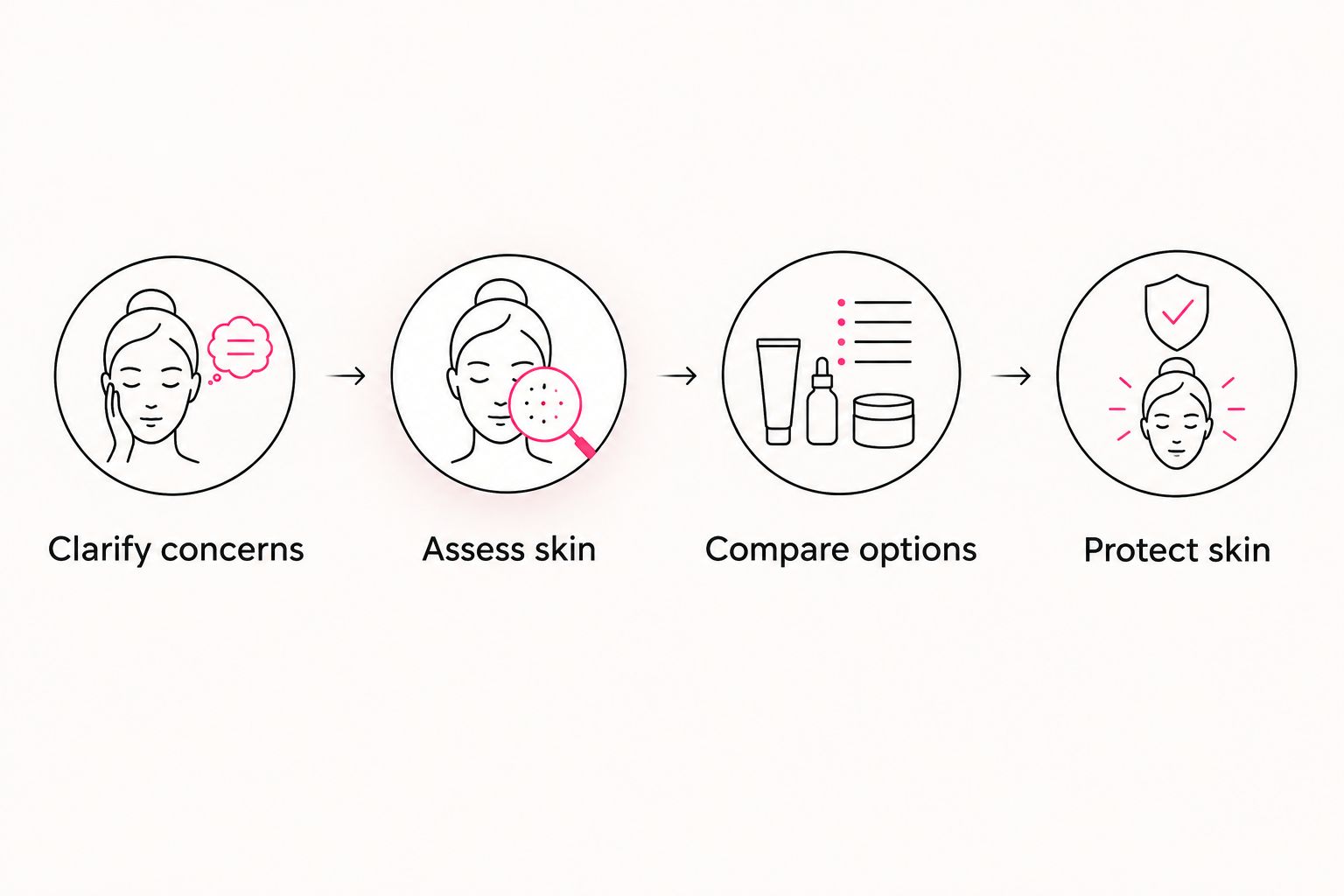
The planning sequence is straightforward: clarify the concern, assess the skin, compare suitable options, and protect healing skin. Keep those decisions in that order so convenience does not replace safety.
Follow aftercare rather than your usual skincare routine
Prepare for recovery by making a list of your usual cleansers, exfoliants, retinoids, and other active products. Ask which to pause, which to continue, and when to restart them. Do not assume a product is suitable immediately after treatment because you normally tolerate it.
Aftercare depends on the procedure. Your clinician should explain cleansing, moisturizing, sun protection, and any wound-care instructions. Picking at peeling skin or restarting irritating products early works against a controlled recovery.
Know how to contact the treating clinic if symptoms concern you. Increasing pain, spreading redness, blistering, or other unexpected changes deserve prompt advice rather than an internet-based adjustment to your routine.
- Obtain written instructions for cleansing and moisturizing.
- Confirm when to pause and restart active skincare ingredients.
- Avoid picking, scrubbing, or removing peeling skin.
- Follow the specific restrictions on heat, exercise, and sun exposure.
- Ask which symptoms require a call or urgent medical attention.
Review progress before adding another treatment
Use consistent photographs and your original goals to assess progress. Freshly treated skin is not the final result, and temporary redness or swelling can make comparisons misleading. Review at the follow-up point your clinician recommends.
Discuss what improved, what remains, and whether additional treatment is appropriate. More treatment is not automatically better. If the remaining concern differs from the original target, reassess the approach instead of repeating it by habit.
For your 2026 maintenance plan, keep prevention separate from cosmetic correction. Continued sun protection remains necessary whether you choose another procedure, switch approaches, or stop treatment after reaching your goal.
- Compare photographs taken in similar lighting and without filters.
- Review results at the clinician-recommended follow-up.
- Describe remaining concerns rather than requesting more intensity.
- Reassess sun exposure before scheduling another procedure.
Compare options for sun damage in golfers
Choose by the concern being treated and the aftercare you can follow. These are treatment categories, not a list of services confirmed at this clinic. A qualified clinician must determine suitability, especially when pigmentation, skin tone, or recent tanning affects risk.
| Option | Best for | Main advantage | Key limitation |
|---|---|---|---|
| IPL | Selected superficial brown discoloration and redness after assessment | Addresses selected color concerns without laser resurfacing | Not a laser; suitability depends on skin tone and pigmentation, and pigment complications are possible |
| Nonablative fractional laser | Selected texture, fine-line, and pigment concerns | Creates treatment zones without ablating the skin surface | Still involves recovery and sun precautions; results depend on the device and concern |
| Ablative resurfacing laser | Selected texture and wrinkle concerns requiring resurfacing | Removes treated surface tissue as part of resurfacing | More involved healing and aftercare; infection, scarring, and pigment changes are risks |
| Clinician-directed topical care | Selected pigmentation concerns and ongoing skin care | Fits into a home routine without a device procedure | Requires consistent use; irritation and diagnostic suitability need attention |
| Sun protection | Every golfer, whether treated or untreated | Helps limit additional ultraviolet exposure | Does not erase existing sun damage or replace medical evaluation |
Skindale Medspa laser treatments belong in a personalized plan, not a strongest-device contest. The benefit is access to treatment planning around your cosmetic goals; the limitation is that no procedure cancels future exposure or removes the need for follow-up.
For your 2026 consultation, ask the clinician to explain the choice in plain language. You should understand what is being treated, why that approach fits, and what would make postponement or an alternative the better decision.
Common mistakes golfers make
Treating every brown spot as cosmetic
A familiar-looking spot still deserves attention if it changes. Do not request light or laser treatment to remove a lesion before its nature has been assessed. Cosmetic improvement and evaluation for skin disease are different tasks.
Booking immediately before a golf trip
A convenient appointment is not necessarily a suitable treatment date. Traveling can interfere with follow-up, and outdoor play can conflict with healing instructions. Put the trip on the consultation calendar before choosing the procedure.
Using sunscreen as permission to ignore aftercare
SPF does not override restrictions on sun, heat, sweating, or exercise. A freshly treated area needs the protection your clinician specifies. If those instructions conflict with a planned round, change the round or the treatment date.
Choosing intensity instead of suitability
A stronger treatment does not automatically produce a better outcome for your concern. Skin tone, diagnosis, treatment area, and recovery capacity matter. Ask why the proposed approach fits you instead of comparing devices by intensity alone.
FAQ
What's the best laser treatment for sun damage if I play golf?
The best laser treatment depends on whether your concern is pigmentation, texture, fine lines, or a lesion that needs medical evaluation. Your skin tone, recent sun exposure, and ability to follow recovery instructions also affect the choice.
Is IPL better than laser for golfers with brown spots?
IPL is not automatically better than laser for brown spots. IPL treats selected color concerns with broad-spectrum light, while lasers use specific wavelengths; a clinician should first identify the pigmentation and assess your skin.
Can I play golf right after laser treatment?
Do not return to golf until your treating clinician clears outdoor play. The timing depends on the procedure and healing, including restrictions on sunlight, heat, sweating, and exercise.
Does laser treatment remove all sun damage?
Laser treatment does not remove all sun damage. It can improve selected cosmetic concerns, but it does not erase your ultraviolet exposure history, prevent future damage, or replace skin examinations.
Can darker skin tones receive laser treatment for sun damage?
Laser treatment requires an individualized assessment for darker skin tones. Device choice, settings, pigmentation diagnosis, and the risk of unwanted pigment changes need careful discussion with a qualified clinician.
What should I bring to a consultation for sun damage?
Bring your medication list, skincare routine, treatment history, and golf calendar. Mention recent tanning, self-tanner use, cold sores, previous pigment changes, and any spot that changes or fails to heal.
What sunscreen should golfers use after treatment?
Follow your clinician's procedure-specific instructions for sunscreen use after treatment. For routine outdoor protection, the American Academy of Dermatology recommends broad-spectrum, water-resistant SPF 30 or higher, alongside protective clothing and shade.
One last thing
Your golf glove protects only the skin it covers; your uncovered hand still needs attention. Add both hands, your ears, and the back of your neck to the conversation instead of treating facial discoloration as the whole picture.
A personalized consultation at Skindale Medspa can help you connect your skin goals with your playing schedule. Bring your questions, explain the natural-looking result you want, and ask for a plan you can comfortably follow.