

Microneedling aftercare to your skincare routine: 2026 workflow
If you want refreshed-looking skin without guessing what to apply after treatment, replace your usual product rotation with a microneedling aftercare routine built around your clinician’s instructions. Use a recovery checklist, then bring your everyday skincare back gradually; Skindale Medspa offers personalized aesthetics care in Scottsdale.
- A microneedling aftercare routine starts with clinician-approved cleansing, moisturizing, and sun protection—not your full skincare lineup.
- Skindale Medspa suits Scottsdale clients seeking personalized medical aesthetics and microneedling care.
- Restart retinoids and exfoliating acids only after your treating clinician clears them.
- Worsening pain, spreading redness, or drainage needs clinical advice, not another skincare product.
Why this matters
Microneedling creates controlled punctures in the skin. Those punctures are part of the treatment, but they also make the recovery period different from an ordinary skincare day. A product you tolerate before treatment can irritate freshly treated skin.
The goal is not to squeeze more steps into your routine. Protect healing skin first; return to your usual products second. Trying several new serums during recovery makes it harder to identify what caused irritation.
For your 2026 skincare plan, separate treatment recovery from everyday maintenance. Your clinician’s instructions take priority over an influencer’s schedule, a product label’s everyday directions, or a routine that worked after a different procedure.
Skindale Medspa is best for Scottsdale clients seeking personalized medical aesthetics care, including microneedling. Personalization matters because treatment depth, additional procedures, and your skin history affect the aftercare instructions you need.
Before you start
- Get written instructions and a contact route. Ask your treating clinician which products to use, when to cleanse, what activities to pause, and how to reach the practice if recovery changes unexpectedly.
- Prepare your actual product list. Include cleanser, moisturizer, sunscreen, prescription creams, acne treatments, exfoliants, and makeup. Bring names or label photos rather than describing everything as a serum.
- Check the hidden gotcha: combination products. A moisturizer can contain exfoliating acids or retinol, and a brightening serum can combine several active ingredients. Check the ingredient list with your clinician before treating a familiar product as recovery-safe.
Do not stop a prescribed medication on your own. Ask the prescriber and treating clinician how to coordinate it with microneedling. Mention a history of cold sores, reactions to skincare, or problems healing before treatment, not after symptoms appear.
Your recovery checklist
Start with a short written plan you can follow when your skin feels sensitive. A phone note works; no special tracking app is necessary. These are labels for your own checklist, not settings in a clinic portal.
- Write your treatment details. Record the treatment date, treated areas, and whether the procedure was traditional microneedling or included another treatment. Keep the aftercare sheet alongside this note.
- Create three product groups. Use the labels Use now, Hold, and Ask first. Put a product in Use now only when your clinician has approved it for this recovery period.
- Record the restart instructions. If the aftercare sheet gives a date, write it down. If it gives a skin-recovery condition instead, preserve that condition rather than replacing it with a generic online deadline.
- Add the contact details. Save the practice’s contact information from your appointment materials. Include the instructions for concerns that arise outside normal office hours.
Expected result: Every product has a clear status, and you know whom to contact. An unanswered question belongs in Ask first, not in an experiment on freshly treated skin.
A useful 2026 habit is to keep this note separate from your usual skincare wishlist. Recovery is not the right moment to introduce something simply because you recently bought it or saw it recommended online.
Your cleansing and moisture plan
Cleansing and moisturizing during microneedling recovery should follow the specific instructions you received. Gentle handling matters as much as the product itself: scrubbing, rubbing, or picking adds irritation when your skin is already recovering.
- Follow the first-cleansing instructions. Do not assume you should wash immediately after treatment. Your clinician should tell you when to begin and whether anything applied during the appointment needs to remain undisturbed.
- Use the approved cleanser. Wash your hands first, use the instructed water temperature, and avoid cleansing brushes, textured pads, or washcloth scrubbing on treated skin.
- Apply the approved moisturizer. Use clean hands and follow the application directions. Do not add facial oils, masks, or extra serums unless they are part of the aftercare plan.
- Leave peeling skin alone. Do not pull loose skin, squeeze blemishes, or exfoliate to make the surface look smoother. Ask the practice what to do if flaking or dryness becomes uncomfortable.
- Keep application hygienic. Avoid sharing towels or applicators, and do not touch treated skin unnecessarily. Follow any specific instructions about pillowcases, makeup tools, and product containers.
Expected result: You can complete your approved cleansing and moisture routine without adding unplanned products or friction. If an application causes persistent burning or discomfort, stop using that product and contact your clinician.
Tightness does not automatically mean you need a heavier cream. It means you should check whether your current plan needs adjustment. Adding layers without checking can introduce ingredients your clinician intended you to avoid.
Your sun protection and activity plan
Sun protection belongs in the recovery plan, but the timing of sunscreen application must come from your clinician. Until you are cleared to apply it, use shade, protective clothing, and a hat, and avoid unnecessary direct sun exposure.
- Confirm when sunscreen can begin. Ask which formulation is appropriate for your treated skin. Do not assume that every sunscreen you already own is suitable immediately after microneedling.
- Use established sunscreen guidance once cleared. The American Academy of Dermatology recommends broad-spectrum, water-resistant sunscreen with SPF 30 or higher. Apply it 15 minutes before outdoor exposure and reapply every 2 hours outdoors, as well as after swimming or sweating, according to the label.
- Separate sunscreen guidance from activity clearance. Reapplication instructions do not mean swimming, heavy exercise, or sweating is appropriate during early recovery. Follow your clinician’s restrictions on exercise, pools, saunas, and hot environments.
- Plan around unavoidable exposure. Tell your clinician about outdoor work, travel, or activities that make the restrictions difficult. Arrange treatment around those commitments rather than deciding after the appointment which instructions to skip.
Expected result: You have both a sun protection plan and an activity plan. One does not replace the other, and sunscreen does not make unrestricted sun exposure a good recovery choice.
For Scottsdale clients building a 2026 routine, shade and scheduling deserve a place beside skincare products. An outdoor commitment is easier to accommodate before treatment than during recovery.
Your gradual skincare restart
Returning to everyday skincare is a separate phase, not permission to restore every product at once. Your clinician should clear the restart, particularly for retinoids, exfoliating acids, prescription treatments, and products that previously caused sensitivity.
- Check the clearance instructions. Compare your skin’s condition with the aftercare sheet. Do not rely on appearance alone if the written instructions require a longer pause or a follow-up assessment.
- Review your Hold list. Confirm which products still need approval. A retinoid prescribed for acne deserves a specific restart discussion rather than being treated like an optional cosmetic serum.
- Bring back one cleared product at a time. Keep the rest of the routine stable so you can identify a reaction. Ask your clinician how to space reintroductions for your skin and treatment.
- Watch for new irritation. If a restarted product causes burning, renewed redness, or discomfort, pause that product and contact the practice. Do not push through irritation to keep a calendar deadline.
- Update your baseline routine. After recovery, keep only the products that support your goals and that your skin tolerates. A longer routine is not automatically a better maintenance plan.
Expected result: Your regular skincare returns through a controlled restart, not a sudden pile-on. You can identify what you introduced and explain any reaction clearly.
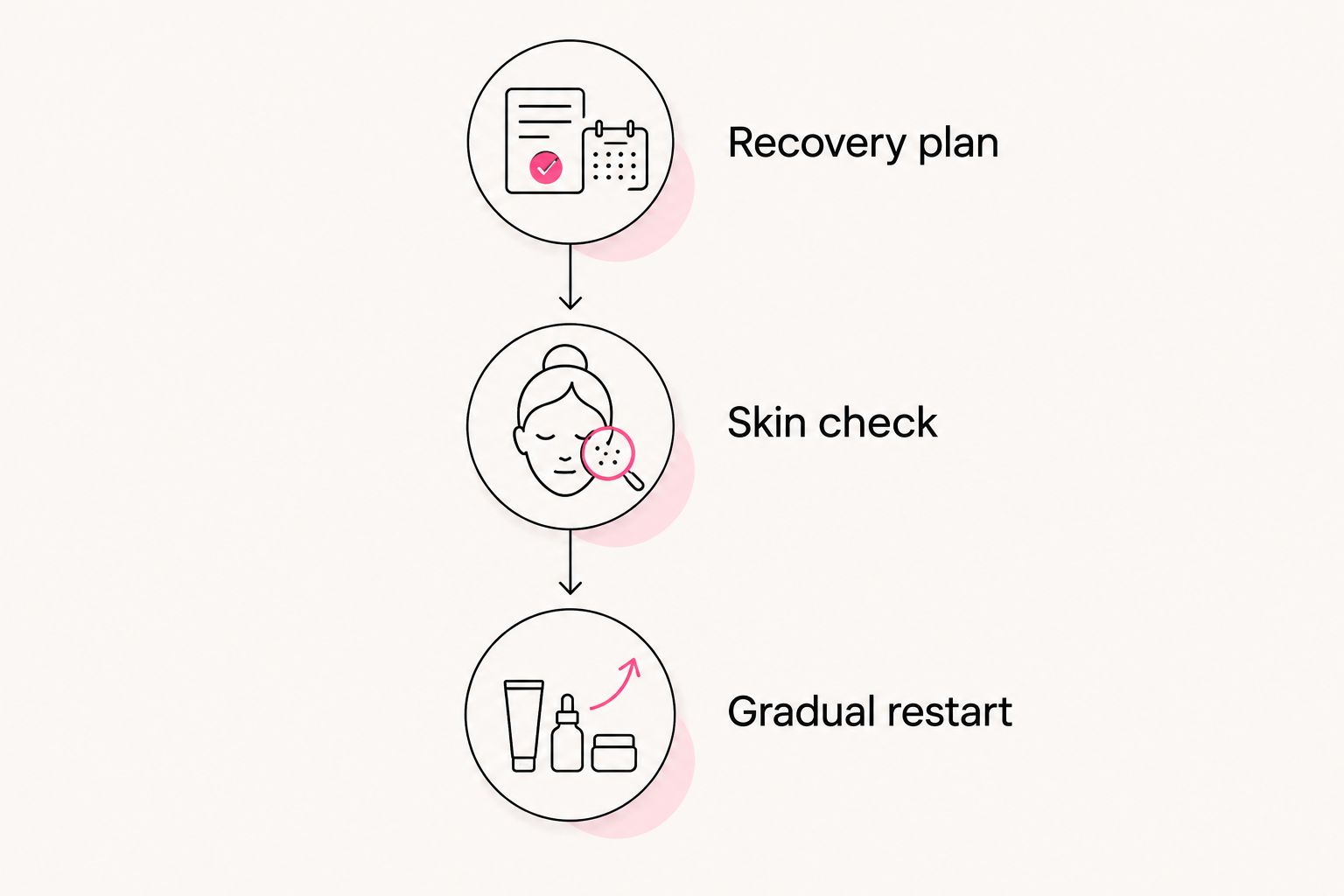
The practical sequence is Recovery plan, Skin check, then Gradual restart. Keep those stages distinct even when your skin looks ready sooner than you expected.
Recovery routine vs. everyday skincare
A simplified routine serves a different purpose from your normal skincare routine. Neither should replace the other permanently: recovery care protects treated skin, while everyday care addresses ongoing concerns once your clinician clears it.
| Routine | Best for | Main benefit | Limitation |
|---|---|---|---|
| Clinician-approved recovery routine | Recently treated skin | Keeps product use aligned with aftercare instructions | Temporarily pauses products used for acne, texture, or pigmentation |
| Gradual return to everyday skincare | Skin cleared for regular care | Restores targeted care while helping identify irritation | Requires tracking and does not justify restarting everything together |
Choose the routine that matches your recovery stage, not the number of products you prefer using. If you are unsure which stage applies, ask your treating clinician before changing the plan.
For 2026, treat this comparison as a decision aid, not a universal timetable. Your treatment instructions determine the transition.
A second workflow for repeat microneedling appointments
For a repeat appointment, reuse your checklist structure—not the previous appointment’s clearance dates. A different treatment approach, a new prescription, or a change in skin sensitivity can change the plan.
- Copy the checklist and update the treatment date. Keep the previous version so you can describe what your skin tolerated.
- Refresh the product list. Add anything introduced since the last appointment, including spot treatments and products you use only occasionally.
- Confirm the treatment type again. Traditional microneedling, radiofrequency microneedling, and treatments combined with other procedures need their own instructions. Do not transfer aftercare automatically between them.
- Discuss the previous recovery. Report irritation, unusual redness, or products that stung. Let the clinician decide whether those details require a different plan.
Expected result: Each appointment has a current aftercare plan. Your previous experience provides useful context without becoming a substitute for clinical advice.
Troubleshooting your aftercare routine
Your approved product stings
Stop applying the product and contact your treating clinician for instructions. Do not layer a second serum over it to counteract the sensation, and do not retry repeatedly to test your tolerance.
Bring the product name and ingredient list to the conversation. Explain when you applied it and whether the discomfort stopped or continued.
Your skin flakes and makeup looks uneven
Do not scrub or peel the skin to create a smoother makeup base. Follow the approved moisturizing plan and the practice’s instructions on when makeup can resume.
If you need makeup for an event, discuss that event before treatment. Aftercare should not depend on finding a stronger exfoliant at the last minute.
Your redness, warmth, or pain is getting worse
Contact your treating clinician promptly if redness spreads, pain increases, or you develop drainage, blisters, or fever. Do not assume worsening symptoms are a normal part of collagen renewal.
Seek urgent medical care for severe swelling, breathing difficulty, or other signs of a serious reaction. Your skincare checklist is not a tool for diagnosing complications.
You restarted an active ingredient too soon
Pause the product and tell your clinician what you used. Follow the revised instructions rather than compensating with additional treatments.
Record the reaction in your checklist. That information helps make the next restart more deliberate and gives the clinician a clearer account than “my routine irritated me.”
Customize your workflow
At Skindale Medspa, discuss how microneedling fits your wider skin goals rather than treating aftercare as an isolated task. Bring your product list and explain whether your priorities include texture, acne marks, or a refreshed appearance. The consultation is the place to establish what treatment and maintenance plan suit you.
For your 2026 planning, include work, exercise, outdoor commitments, and upcoming events. Ask about preparation, recovery restrictions, and follow-up before choosing a treatment date.
Giving someone a Skindale Medspa gift ecard? Let the recipient discuss their own goals and medical history with a clinician rather than choosing a procedure or aftercare routine for them.
FAQ
What is the best microneedling aftercare routine?
The best microneedling aftercare routine is the one your treating clinician approves for your procedure and skin. It typically focuses on instructed cleansing, moisturizing, sun protection, and temporarily pausing irritating products.
When can I wash my face after microneedling?
Wash your face at the time specified in your aftercare instructions. The timing depends on the procedure and anything applied during treatment, so do not substitute a generic online schedule.
Can I use retinol after microneedling?
Do not restart retinol until your treating clinician clears it. If you use a prescription retinoid, ask for specific instructions about pausing and restarting it.
Can I wear makeup after microneedling?
Wear makeup only after your clinician says it is appropriate. Avoid using makeup to cover worsening redness or irritation, and follow the practice’s hygiene instructions for application tools.
What sunscreen should I use after microneedling?
Use the sunscreen your clinician approves, starting when they instruct you to apply it. General American Academy of Dermatology guidance recommends broad-spectrum, water-resistant SPF 30 or higher, but that guidance does not determine immediate post-treatment application timing.
Is radiofrequency microneedling aftercare the same as regular microneedling?
Do not assume the aftercare is identical. Radiofrequency microneedling adds energy delivery to the needling procedure, so obtain instructions for the specific treatment you receive.
How do I know whether my skin needs medical attention after microneedling?
Contact your clinician promptly for spreading redness, increasing pain, drainage, blisters, or fever. Seek urgent medical care for breathing difficulty or severe swelling rather than trying to manage those symptoms with skincare.
Can I use my usual skincare routine once my skin looks normal?
Normal-looking skin alone is not clearance to restart every product. Follow your clinician’s timing and reintroduce cleared products gradually so you can identify irritation.
One last thing
The most useful aftercare preparation is to photograph the ingredient labels of the products you already own. Familiar packaging can hide an exfoliant or retinoid, and a label photo gives your clinician something specific to assess.
Bring your routine to the consultation, not just your treatment goals. Schedule a personalized consultation with Skindale Medspa to discuss microneedling, your skin history, and an aftercare plan you feel comfortable following.