

Microneedling for acne scars young adults: Plan 2026
Young adults considering microneedling for acne scars want smoother skin without losing a natural look; the treatment uses controlled needle punctures to support collagen remodeling in depressed scars. This 2026 guide explains how to distinguish scars from acne marks, choose an appropriate treatment, and plan care around breakouts, school, work, and sun exposure.
- Microneedling for acne scars young adults: prioritize acne control, scar assessment, and a clinician-led treatment plan.
- Skindale Medspa offers personalized medical aesthetics in Scottsdale, including microneedling.
- Traditional microneedling and radiofrequency microneedling differ; neither is the right choice for every scar.
- Daily broad-spectrum SPF 30 or higher supports skin protection but does not fill depressed acne scars.
Why microneedling matters for young adults
Acne scars can remain after breakouts settle, but not every lingering spot is a scar. Flat red or brown marks involve color changes; depressed scars involve changes in the skin’s structure. Choosing treatment starts with identifying which problem you actually have.
Young adults also need a plan that accounts for ongoing acne, changing prescriptions, outdoor activities, and commitments that make visible redness inconvenient. Treating texture while new inflammatory breakouts continue does not address the whole problem.
Skindale Medspa offers microneedling within its personalized medical aesthetics care in Scottsdale. Skindale Medspa is best for Scottsdale young adults seeking personalized aesthetic care rather than a one-size-fits-all acne-scar plan. Suitability still depends on an individual assessment, not your age or a treatment’s popularity.
For your 2026 treatment plan, separate the goals: control new acne, assess existing scars, and decide whether a procedure fits your skin and schedule. Microneedling addresses selected texture concerns; it does not replace acne treatment.
How to plan microneedling for acne scars
1. Identify scars before choosing a treatment
Start without buying anything: look at your skin in consistent lighting and record whether each concern is flat, indented, or raised. Photos help you explain what bothers you, but they do not establish a diagnosis. Shadows, redness, and camera processing can change how texture appears.
Depressed scars include broad, shallow indentations, sharply edged depressions, and narrow, deep pits. Clinicians often call these rolling, boxcar, and ice-pick scars. These shapes matter because a procedure that helps one pattern does not necessarily address another.
Raised scars require a different assessment. Do not assume that every acne scar should be needled.
- Take 2 baseline photos in the same lighting: one front-facing and one angled.
- Note whether your main concern is color, texture, or both.
- Identify areas with ongoing painful or inflamed breakouts.
- Mention any raised scars or history of thick scar formation.
- Bring your observations to a qualified clinician for confirmation.
2. Stabilize active acne and simplify home care
Begin with the routine you already use and identify anything that causes irritation. Avoid adding several acids, scrubs, or strong treatments while arranging a scar consultation. More products do not create a clearer picture of what your skin tolerates.
A clinician should assess active acne before microneedling. Needling through inflamed or infected areas is not an appropriate shortcut to clearer skin. Prescription acne care and scar treatment sometimes need separate stages.
Use broad-spectrum SPF 30 or higher as part of daily sun protection, consistent with American Academy of Dermatology guidance. Sunscreen helps protect skin; it does not rebuild a depressed scar. In Scottsdale, discuss outdoor work, sports, and other sun exposure when choosing a treatment date.
- Keep a written list of cleansers, moisturizers, and acne treatments.
- Record irritation rather than trying to cover it with additional products.
- Use broad-spectrum SPF 30 or higher and follow its application directions.
- Tell your clinician about ongoing breakouts before scheduling a procedure.
- Ask which products to continue, pause, and restart; do not stop prescriptions on your own.
3. Compare treatments by scar type, not trend
The manual starting point is a consultation checklist: write down your main concern, your current acne treatment, and the recovery constraints you cannot change. Bring those details before choosing a device or treatment name. A plan should explain why the proposed approach fits your scars.
Traditional microneedling creates controlled punctures without adding radiofrequency energy. Radiofrequency microneedling adds energy through needles, making it a different procedure with different settings and safety considerations. Neither treatment promises completely smooth skin, and deeper or tethered scars can require another approach.
Skindale Medspa’s microneedling offering gives you a local option to discuss within personalized care. Ask what technique is proposed, who performs it, and what its limits are for your particular scars. Personalization means explaining when a treatment is not the right fit, too.
- Ask whether the proposed treatment is traditional or radiofrequency microneedling.
- Request an explanation tied to your scar pattern, not a general glow benefit.
- Discuss alternatives for deep pits, raised scars, or tethered depressions.
- Ask about practitioner training, sterile equipment, and aftercare access.
- Confirm how your skin tone and pigmentation history affect the plan.
4. Review safety before committing
Start by writing down your medical history, medications, supplements, and previous reactions. Include information that feels unrelated to skincare: healing problems, immune conditions, and a tendency to form raised scars can affect procedure decisions. Your clinician decides which details change the plan.
Microneedling can cause redness, swelling, discomfort, and temporary skin sensitivity. Infection, pigment changes, and scarring are additional risks. Radiofrequency microneedling adds energy-related risks, including burns, so it should not be treated as interchangeable with traditional microneedling.
In 2026, make informed consent part of the decision rather than paperwork you rush through. You should understand what is being done, why it is recommended, what could go wrong, and who to contact afterward.
- Disclose current and recent acne medications, including isotretinoin.
- Mention cold sores, skin infections, and previous wound-healing problems.
- Explain any history of keloids or dark marks after irritation.
- Ask how equipment sterility and infection prevention are handled.
- Request written instructions and a clear route for urgent follow-up.
5. Schedule treatment around real recovery needs
Use your calendar before choosing an appointment. Identify outdoor commitments, workouts, photography, interviews, and events where temporary redness would be inconvenient. Recovery depends on the procedure, settings, treatment area, and your skin’s response; a generic timeline is not a personal clearance date.
Avoid treating an important event as the deadline for your first procedure. You do not yet know how your skin will respond. Give the clinician enough information to recommend appropriate timing rather than asking for a promised recovery window.
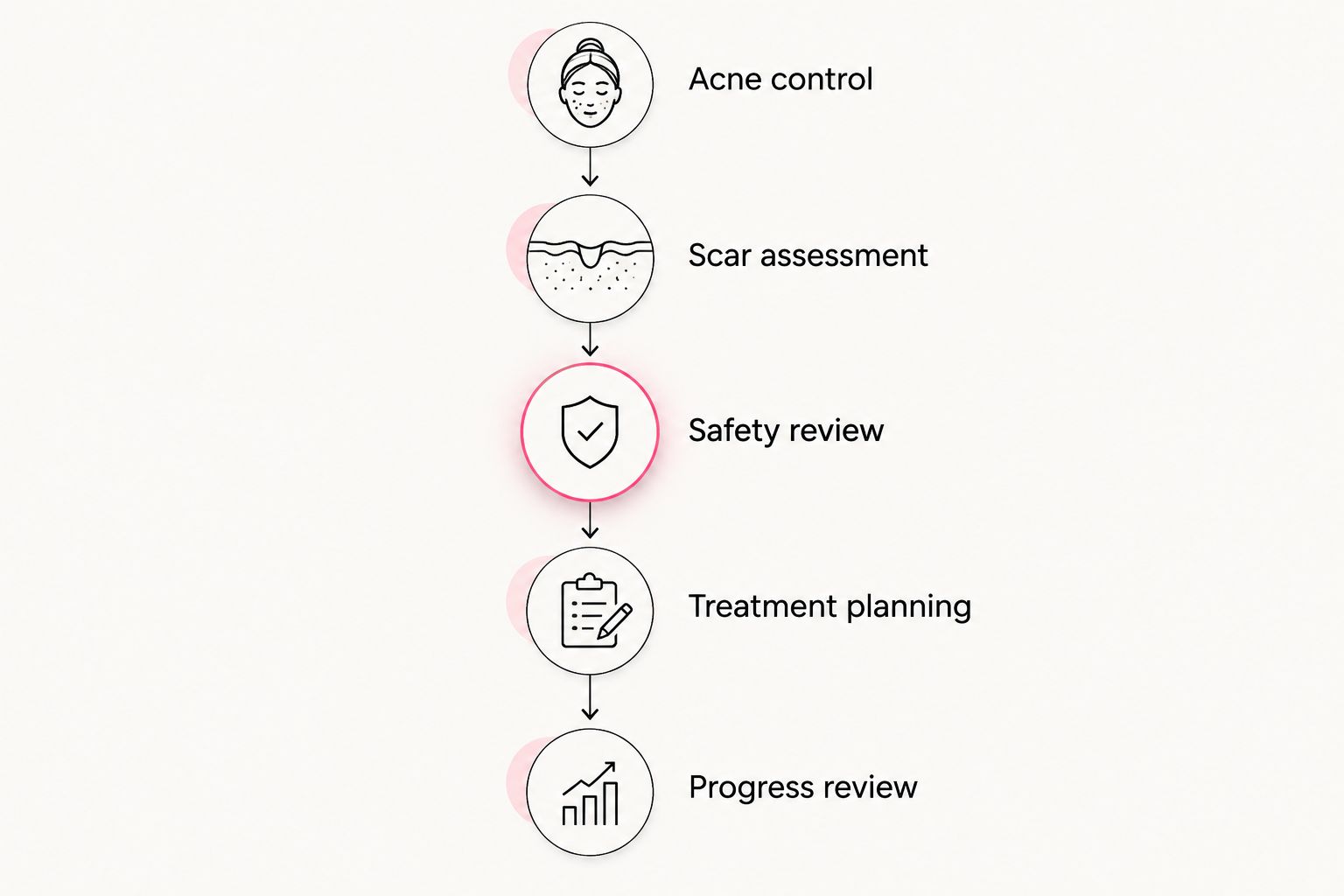
Ask for a written sequence covering Acne control, Scar assessment, Safety review, Treatment planning, and Progress review. This keeps the decision focused on suitability before scheduling, and results after healing.
For a 2026 plan, check your actual commitments rather than relying on someone else’s recovery experience. Your clinician’s instructions take priority over social media routines.
- Flag important events before agreeing to a treatment date.
- Discuss exercise, swimming, makeup, and sun exposure restrictions.
- Prepare only the aftercare products your clinician recommends.
- Keep the written contact instructions somewhere easy to find.
- Arrange follow-up before deciding whether to repeat treatment.
6. Measure progress without chasing perfect skin
Start with your baseline photos and a short description of the texture you want to improve. Repeat photos under comparable conditions when your clinician recommends reassessment. Different lighting can create the appearance of a dramatic improvement or decline without a meaningful skin change.
Collagen remodeling is gradual. Immediate swelling is not the final result, and an early photograph cannot establish the outcome. Ask your clinician when results should be assessed and which remaining scars need a different approach.
Prepare 3 consultation questions: what improvement is realistic, how progress will be judged, and what would change the plan. The goal is meaningful improvement, not a guarantee that every scar disappears.
- Use consistent lighting, camera distance, and facial position.
- Keep unfiltered photos rather than comparing edited images.
- Track new breakouts separately from existing scar texture.
- Report persistent or worsening symptoms instead of waiting for a photo review.
- Reassess remaining scars before agreeing to additional procedures.
Compare acne-scar care options
Choose the option that addresses your actual concern. Home care supports skin health and acne management, while procedures address selected structural problems. A combination plan needs a clear reason for each component, not simply more treatments.
| Option | Best for | Main benefit | Key limitation |
|---|---|---|---|
| Clinician-guided acne care and daily sun protection | Young adults with ongoing acne or flat post-acne marks | Addresses new breakouts and protects skin | Does not fill established depressed scars |
| Traditional microneedling | Selected depressed scars after skin assessment | Supports collagen remodeling without radiofrequency energy | Results vary; deep or tethered scars can need another approach |
| Radiofrequency microneedling | Selected texture concerns when energy-based treatment is appropriate | Combines needling with radiofrequency energy | Adds energy-related risks and requires careful selection and technique |
| Scar-specific dermatology procedures | Deep pits, tethered scars, raised scars, or mixed patterns | Allows treatment to target the scar’s structure | Procedures have different risks and recovery needs; assessment is essential |
A consultation should explain both the expected benefit and the limitation of the recommended option. Ask whether the plan treats the concern you named or a separate issue. Skin rejuvenation and acne-scar correction overlap, but they are not identical goals.
Common mistakes young adults make
Treating acne marks as depressed scars
Flat discoloration and an indentation need different plans. Booking microneedling because every post-acne mark is called a scar can lead to a mismatch between the procedure and your main concern.
Describe what you see before naming the treatment you want. A clinician can then separate color changes from structural scars.
Scheduling around an event instead of healing
A graduation, interview, or trip creates a deadline, not a reason to compress recovery. First-time treatment introduces uncertainty about your skin’s response.
Choose timing with your clinician and leave important appearances out of the immediate recovery period they recommend.
Copying a friend’s treatment settings
Your friend’s scar pattern, skin tone, medication history, and healing response are not yours. A device name or social media result does not establish the right settings for your face.
In 2026, use other people’s experiences to generate questions, not to prescribe your treatment.
Using an at-home roller as a substitute
Home needling is not equivalent to a professionally assessed procedure. Repeated puncturing introduces risks involving hygiene, technique, irritation, and injury.
Start with noninvasive home care. Leave decisions about penetrating the skin to a qualified clinician.
FAQ
Is microneedling good for acne scars in young adults?
Microneedling can improve selected depressed acne scars in young adults. A clinician should first assess scar type, active acne, medications, and healing history; flat marks and raised scars need separate consideration.
Can I get microneedling if I still have acne?
Active inflamed or infected acne needs assessment before microneedling. Do not needle through those areas or assume scar treatment will control new breakouts.
Is traditional microneedling better than radiofrequency microneedling?
Neither approach is best for every acne scar. Traditional microneedling does not add radiofrequency energy, while radiofrequency microneedling adds energy-related benefits and risks that require individual assessment.
How many microneedling sessions will I need?
The number of sessions depends on your scars, treatment approach, response, and goals. Ask for a provisional plan with reassessment points rather than accepting a fixed course without an examination.
Is microneedling suitable for darker skin tones?
Darker skin tones can be considered for microneedling, but suitability requires an individual assessment. Discuss pigment changes after previous irritation, practitioner experience, and the proposed treatment settings.
Can microneedling completely remove acne scars?
Microneedling does not guarantee complete acne-scar removal. Its aim is improvement in selected scars, and deeper or tethered scars can require another treatment approach.
What should I ask at an acne-scar consultation?
Ask which scar types you have, why the proposed treatment fits them, and how improvement will be assessed. Also review risks, medications, aftercare, and who to contact if healing concerns arise.
Where can I discuss microneedling in Scottsdale?
Skindale Medspa offers microneedling and personalized medical aesthetics care in Scottsdale. A consultation is the place to discuss your acne history, scar concerns, safety considerations, and natural-looking goals.
One last thing
Your most useful consultation detail is not a treatment name. It is a clear description of what bothers you: uneven texture in side lighting, individual deep pits, lingering color, or continued breakouts. Those are different starting points.
For your 2026 plan, bring that description, your skincare list, and consistent photos. When you feel ready, schedule a personalized consultation to discuss which approach fits your skin and your goals.