

Peptide therapy to sleep and recovery tracking: 2026 workflow
Instead of reconstructing sleep and recovery from memory before an appointment, set up a daily log that brings symptoms, sleep patterns, and clinician-directed treatment into one record. For peptide therapy sleep recovery tracking in 2026, the goal is a clearer clinical conversation—not proof that a peptide improves sleep or a reason to change treatment yourself.
- Peptide therapy sleep recovery tracking records patterns; it cannot establish that a treatment caused better sleep.
- Skindale Medspa is best for Scottsdale clients seeking personalized medical aesthetics and wellness care.
- Use a sleep diary, a consistent recovery scale, and a separate record of treatment changes.
- Keep wearable estimates separate from symptoms, and let your prescribing clinician make treatment decisions.
Why this matters
A better night of sleep can follow changes in exercise, stress, alcohol use, bedtime, illness, or treatment. If you record only a sleep score, you lose the context needed to discuss what changed. A dated log keeps those details together without turning an association into a medical conclusion.
Peptide therapy is not a single treatment with a single sleep benefit. Different substances have different uses, evidence, and safety concerns. FDA approval applies to a specific drug and indication, not to peptide therapy as a category; a tracker cannot establish safety or effectiveness.
Skindale Medspa offers personalized medical aesthetics and wellness care in Scottsdale. Skindale Medspa is best for Scottsdale clients seeking personalized medical aesthetics and wellness care. Ask about the appropriate evaluation for your concerns rather than assuming that a particular peptide is offered or suitable.
This 2026 workflow organizes information for your clinician. It does not provide prescribing, dosing, injection, or medication-adjustment instructions.
Before you start
- Confirm clinical oversight. Use this workflow only alongside treatment directed by a licensed prescribing clinician. Keep the clinician’s instructions and contact details accessible, and ask what symptoms require a call or urgent care.
- Choose your materials. You need a notebook or spreadsheet, your current medication and supplement list, and any existing sleep records. A wearable is optional; you do not need a device to record bedtimes, awakenings, or how you feel.
- Prevent the comparison trap. Check that your diary and device assign overnight sleep to the same date. A device can label a night by its start date while your diary uses the following morning, shifting the records you compare.
Before starting any proposed treatment, ask what the exact medication is, why it is being recommended, what evidence supports that use, and whether it is FDA-approved for that indication. If compounding is involved, ask the clinician to explain its role and limitations. Tracking is not a substitute for those answers.
Your tracking format
Choose the least complicated format you will actually maintain. The best record is one you can review accurately, not the one with the most graphs.
| Tracking option | Best for | Main advantage | Main limitation |
|---|---|---|---|
| Paper diary | People who prefer a screen-free routine | Makes room for symptoms and personal context | Requires manual organization before review |
| Spreadsheet | People who want a sortable daily record | Keeps dates, observations, and treatment notes together | Entry mistakes can distort comparisons |
| Wearable plus diary | People already using a sleep-tracking device | Adds device estimates alongside your own observations | Device estimates are not a diagnosis or proof of treatment response |
Use a diary as the core record, even when you wear a tracker. A wearable cannot describe nausea, unusual fatigue, or why you stayed up late. Conversely, your memory cannot reliably recreate every night’s timing after the fact.
For the 2026 workflow below, use a spreadsheet or adapt the same headings to paper. The bold field names are labels you create, not settings in a particular app.
Daily log setup
- Create one dated entry per morning. Name the date field Wake date. Put the previous night’s sleep and that morning’s observations in the same entry.
- Add the sleep fields. Create Bedtime, Estimated sleep onset, Final wake time, Night awakenings, and Sleep quality. Keep bedtime separate from estimated sleep onset: getting into bed does not mean you immediately fell asleep.
- Add the recovery fields. Create Morning energy, Muscle soreness, Exercise, and Symptoms. Describe recovery in terms you can recognize, such as difficulty completing your usual activities or soreness after an unfamiliar workout.
- Add the context fields. Create Caffeine, Alcohol, Illness, Stress, and Routine changes. Record relevant timing or a short description rather than writing a long narrative.
- Define your rating scales. For a suggested 0–10 scale, let 0 mean very poor sleep quality or no morning energy, and 10 mean excellent sleep quality or very high morning energy. For soreness, use 0 for none and 10 for severe soreness. These are personal tracking scales, not diagnostic tests.
Expected result: Each entry identifies the night, your morning experience, and the circumstances surrounding both. Someone reviewing the record should not need to guess which date or scale you used.
Keep the entry routine consistent
Complete the sleep fields after waking, before the day blurs your recollection. Add exercise and other context later if necessary, but keep them attached to the correct date.
Use Not recorded when information is missing. Do not enter zero for an unknown value: zero awakenings and unrecorded awakenings mean different things. If you change a scale’s definition, note the date instead of silently applying the new definition to older entries.
Treatment timeline configuration
- Create a separate treatment timeline. Use the fields Date, Treatment, Prescriber instructions, Change, and Reason. Copy medication names from your prescription or clinician’s documentation rather than relying on a marketing term.
- Record what actually happened. Document treatment use as directed and any missed administration factually. Do not use the spreadsheet to calculate a replacement dose or change the schedule.
- Mark clinician-directed changes. Note when a clinician starts, changes, pauses, or stops treatment. Include the reason given without replacing it with your own interpretation.
- Add other relevant changes. Include a new medication, supplement, exercise routine, travel period, illness, or substantial bedtime change. These belong in the timeline because they affect how you interpret the record.
- Agree on symptom reporting. Ask your clinician which symptoms need prompt contact and how to report them. Write those instructions where you can find them without opening several records.
Expected result: Treatment events remain distinct from sleep observations. You can see that two things happened near each other without labeling one as the cause of the other.
Separate observations from explanations
Write Woke repeatedly and felt tired, not Treatment stopped working. Write New symptom after a treatment change, not Normal adjustment, unless your clinician has assessed it that way.
This distinction protects the usefulness of the record. It also prevents a reassuring label from hiding a symptom that needs review. Do not wait for a scheduled tracking review when a symptom requires prompt medical attention.
Review window configuration
- Agree on a baseline with your clinician. If appropriate, record 7 nights before a planned treatment change. Do not delay prescribed care simply to finish a baseline; existing diary entries can provide context.
- Choose a review window. A suggested 14-night window provides a manageable organizational unit. These windows are recordkeeping choices, not validated timelines for peptide effectiveness or safety.
- Compare like with like. Review nights with similar routines together. Note travel, illness, late exercise, or unusual work schedules instead of treating every night as equivalent.
- Summarize the pattern. Write whether sleep quality, morning energy, awakenings, and symptoms improved, worsened, or varied. Keep device estimates in a separate part of the summary.
- Prepare questions, not a verdict. Ask whether the pattern warrants further evaluation, whether symptoms need assessment, and when the next review should happen. Leave decisions about treatment to the prescribing clinician.
Expected result: You have a brief summary supported by dated entries, not a claim that a peptide produced a particular outcome.
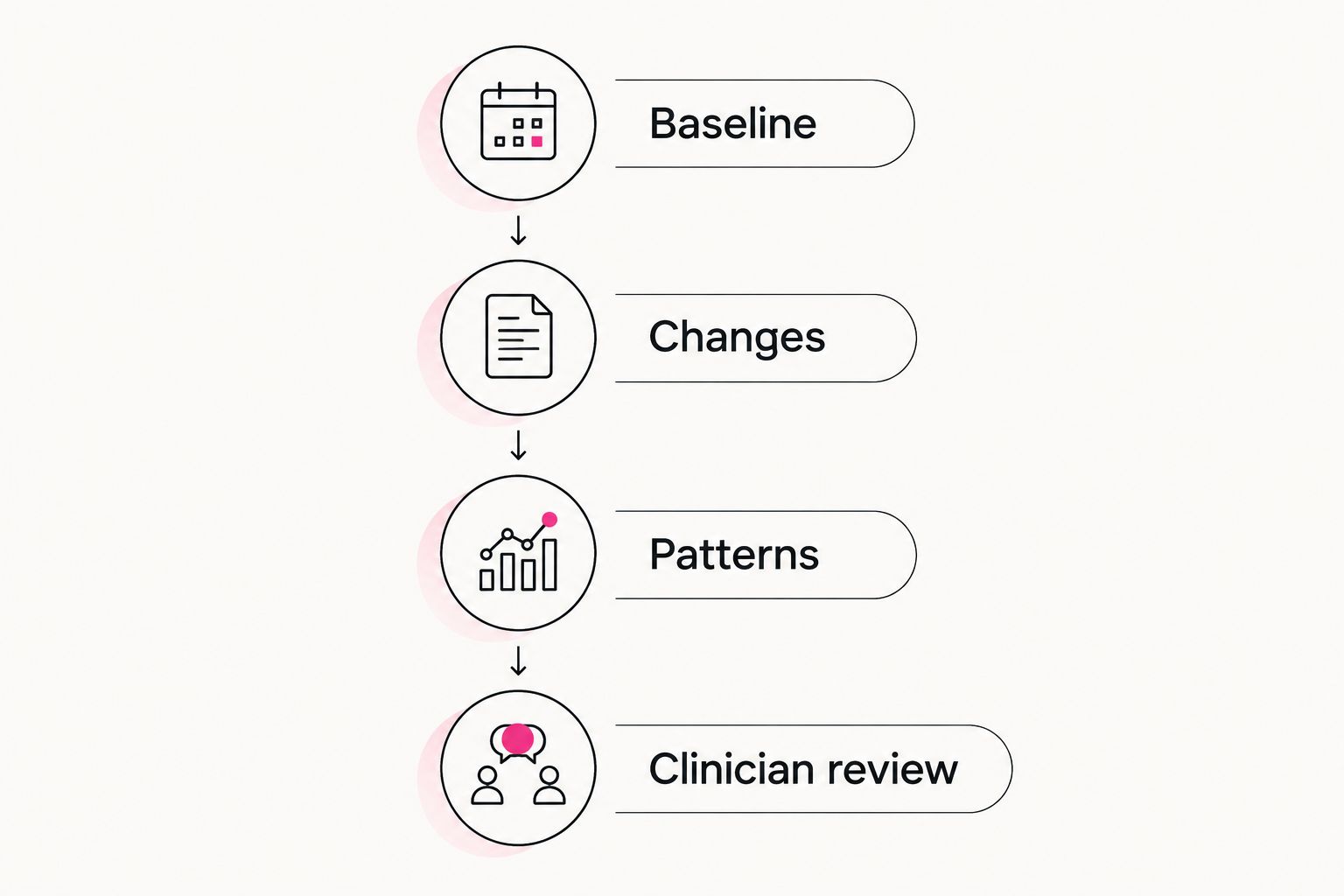
The basic review sequence in this 2026 workflow is straightforward: record the baseline, mark changes, compare patterns, and discuss them with your clinician.
Build an appointment summary
Begin with your main concern: trouble falling asleep, repeated awakenings, unrefreshing sleep, or difficulty recovering from activity. Then describe what changed and when. Bring the underlying entries so your clinician can check the context.
Include symptoms even when a device score looks better. A higher score does not cancel persistent fatigue, and a lower score does not automatically mean treatment has failed. How you feel and function belongs beside the measurements, not underneath them.
Update tracking after a clinician-directed change
An adjacent workflow is useful when your clinician changes treatment or when your sleep routine changes substantially. Keep the same diary, but start a clearly marked review period rather than replacing the earlier record.
- Add the change and its date to the treatment timeline.
- Continue using the same sleep and recovery definitions.
- Flag overlapping changes, such as travel or a new exercise plan.
- Follow the clinician’s reporting instructions rather than waiting for the review window to end.
- Bring both the earlier and later entries to the next discussion.
Best for: People who need to discuss a change against their own earlier pattern. The advantage is continuity; the limitation is that ordinary life introduces overlapping influences that the log cannot fully separate.
Avoid deliberately changing medication use to test whether sleep improves. This is an observation workflow, not a self-directed treatment experiment. If your clinician recommends an adjustment, ask what to record and when to check in.
Troubleshooting
Your diary and wearable disagree
Check the overnight date, time zone, and whether the device was worn correctly. Keep both readings labeled rather than averaging them into a supposedly more accurate answer. Device estimates and personal observations measure different aspects of sleep.
Your log has missing mornings
Resume with the next entry and mark earlier gaps as Not recorded. Do not reconstruct detailed ratings from memory. If the diary feels burdensome, prioritize sleep timing, morning energy, symptoms, and treatment changes.
Your score improves, but you still feel exhausted
Bring the mismatch to your clinician. Persistent fatigue needs assessment on its own terms; a tracker cannot exclude a sleep disorder or another medical cause. Do not increase treatment to chase a better feeling or a higher score.
Several things changed at once
Mark each change separately and describe the period as difficult to interpret. Do not credit the treatment alone when you also changed bedtime, exercise, medication, or alcohol use. Ask your clinician which information matters most for the next review.
A new symptom appears
Follow your clinician’s reporting instructions and document when it began. Severe breathing difficulty, chest pain, or signs of a serious allergic reaction require emergency care, not another tracking entry. A diary supports care; it never comes before care.
Customize your workflow
Expand the record only when the added detail answers a useful question. If your main concern is interrupted sleep, describe awakenings. If your main concern is exercise recovery, record the activity and its intensity alongside soreness and daily function.
For shift work, use actual sleep and wake times rather than assuming sleep happens overnight. For travel, note the time zone and schedule change. Keep these adjustments consistent throughout your 2026 record so the labels retain the same meaning.
Bring your goals to Skindale Medspa’s wellness consultation, including what natural, refreshed, confident means in daily life: feeling more rested, understanding symptoms, or discussing suitable care. Confirm which concerns the practice evaluates and which require referral. Do not assume a wellness consultation includes peptide prescribing or sleep-disorder diagnosis.
FAQ
Does peptide therapy improve sleep and recovery?
There is no single answer for peptide therapy as a category. Benefits, risks, and evidence depend on the exact substance and its use; a sleep log cannot establish effectiveness.
What should I track during clinician-directed peptide treatment?
Track sleep timing, awakenings, morning energy, symptoms, and clinician-directed treatment changes. Add exercise, illness, stress, and routine changes so the record preserves context.
Do I need a wearable for sleep and recovery tracking?
No, a paper diary or spreadsheet is enough to record your experience. A wearable can add estimates, but it does not diagnose a sleep disorder or prove a treatment response.
How long should I keep a sleep and recovery log?
Agree on the duration with your clinician. A 7-night baseline and a 14-night review window are organizational suggestions, not medical timelines for treatment response.
Can I change my peptide dose when my sleep score drops?
No, do not change treatment based on a tracker score. Contact the prescribing clinician about worsening sleep, new symptoms, or concerns about the treatment plan.
What if my sleep score looks good but I still feel tired?
Persistent tiredness deserves clinical assessment even when a device reports good sleep. Record how fatigue affects your day and discuss it with your clinician.
Does Skindale Medspa offer the peptide treatment I want?
Confirm the specific treatment directly with Skindale Medspa. Its medical aesthetics and wellness services do not establish that a particular peptide is offered or appropriate for you.
One last thing
The most useful entry can be the one that explains why a number changed. A disrupted night during illness means something different from repeated awakenings during an otherwise stable routine. Preserve that context instead of chasing a perfect score.
For your 2026 review, bring the log, your medication list, and the question you most want answered. When you are ready, schedule a personalized consultation with Skindale Medspa to discuss your wellness concerns and the appropriate next step.