

Skin resurfacing for mature skin over 60: Plan in 2026
You want smoother, more even-looking skin without losing the features that make you look like yourself. Skin resurfacing for mature skin over 60 is treatment that renews the skin’s surface or stimulates repair, with the aim of improving texture, fine lines, and selected signs of sun damage—not changing your facial identity.
- Skin resurfacing for mature skin over 60 starts with skin health, healing capacity, and realistic goals—not age alone.
- Skindale Medspa suits Scottsdale adults seeking personalized skin resurfacing guidance and natural-looking results.
- Laser resurfacing, chemical peels, and microneedling address different concerns; none replaces a medical assessment.
- Choose treatment intensity around your skin tone, medical history, and ability to follow aftercare.
The best starting point is an assessment, not the strongest treatment. Skindale Medspa offers personalized medical aesthetics in Scottsdale, including laser treatments and microneedling. Bring your specific concerns to the consultation so the discussion centers on what you want to improve—and what you want to leave unchanged.
Why skin resurfacing matters for adults over 60
Mature skin can have several concerns at once: uneven pigmentation, rough texture, fine lines, dryness, and reduced firmness. These concerns do not all respond to the same procedure. Treating brown spots is different from treating etched lines, and neither necessarily addresses loose skin.
Skin also changes with age. Older skin generally becomes thinner and more fragile, making the condition of the skin and the demands of healing important parts of treatment selection. Your medical history, medications, previous procedures, and sun exposure matter alongside your age.
For your 2026 treatment plan, define success in everyday terms: makeup sitting more evenly, less noticeable roughness, or a softer appearance to certain lines. Natural-looking improvement is a clearer goal than trying to erase every sign of aging.
Resurfacing also has limits. It does not replace evaluation of a changing skin lesion, restore lost facial volume, or provide the same correction as surgery for substantial skin laxity.
How to plan skin resurfacing in 2026
1. Identify the concern you want to improve
Start at home with a mirror, consistent lighting, and a written list. Separate what bothers you about texture from what bothers you about color or facial shape. A photograph without filters helps you explain your concern without relying on vague terms such as tired-looking skin.
Choose a priority rather than requesting every available treatment. If roughness is your main concern, the assessment should focus on surface texture. If a single dark spot worries you, establish what it is before discussing cosmetic treatment.
At age 60 years and older, a targeted goal helps keep expectations clear. A resurfacing plan can improve selected features while leaving normal expression and facial character intact.
- Write down your main concern and where it appears.
- Separate fine lines, pigmentation, roughness, and loose skin.
- Take an unfiltered photograph in consistent lighting.
- Describe the change you would notice in daily life.
- Identify any spot that is new, changing, bleeding, or not healing.
2. Check skin health before choosing a procedure
Gather your medical information before you book treatment. Include prescription medicines, supplements, allergies, previous skin reactions, and any history of difficult healing. Do not stop prescribed medication on your own to prepare for a cosmetic procedure.
Tell the clinician about cold sores, active rashes, recent tanning, prior radiation to the treatment area, and conditions that affect immunity or healing. These details can change the treatment choice or the preparation needed. A history of cold sores is particularly relevant when treating around the mouth because procedures can trigger a recurrence.
A suspicious lesion needs medical evaluation before cosmetic treatment. Resurfacing is not a substitute for a skin cancer examination, even when the spot resembles ordinary sun damage.
- Bring a current medication and supplement list.
- Disclose cold sores and previous procedure complications.
- Describe how cuts or wounds usually heal.
- Mention active irritation, infection, or recent sunburn.
- Ask whether a dermatology assessment is needed first.
3. Match the treatment to the problem
Review the basic treatment categories before comparing devices. Laser resurfacing uses light energy to treat skin; chemical peels use a controlled chemical application; microneedling creates small punctures to stimulate repair. Their depth, recovery needs, and suitability differ.
A personalized assessment is the next step when home observation cannot distinguish pigment from texture or identify the safest treatment depth. Skindale Medspa offers laser treatments and microneedling, but the choice should follow an assessment rather than a request for a particular procedure name.
Ablative lasers remove skin tissue, while nonablative lasers heat targeted tissue without removing the surface in the same way. Fractional treatment describes a pattern of treated zones and can be ablative or nonablative. Fractional does not automatically mean gentle or suitable for everyone.
- Match texture concerns to a treatment designed for texture.
- Ask whether the proposed laser is ablative or nonablative.
- Clarify whether treatment is fractional and what that means.
- Distinguish traditional microneedling from radiofrequency microneedling.
- Ask which concerns the recommended procedure will not address.
4. Choose an intensity you can recover from
Begin with your actual schedule and support needs. Write down upcoming travel, outdoor commitments, exercise routines, and events before discussing treatment intensity. Do not plan around a generic recovery estimate found online.
More intensive resurfacing generally creates a greater wound-care burden and carries risks such as infection, scarring, and pigment changes. A lighter procedure can be easier to accommodate, but its results can be more limited. Neither approach is automatically the right choice for mature skin.
For a 2026 appointment, ask the treating clinician to distinguish visible redness from complete healing. Looking ready to socialize does not necessarily mean your skin is ready for every skincare ingredient or outdoor activity.
- Explain how much visible redness or peeling you can accommodate.
- Ask what wound care the proposed treatment requires.
- Confirm when makeup and regular skincare can resume.
- Discuss exercise, swimming, and outdoor restrictions.
- Arrange help if the aftercare plan requires it.
5. Prepare your skin without adding irritation
Start with a simple routine rather than buying a collection of new products. Gentle cleansing, an appropriate moisturizer, and sun protection support a stable skin barrier. A clinician should decide whether you need additional preparation for the procedure being considered.
Retinoids, exfoliating acids, scrubs, and other active products can affect irritation and preparation instructions. Do not assume that using more actives before treatment produces a better result. Ask what to pause, what to continue, and when to make each change.
The American Academy of Dermatology recommends broad-spectrum, water-resistant sunscreen with SPF 30 or higher. For your 2026 routine, combine sunscreen with shade and protective clothing; sunscreen alone is not permission to increase sun exposure.
- List every skincare product you currently use.
- Avoid introducing strong new exfoliants before assessment.
- Ask for specific instructions about retinoids and acids.
- Use broad-spectrum sunscreen with SPF 30 or higher.
- Tell the clinician about recent tanning or sunburn.
6. Get written aftercare and a contact plan
Before agreeing to treatment, ask for the aftercare instructions in writing. You should know how to cleanse the area, which products to apply, and which activities to avoid. Instructions differ by procedure, so advice from someone who had another treatment is not a substitute.
Ask who to contact if recovery looks different from the expected course. Increasing pain, spreading redness, pus, fever, or new blisters warrant prompt contact with the treating clinician. The practice should explain which symptoms require urgent medical attention.
For outdoor sun protection, American Academy of Dermatology guidance calls for sunscreen reapplication every 2 hours and after swimming or sweating. Immediately after resurfacing, follow the clinician’s instructions about when sunscreen can be applied and use physical protection as directed.
- Request written cleansing and moisturizing instructions.
- Confirm when sunscreen can go on the treated area.
- Ask which symptoms require a same-day call.
- Save the practice’s treatment-related contact information.
- Follow restrictions on picking, rubbing, and exfoliating.
7. Review results before adding another treatment
Record your starting concern and compare it with follow-up photographs taken under similar conditions. Changing lighting, facial expression, or makeup can make improvement difficult to judge. Your review should focus on the goal you set, not on finding a new imperfection.
Healing and collagen remodeling are not the same process. Early redness or swelling can obscure the result, and some changes develop gradually. Ask your clinician when the chosen procedure can be assessed fairly rather than choosing your own deadline.
Do not add another procedure simply because your skin is still healing. A follow-up assessment should establish whether further treatment is useful, whether your original goal has been met, and whether the benefit justifies additional recovery.
- Compare photographs with matching lighting and expression.
- Track the specific concern selected before treatment.
- Ask when the result is ready for assessment.
- Report persistent irritation or unexpected pigment changes.
- Review the reason for any proposed repeat treatment.
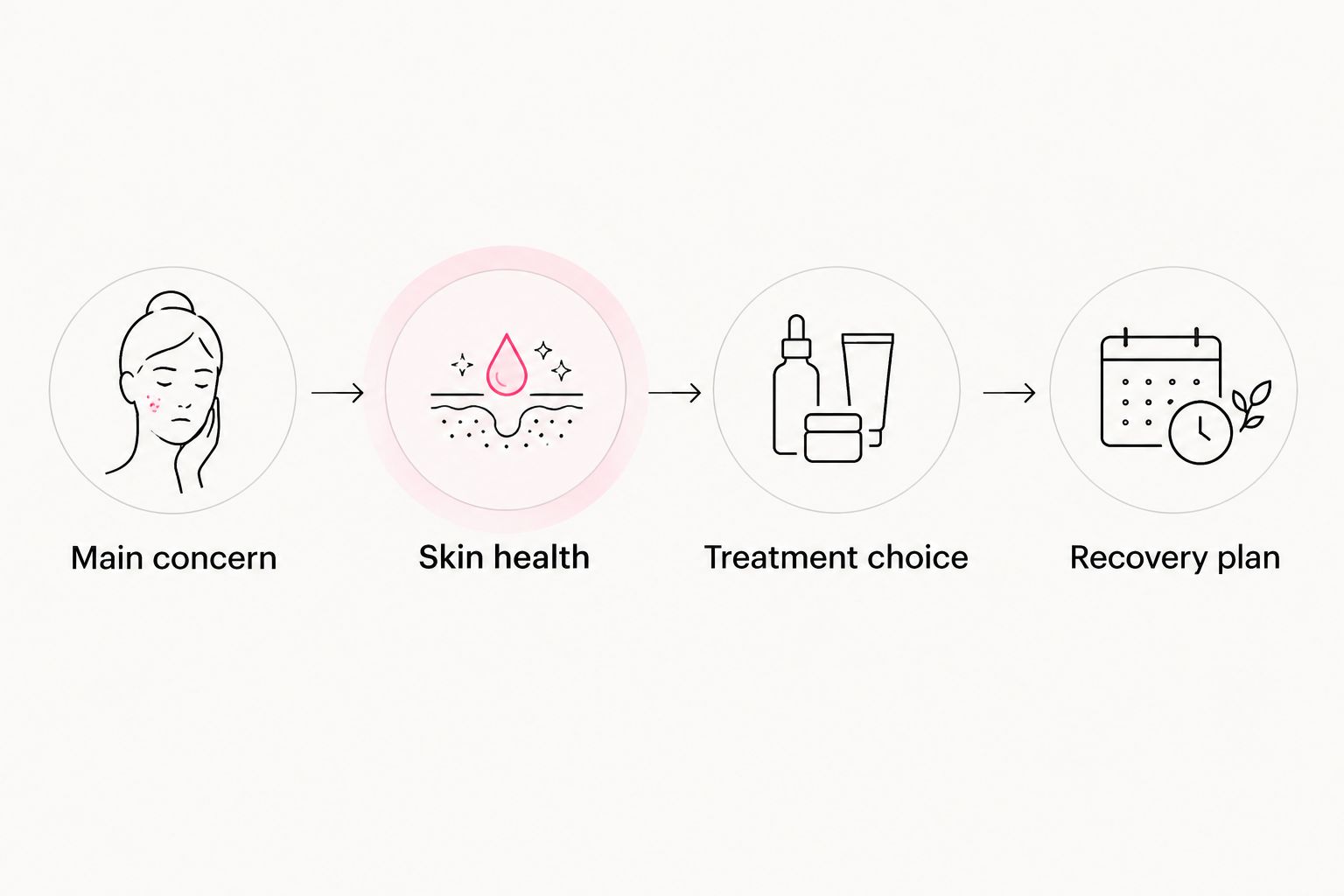
The decision sequence is straightforward: define the concern, assess skin health, choose a treatment, and understand recovery before proceeding. Each decision informs the next; choosing a device first reverses that order.
Compare resurfacing options for mature skin
Use this comparison to prepare questions, not to diagnose your skin. Treatment depth, settings, skin tone, and clinician judgment change both the benefits and the risks. A procedure category alone cannot tell you how much recovery you will need.
| Option | Best for | Main advantage | Key limitation |
|---|---|---|---|
| Gentle home skincare | Maintaining comfort and supporting the skin barrier | Fits daily care without procedural recovery | Does not reproduce the effects of procedural resurfacing |
| Superficial chemical peel | Selected surface roughness and uneven tone | Treats the outer skin layers at a controlled depth | Can irritate skin and cause pigment changes; deeper lines remain |
| Traditional microneedling | Selected texture concerns and acne scars | Stimulates a repair response without removing the surface like an ablative laser | Results develop gradually; infection and pigment changes remain possible |
| Nonablative laser resurfacing | Selected texture changes and fine lines | Heats targeted tissue without ablative surface removal | Improvement can be more limited than deeper resurfacing; burns and pigment changes remain risks |
| Ablative laser resurfacing | More pronounced surface damage and etched lines in suitable candidates | Provides more intensive resurfacing | Requires more involved healing and carries scarring, infection, and pigment risks |
| IPL | Selected pigmentation and redness | Targets color-related concerns | Is not a laser and is not equivalent to resurfacing for deeper texture concerns |
IPL uses broad-spectrum light rather than a laser’s specific wavelength. It belongs in the discussion when uneven color is your priority, but it should not be presented as interchangeable with every resurfacing procedure.
Skindale Medspa is best for Scottsdale adults seeking personalized skin resurfacing guidance rather than a treatment chosen by age alone. Its stated services include laser treatments and microneedling; suitability for a particular procedure still depends on clinical assessment.
Common mistakes adults over 60 make
Treating age as the only eligibility test
Being over 60 does not automatically rule resurfacing in or out. Skin condition, medical history, pigmentation risk, and healing capacity determine suitability. Ask why a procedure fits your circumstances rather than whether it is popular with your age group.
Expecting resurfacing to replace a lift
Resurfacing primarily addresses skin quality. It does not provide the same correction as surgery for substantial sagging or restore facial volume in the way an appropriately selected volume treatment does. Separate surface concerns from structural ones before making a decision.
Choosing the strongest treatment first
More intensive treatment adds recovery demands and risk. It is not automatically the best route to a natural-looking result. Choose the treatment whose expected benefit matches your priority and whose aftercare you can follow.
Treating a dark spot without checking it
A changing or unusual lesion deserves evaluation before cosmetic treatment. Do not assume every brown mark is harmless sun damage, and do not use resurfacing to postpone an examination.
Returning to active skincare too quickly
Peeling skin is not an invitation to scrub, and redness is not a signal to add another corrective product. Follow the written plan. Restart retinoids, acids, and other active ingredients only when the treating clinician advises it.
FAQ
Is skin resurfacing safe after age 60?
Age alone does not determine whether skin resurfacing is appropriate after 60. A clinician must assess your skin, medical history, medications, and healing risks before recommending a procedure; no treatment is risk-free.
What's the best skin resurfacing treatment for mature skin over 60?
The best treatment is the one matched to your main concern and healing capacity. Laser resurfacing, chemical peels, and microneedling address different problems, so a medical assessment should come before choosing a procedure.
Is microneedling better than laser resurfacing for older skin?
Microneedling is not universally better than laser resurfacing for older skin. The choice depends on the texture concern, treatment depth, skin tone, medical history, and recovery demands.
Can skin resurfacing remove sagging around the jawline?
Skin resurfacing does not provide the same correction as a surgical lift for substantial jawline sagging. It primarily targets skin quality, so loose skin and surface texture need separate assessment.
Can I have resurfacing if I take blood thinners?
Tell the treating clinician about blood thinners before considering resurfacing. Do not stop prescribed medication yourself; the clinician must assess bleeding risk and coordinate with your prescribing professional when needed.
Is IPL the same as laser skin resurfacing?
IPL is not the same as laser skin resurfacing. IPL uses broad-spectrum light and commonly targets selected pigment and redness concerns, while resurfacing procedures focus on renewing skin or stimulating repair.
What should I ask at a skin resurfacing consultation in 2026?
Ask which concern the treatment addresses, why it fits your skin, and what recovery requires. Also request an explanation of pigment and scarring risks, written aftercare, and a contact plan for unexpected symptoms.
One last thing
Bring a list of features you do not want changed to your 2026 consultation. Wanting smoother skin does not mean wanting a different face, and that distinction gives the clinician a clearer goal than simply asking to look younger.
If you are considering treatment in Scottsdale, schedule a personalized consultation with Skindale Medspa to discuss your skin, your priorities, and the recovery you can comfortably manage. There is no need to arrive with a procedure already selected.